BOSTON, Nov. 22, 2006 —(ABC)- Joe Mroszczyk, president of the College Republicans at Boston University, admits he set out to stir up a hornet’s nest when he came up with the idea of offering a whites-only scholarship at the school. But he got a little more buzz than he bargained for. “To tell you the truth, we didn’t see this coming,” Mroszczyk said. “The Drudge Report picked it up yesterday, and today I just finished a round of national interviews. It’s kind of overwhelming.” All the media attention is focused on a $250 Caucasian Achievement and Recognition Scholarship offered by Mroszczyk and the BU chapter of the College Republicans. Applicants must have a cumulative grade point average of 3.2 or higher; they must write two essays; and, here’s the kicker, they must be at least one-quarter Caucasian. The application itself offers an explanation: “We believe that racial preferences in all their forms are perhaps the worst form of bigotry confronting America today.” According to Mroszczyk, his group is offering the scholarship to point out “how ridiculous it is to have any sort of racially based scholarship.” At BU, for example, students who are at least one-quarter Hispanic can apply for a National Hispanic Recognition Scholarship. “There are plenty of poor, white, academically gifted students who need that money just as much,” Mroszczyk said.
True. We need not look any further than the reaction to this scholarship fund, to understand that the equality was never the primary goal of such scholarships centered around minorities.
Never.
Nor is this point being made by this scholarship offering a new one.
I pointed out on this blog several years ago, that there are far more whites than blacks on welfare. yet when welfare reform was on the table, back then, it was perceived as an attack, not on the whites who were by far the largest recipients of welfare funding, but on blacks. I judge this to be simply more of the same.
Appendum (DavidL)
The article attributes this to David Coreas:
“We have to look at the situation honestly,” he said. “Caucasians tend to have a higher per capita income than Latinos and other minorities. We have to have scholarships to survive.”
I find Coreas reasoning, such as it is, interesting. Because the average white earns more that the average Hispanic, all Hispanics deserve aid but no whites do. Talk about stereotyping. That is a rich Hispanic is more deserving than a poor white. Well that is affirmative action logic, but I don’t buy it.
Tags: BitsBlog, Race relations
James over at OTB makes mention of a Beruit Daily Star article in which the author suggests that …
…this week’s assassination of Lebanese industry minister Pierre Gemayel, most likely at the behest of the government of Syria, would seem to obviate talk about “engaging” that government as part of the solution to problems in the region.
…
Most realists, myself included, are incredibly skeptical of multilateral diplomacy outside the economic realm. The regime in Syria is going to do what it believes most maximizes its advantage. Given that the US and UK are currently in a position of weakness in the Middle East, it’s incredibly unlikely that Syria is going to be cooperative.
Exactly why electing Democrats here in the US was such a disaster for middle east peace. The position of weakness as you mention, James, was imposed on us by two factors, the larger of which was the Democrats themselves, by insisting on a course of toothless diplomacy. I do take slight umbrage with your comment about Syria’s advantage. You’re quite right, as far as you go, but ask the question: Advantage toward what? Better economic numbers are all well and good, but let’s not forget the religious and social aspect of all of this. I judge economic issues to be the lesser of their concerns, and pursuit of an Islamic-based, region-wide government, with Syria in the leading role, to be the larger.
And thanks to the Democrats, they have a better chance at success.
Tags: BitsBlog, Democrats, Middle East Affairs

(H/T photo: Waco )
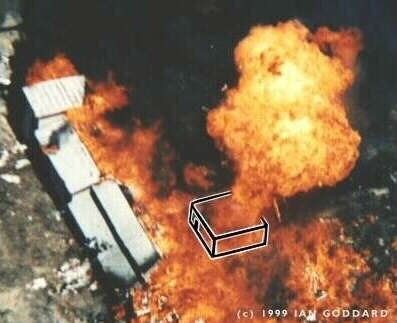
I was off line for a couple days. Tough having to get your news from the fish wrapper. It take all sorts, but the only terrorist, the reprobate Ramsey Clark is only a terrorist sympathizer, Janet “The Butcher” Reno, is criticing the Bush administration terror policy. Neither David Koresh nor Elian Gonzalez was available for comment.
(Post originally by David L at old site. )
Tags: BitsBlog
After 3 and a half years at Blogspot, I decided it was time for a change of venue. Blogger wasn’t bad, particularly for what I paid for it. But, when my older boy asked me for his own website, for his train photos, I decided I was going to need a domain and a fairly substantial site.
So, as I had the money on that particular weekend, I ordered up the domain, and the website.
Normally, I’d spare you the tale of woe , but those of you currently under Blogspot will appreciate this;
My first move was to have Blogspot publish to my new web server. Only one problem; Blogspot kept dropping the FTP connection in mid push. Arrgh!
And since the “bitheads” subdomain was released.. going back wasn’t going to happen, either… backing the changes off was impossible… someone was apparently camped on my domain, and took it over the very SECOND I vacated it.
So, since Blogspot still had the database available to me, I decided to go to WordPress, which has a fairly decent converter routine. Well, that wasn’t much help either, again, because of the relative size involved, apparently. The conversion process was painful, to say the least. At this writing, I’ve still not got it all, and frankly, I MAY not get it all. My advice: Try to get other backups of your blogspot work before you vacate your current blogspot address.
I’m reluctant to leave behind all the posts from the last several years, without a fight. So I’ll be working on that aspect, first.
Anyway, the new place looks to be far better. We now have categories, which allows me to run my Bits Bivouacs postings, under a category called “RV Life”. (That blog imported well, so you’ll see some of those posts pretty close to the top of the heap for a couple days or so) There’s a few breakout categories already and I’m sure we’ll be adding more.
The comments section, which I’m just getting my arms around, looks far better than the Haloscan one we had over to the old site, and darned sure better than anything Blogger ever came up with.
You can see there’s much to do… there’s a lot of things that need adding and some things that need subtracting. But I’m as pleased about this as I possibly could be; after a week of work, BitsBlog has a heartbeat, again.
Thanks for waiting. I promise, it’ll be worth it.
Tags: BitsBlog
Welcome to the ever growing world of BitsBlog.BitsBlog is run by Eric “BitHead” Florack, with able writing help from old friend DavidL, and new freind, Fersboo.
Bit’s a vet of some 25 years of online discussions of politics, starting in the old FIDONET and GT networks, then moving to Usenet and finally having his own website about 1996.
DavidL is no stranger to Online political discussions, having been involved back in the GT and Fido days, as well.
Both David and Bit hail from Rochester, NY
Fersboo is from Annapolis MD, and started on BitsBlog in 2004.
BitsBlog, per se, has been around since June of 2002, starting life as a Blogspot blog. BitsBlog became a stand-alone Blog, running WordPress software on Thanksgiving Day, 2006.
Just got back from a camping trip over to the Erie run. So we call it, anyway. This would be loosely defined as interstate 90, routes 5 and 20, anywhere between Buffalo, and Cleveland.
Just about every Columbus day weekend, since we first got a camper, we’ve been doing a last gasp type of run. It’s usually cold, and when we get back we’re usually worn out, stuffed to the gills with food cooked on the grill or over the open fire, and gamed out, (Uno is a favortite) smelling of wood smoke… loaded with photos of the trip, and thoroughly delighted.
This time out, we went to one of our favorite haunts…. Lake Erie state park.I’ve written about this park often enough previously, so I won’t get into here. … but I did want to pass along a few photographs my older boy took.

Me, of course, in front of the rig, just as we were setting up.
The boys decided they wanted to do some railfanning… Big shock, since we’re less than a mile away from one of the most heavily trafficked rail lines in the entire world. Of course on the first attempt, we saw nothing but empty skyline.

We decided, after about an hour of this, to run into town to pick up a few things, and managed to catch a little action while enroute:

As you can see, this is a picture taken from over the train as it passes. Essentially, you stand on the bridge over the tracks until the train passes underneath you. It’s quite safe, but still, you get to feel the power of this monster as it goes by you. It’s something akin to sticking a garden hose in your mouth, and holding it there until such time as the water starts pouring out your ears. Just to give you some scope of the kind of power were dealing with, this train had three engines on that point, each providing 4400 or so horsepower. The train was a little over 100 cars long, and carried close on 250 truckloads of things.
A show of power and grace and sound and fury.. and it’s all free. And the kids love it.
If you look closely, you will notice that there is an old fashioned railway station to the right of the shot. If I’m not much mistaken, this station was built on the site where president elect Abraham Lincoln, met eleven year old Grace Biddell, on his way to Washington. I’ve written of this event in the past as well.
We got our things and headed back to camp… where we went walking on the beach, and caught a really fine sunset:


After which, we got the campsire going, and a couple hours later, turned in for the night. Got down to the middle 30’s supposedly, but we were just fine in our little home away from home.
For number of reasons we weren’t able to get out as much as we would have liked to this year, And so this particular last run of the season, was a little harder taken than some. Still, there is the promise of next season. So, I will patiently pack and store and weatherproof and I will tow the rig over to the storage space for the winter within the next week or so.
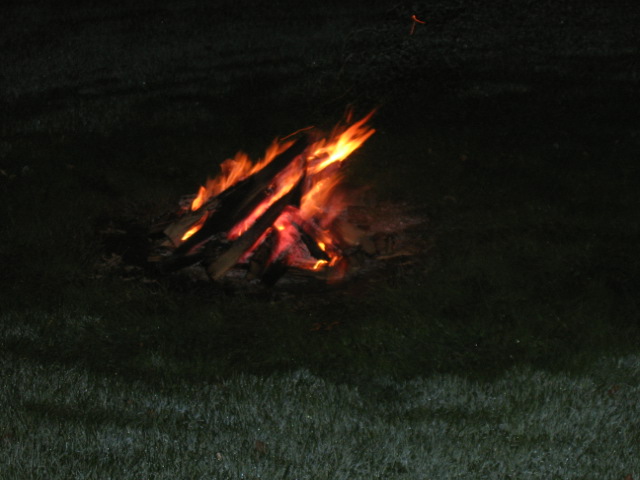
But the memories…. well, those, I’ll keep.
Tags: RV Life
When we woke up in the morning, we must have spent at least an hour listening to the birds and the squirrels making noise all around us. That’s something we don’t often do at home. We had some breakfast, and went along home to take care of medicating the cats.
When we got back to camp, we found things as we’d left them, except that the place was decidedly cooler thanks to the previous night’s storms. Oh… we did manage to bring back a lot of early morning bugs with us; A sure sign of trailering in lake country…

We spent the day mostly lounging around and getting used to the new trailer, and some of the things I’d built up to add over the winter. In the process, we found that the boys were both more physically active than we’d seen them in a long while. Particularly the younger boy…On the playground…
Chucking rocks into the lake…
… and just generally being kids. Truth to tell, that did us a lot of good all by itself. While watching the rocks being drowned, I noted the way the light played on the waves, again, and caught this.

I’m forced by logistics to bend the photographic timeline to explain something to you.
Right smack dab in the middle of the shot, is a point of land out into the lake. I am not all sure what the point of land is called, since it doesn’t show up on the map. But whoever owns that parcel of land put on a show of fireworks that night that was hours long. Must have totaled thousands of dollars. It provided an interesting contrast to the extended pyrotechnic display of the previous evening from the farmers. The sight of the fireworks playing off the water was impressive to say the least.
Prior to the fireworks, of course, was a sunset. One of the best sunsets I’d seen in a long time… There’s something about the sunsets along the shore of a large body of water.


We had a nice campfire, including some wood left over from our Cohocton trip, some I’d found on the road…(apparently having fallen off someone’s pickup truck and into the road) and some we found scavenging the lake shore.

All in all, a wonderful time.

Tags: RV Life

So here came July 4th weekend. We haven’t gone much of anyplace this year for several reasons… mostly, two cats that need medication daily. But we’re setting out to Lakeside Beach State Park, which is our new favorite park of late. Here we are in the driveway the morning we’re set to leave. It’s hot out, nearly 80 degrees already and only around 10:30 as this pic is taken. But we’re mostly loaded. and set to go. Check in time at Lakeside is 3pm, so we’ll leave around 2 and take our time to make the 30 or so miles to the park. (NOTE: As always, drill each pic for a full-size view)

I’ve already spend the previous week trying to get the trailer ready to go. Mostly, the little cleanups. But also, a BIG cleanup where I actually took the rig over to the local carwash, and used the spray brush. Then I brought it back to the driveway and gave it a solid going over with the heavier cleaners to get rid of the black streaks from waterflowing under the windows and fixtures. The old Kiwi was looking much better by the time I got done.
 The thing is LONG, looking at it from this angle.
In the last week, I had the Air conditioner checked, as well as the left front stabilizer jack replaced. LP tanks filled….($15 each) and away we go.
It’s a fairly short hop from our house to the park… about 40 miles, perhaps a bit less, most of it on the Lake Ontario state Parkway, but because of some low bridges (11-4) on the east end of the parkway, I ended up getting on it about 10 miles to the west of 390, where I usually get on.
 Here’s the camp once we pulled in and got level. I know the leveling looks pretty extreme, but that’s a grass pad for you. The sharper among you will note that this is the same site we were at last October…. G38 Known quantity for us, I guess, though this time we started looking around for a better site for us within the park. We found one, too… F40 looked pretty mice. Near the playground that G38 sits near, and in some added shade… which would have been a real help in the heat. It got as high as 90, this day. (Ouch)
 One addition to the rig we didn’t have previously is an RVQ. Now, our rig is a 2000 21c.. and the RVQ didn’t come with it as an option.. or as standard in later years. This is a lack I lamanted in the Kiwi Owners group some weeks ago. I was very fortunate to meet Jay in the group who said he had one he’d never used and would gladly trade it for the two burner stove our rig came with. As it happens Jay lives out on Long Island, but camps all over the state… we met him at Watkins Glen state Park when he and his group were camping there a few weekends before our trip.
 We found, once we got it home the thing didn’t work. Turned out the problem was an ever-so-slightly different requirement in the size of the gas nozzle in the quick connect. Cost $8.00 to fix that, and away we went.
You can see it works rather well, now. I always start with something simple on a new bit of cooking gear, so dogs and burgers seemed the best bet, here. It was nice not to have to bring that heat inside, and the grill works very well, indeed. Many thanks to Jay. I’ll have to more closely check out that camping group of his. It’d be nice to run with them, I think.

This being a July 4 weekend all the amateurs in the world were out. This included many large family groups of multiple levels of family. These usually take up more than one space. Else, they redefined for themselves what constituted a camping space. For example here’s the group in the aforementioned site F40. What you don’t see is the large camper up on the pad which is to your left.
As we discovered, most of the campers were local people from as far west as Niagara Falls, and as far east as Oswego. Occasionally, we ran into people from Stuben County down in the southern tier of New York. Surprisingly enough, there were not many from outside the region. This leads me to believe that Lakeside Beach is probably one of the best kept secrets in the neighborhood. The place was teaming all weekend with kids of all ages just having some fun being outdoors. Lots of bike riding was going on , and there is certainly enough in the way of space and trails to be doing that on. Someone brought a gas powereed RC car which delighted the neighborhood kids.


Toward sunset, I decided to take a look at the sunset across the lake, and was rewarded with this shot, just begging to be taken.

That’s my younger boy… exploring… and running as fast as his legs would carry him. In turning away from that sight, I was rewarded with something almost as good… one of the better sunsets I’ve seen in a few years…

At this point I ran out of batteries, and had to drop them on the charger.
($@%^#&!!!)
The clouds then moved in, and within a few hours it was raining on and off for the remainder of the night. One major disadvatage to this site… the while it does give you nice sunset views right from your front porch, the prevailing wind is out of the west, and tends to make your awning a bit of a problem. In fact, it’s that problem that caused me to look for other accommodations for the next time we’re out there. We found one that looked interesting, but more on that later.
Seeing the storm was coming up, we decided to put the awning up for the night to ride out the storm. It did give rather windy… I would estmate peak gusts to around 45mph. While the storm was going on, we were presented with something of a mystery. We started hearing loud explosions to the west of us , perhaps four or five miles away. These explosions were obviously aloft, and yet presented no light flashes to speak of. They were loud enough to roust everyone in the camp. I immediately had at least a dozen people standing up in front of my site wondering what the world all the noise was about. Was there storm damage going on to the west of us? Was there some kind of a war we didn’t know about? Given the strength of the storm it wasn’t hard to imagine some storm related damage going on.
It turns out that these explosions were an attempt at weather modification by area fruit farmers. I don’t understand all of it, but apparently the idea os the use of explosive force to break up clouds which would, if left unchecked, produce hail which would damage the crops…. in this case, fruit. This is a fairly localised attempt at weather modification as opposed to the larger attempts by the military in years gone by, to control such things as hurricanes. I had thought personally, that this was extremely theoretical. But apparently, it is more reality in localised efforts, than I was aware. Scared the beep out of a LOT of people that night, I can tell you.
We finally got to sleep around 4:30 that morning. Obviously, we slept in a bit. That’s OK, the whole camp did.
More in part 2, which I’ll release sometime Tuesday Night.
Tags: RV Life
The first trip of the 2006 season was to Tumble Hill Campground, at 10551 Atlanta Back Rd. in Cohocton, NY. 
Cohocton is in the southern tier region of New York state, just off the exit two of I-390. Last time the census was through this town, they managed to count 838 people… mostly of German and Irish decent. Translation; this is not exactly a big town. It’s name is derived from the Iroquois term for “log in the water”. Their annual big to-dos are the fall foliage festival and the annual tree sitting contest.
We found the campground itself surprisingly good. The usual assortment of site types , a recreation hall, a rental cabin, and a rental trailer, fire rings with thoughtfully added adjustable cook surfaces on them, and Cable TV hookups for those rigs equipped with them, are just a part of the package.
Since we needed to flush the water system, we opted for the full hookups, and the which ran us a surprisingly low $26 for the night, and included 30 amp service and water and the Cable TV, too.
Since my driveway is too narrow to open the awnng, my first order of business was to get that up and airing out. This required about 10 minutes as I reacquainted myself with the task.
 From there, it was get the ends out, the beds laid down, the sewer hooked up, the power hooked up, the water hooked up, and the TV cable hooked up. Perhaps another 20 minutes.
At that point, I actually had time to take in some of the surroundings. It really is a beautiful area and reminds one of the Smokey mountains, at times… Particularly if it’s raining. This turned out to be one of those times.
Frankly, I should have figured on this. Memorial day weekend was hot and dry but we’ve waited because of reservation concerns; in short we forgot to make reservations so we didn’t bother going. We decided to go the following weekend… and were rewarded with the rain.

Still, it wasn’t all that bad. We managed to get a good fire going, With wood we purchased on site, (A rather generous supply for $4) and ended up cooking our hamburgers and hotdogs on the open fire…. the wood smoke adding it’s special taste.
Dinner (and washing up ) completed we then set about making sure all the systems in the trailer were working. The heater seems to work fine. The air conditioner while we didn’t need it, was tested anyway and it appears it’s going to need a recharge of R134. The cable system worked very well. Battery, lighting and water systems all worked well.
One small issue that came up that we hadn’t known how to fix at the time was that the outside power outlet wasn’t working. It wasn’t until we got it home, that we realized what was going on; the outdoor plug shares the circuit with the indoor plug under the rear bed. The indoor one, has a ground fault interrupter, which had tripped. Next time, we’ll know.

All this accomplished we then set about getting the chairs out for sitting around the nicely-going fire. Except for one small problem. This picture was taken just before I went to get chairs. No, there’s nothing wrong with the camera, those are raindrops you can see. (Sigh….)
Still, the place was dead quiet at 10pm, and it was very nice to listen to the rain falling on the canvas. A relaxing sound, really… and I’ve not slept quite that well in a long time.
Some other shots of the place: The Playground..(With my younger boy)

A panorama shot or two of the neighboring hills


The Rec Hall…

You’re only a short hop away from many different activities most within about ten minutes drive of the place. Some of the more distant drives include stony brook state park , Hammondsport, Corning, Letchworth state Park, Watkins Glenn, and Canandaigua.
There’s a laundry available for your use, as well as sand volleyball courts , horseshoe courts , a phone room with a modem hookup, crafts for the kids every Sunday, along with a morning social and Sunday with free coffee and snacks.
If there was a drawback to the place, it’s the road leading in… and up. Seriously up. Nothing insurmountable, but the gravel road leading up into the campsites from the main office, well kept as it was, was a challenge to my slightly underpowered rig. Getting up the thing is a matter of some finesse instead of brute force.
On the whole, we were impressed. We will be back.

Bit’sBox update:
The added horsepower from the mods done over the winter (intake and exhaust) made quite a difference on the flat, but not as much in the hills as I’d have liked. I found myself shifting mentally into ‘chug-along’ mode more often than I wanted to, particularly on the stiffer hills.
Also the MPG was a tad lower than I’d estimated based on the Lake Ontario and Lake Erie runs of last fall… At the time, I recorded 13mpg. However, this run, which gave us a bit more in hills, gave us a bit closer to 10mpg. Livable, certainly, particularly with a CVGW of around 10,000lbs… but hardly anything to write home about. Still, when one considers that I’m getting 22mpg on the open road without the trailer, that’s not bad.
Tags: RV Life
Steven Coffman mentions a need for a 12v fridge for under $100.
I have found the Thermo-electric Coleman cooler, (http://www.avidoutdoors.com/co40quthco.html) to be very useful. It’s a shade over $100 list, add the 110v power supply and you go to $140, but Walmart usually has ’em with the power supply for under $100.
I’ve found though a few years of use, though that this thing really works best when you help it along.
First, I’ve found that the fridge running all the time will kill any car battery in about an hour. It’s simply not practical to keep ’em running all the time on the vehicle battery.
Secondly, even asuming no power consumption issues, the thing will only keep stuff at 40 degrees below the temp of the outside air, without help. (Or, if you wire it backwards, it’ll get 100degrees warmer than outside air. (Great for hauling Thanksgiving goodies to Grandma’s house… and yes, it’s designed to do that.)
So, by the numbers, if it gets to be 80 outside the fridge, 40 degees is the best you’re gonna do INside it. If it’s 90-110 outside, hang it up, son, you’re done, and so is the stuff in your fridge.
What I’ve done to counter this situation in my van, is to wire it to a 12v feed that is only on when the van’s running. This requires a change of attitude about what is the primary coolant.; Your attituude should be that the primary cooling isn’t the powered part, but rather, the gallon jugs of ice. To keep the thing cold during those times when the van is powered off I keep one or two gallon jugs of ice. (How much ice I start with depends on how hot it is for the week, and what kinda space I need inside the box) With this system, we’re able to do quite well for several days; it keeps everything quite cold. The longer we run hte truck per day, the longer the things stays cold.
Most of our trips are camping type trips, or just straight road trips… and they run under four days, so this works just fine. I suppose some of these ideas are from the pop-up-camper’s mindset; make use out of every ounce of space and power you can, for multiple purposes. See what you think.
I keep one- gallon milk jugs of ice… two in the van fridge and two in the freezer at home. In this fashion, I’ve found myself able to get about 4 days out of the van fridge, before I need to change out the ice, even in high summer. That’s far longer than just a regular cooler. When the first pair of ice jugs is melted, I simply switch them out with the ones in the basement freezer. I keep at least a couple six packs of drinks and or a gallon of kool-aid on hand at all times durning the summer, even when not over the road. It’s nice, coming hom from work with a cool lemonaide in hand. There’s always one waiting for me.
Additionally, I’ve found that there’s an advantage to this system I’d not planned for; We’re able to bring water from home, without wasting space. You see, my wife has a problem, sometimes, with water from other sources. So, the water I freeze is filtered water from home. A couple of days from refill/refreeze point, we’ll have water to drink.
Sometimes, I even make a gallon of kool-aid, or iced tea, or something, and freeze THAT, as one of the gallons. We’re experimenting with freeing the Juice pouches you get at the store, just now. The kids like them, and they minimize spillage inside the van, of course… plus they are great for tight packing in the fridge. But we’re using some of them as ice bags, too… First time worked OK. Keep ’em near the top and they’ll melt in a day or two. My concern is will they burst… but so far we’ve been OK. Keep some unfrozen for immidiate consumption, but freeze some, and pack ’em right, and you’ll extend the life of your ice bottles, is the idea… while adding no space requirements inside the box.
Sometimes, I’ll also partially freeze bottles of storebought lemonade and such, too. And of course if you’re camping, freezing the burger, chicken, dogs, and so on… even bread and rolls you’re packing for the trip, will also help extend the life of your bottled ice, and will give you a little peace of mind of the stuff being fresh when you need it. I’m even playng at cooking up a couple lbs of bacon, and breaking it into bits and freezing in a couple smaller containers for use in eggs and such. Saves space and weight over uncooked bacon, and in frozen form helps keep the ice going, and keeps longer, too.
I do have a 110v supply for the thing, which I will use in Camp mode; the van is wired for 110VAC… which is connected the moment we make camp… so the fridge is basicly running 24/7 which will keep the thing cold well over a month before the ice melts. That may not be practical for your car, but I’m just sayin’.
Hope these ideas help.
Tags: RV Life
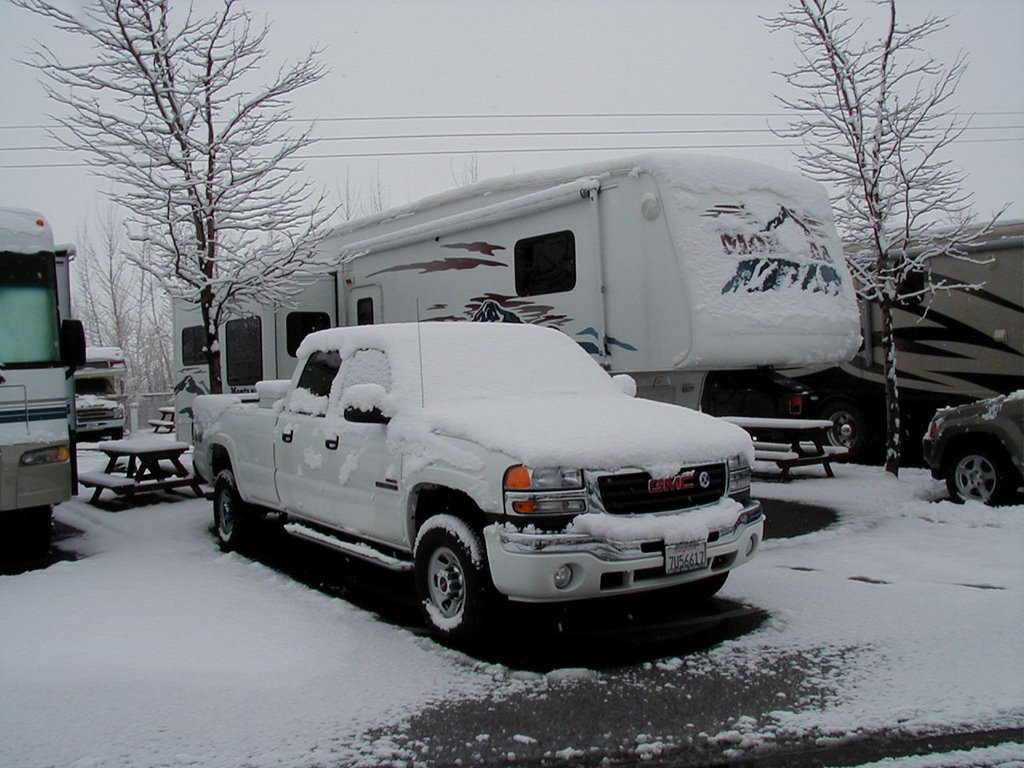
Here’s what a freind’s campground looked like in Carson City on March the Third: (Drill for full size)
Tags: RV Life
We’re at that part of the year where we’re not quite ready to bring the Kiwi home, and yet we’re champing at the bit to bring it home.
This year perhaps, came a little earlier than some years, given that this is a relatively gentle winter around here. Yet, the temperatures are still maxing in the fifties, and the ground is a little wet. Great way to get it stuck in the mud.
So, we’re waiting for a few weeks.
I have a number of projects to deal with before we take the trailer out on a shakedown run, too. Some of these will need to be dealt with at the RV dealer, saome I’ll do myself.
At the Dealer’s:
Some of the things I need to do what I get it home:
I’ll be taking photographs and posting them of each of these projects as I accomplished them, and of course any trips we decide to go on. My guess is we’ll be doing an awful lot of local runs to state Parks in the immediate neighborhood.
Tags: RV Life
10:01 A.M. EST
THE PRESIDENT: Good morning. Yesterday I delivered a — the second in a series of speeches on the situation in Iraq. I spoke about the violence that the Iraqi people had faced since last month’s bombing of the Golden Mosque in Samarra. I also said that for every act of violence there is encouraging progress in Iraq that’s hard to capture on the evening news.
Yesterday I spoke about an important example of the gains we and the Iraqis have made, and that is in the northern city of Tal Afar. The city was once under al Qaeda control, and thanks to coalition and Iraqi forces, the terrorists have now been driven out of that city. Iraqi security forces are maintaining law and order. We see the outlines of a free and secure Iraq that we and the Iraqi people have been fighting for. As we mark the third anniversary of the launch of Operation Iraqi Freedom, the success we’re seeing in Tal Afar gives me confidence in the future of Iraq.
Terrorists haven’t given up; they’re tough-minded, they like to kill. There’s going to be more tough fighting ahead. No question that sectarian violence must be confronted by the Iraqi government and a better-trained police force. Yet we’re making progress. And that’s important for the American people to understand.
We’re making progress because of — we’ve got a strategy for victory, and we’re making progress because the men and women of the United States military are showing magnificent courage and they’re making important sacrifices that have brought Iraq to an historic moment — the opportunity to build a democracy that reflects its country’s diversity, that serves its people, and is an active partner in the fight against the terrorists.
Now Iraq’s leaders must take advantage of the opportunity. I was encouraged by the announcement Sunday the Iraqi leaders — that the Iraqi leaders made — are making progress toward a council that gives each of the country’s main political factions a voice in making security and economic policies. It’s an indicator that Iraq’s leaders understand the importance of a government of national unity. Our Ambassador to Iraq, Zal Khalilzad, is very much involved in the process and will encourage the Iraqi leaders to put aside their differences, reach out across sectarian lines and form a unity government.
Here at home, I’m also encouraged by the strength of our economy. Last year our economy grew at a healthy 3.5 percent. Over the past two-and-a-half years, the economy has added nearly 5 million new jobs — that’s more than Japan and the 25 nations of the European Union combined. The national unemployment rate is 4.8 percent — that’s lower than the average rate of the 1970s, the 1980s and the 1990s. Productivity is strong. Inflation is contained. Household net worth is at an all-time high. Real after-tax income is up more than 8 percent per person since the beginning of 2001. The growing economy is a result of the hard work of the American people and good policies here in Washington.
I believe America prospers when people are allowed to keep more of what they earn so they can make their own decisions about how to spend, save and invest. So I’m going to continue to work with Congress to make the tax relief permanent, continue to work with Congress to restrain federal spending, continue to work with Congress to achieve the goal of cutting the deficit in half by 2009.
We cannot take our growing economy for granted, and so I look forward to working with the Congress to make sure we invest in basic research, and promote math and science education. I’m going to work with Congress to reduce our dependence on foreign oil. I know it came as a surprise to some of you that I would stand up in front of the Congress and say, we got a problem, we’re addicted to oil. But it is a problem. And I look forward to working with both Republicans and Democrats to advance an agenda that will make us less dependent on foreign oil; an agenda that includes hybrid cars and advanced ethanol fuels and hydrogen cells. I’m going to look forward to working with Congress to make sure health care is affordable and available.
We’re going to work with Congress to make sure we meet our commitments to our fellow citizens who are affected by Katrina. I appreciate the step that the House of Representatives took last week on passing a supplemental appropriations bill that funds Gulf Coast reconstruction and, of course, supports our men and women in uniform. I look forward to working with the Senate to get that supplemental bill passed and to my desk.
Now I’ll be glad to take any questions you have, starting with AP person. (Laughter.)
Q Thank you, Mr. President.
THE PRESIDENT: That would be you, Terry.
Q Iraq’s Interim Prime Minister said Sunday that violence is killing an average of 50 to 60 people a day, and that, “if this is not civil war, then God knows what civil war is.” Do you agree with Mr. Allawi that Iraq has fallen into civil war?
THE PRESIDENT: I do not. There are other voices coming out of Iraq, by the way, other than Mr. Allawi — who I know, by the way, and like, he’s a good fellow. President Talabani has spoken. General Casey, the other day, was quite eloquent on the subject. Zal Khalilzad, who I talk to quite frequently. Listen, we all recognize that there is violence, that there’s sectarian violence. But the way I look at the situation is that the Iraqis took a look and decided not to go to civil war.
A couple of indicators are that the army didn’t bust up into sectarian divisions. The army stayed united. And as General Casey pointed out, they did, arguably, a good job in helping to make sure the country stayed united.
Secondly, I was pleased to see religious leaders stand up. Ayatollah Sistani, for example, was very clear in his denunciation of violence and the need for the country to remain united. The political leaders who represent different factions of the Iraqi society have committed themselves to moving forward on a unity government.
No question that the enemy has tried to spread sectarian violence. They use violence as a tool to do that. They’re willing to kill innocent people. The reports of bound Sunnis that were executed are horrific. And it’s obviously something we’re going to have to deal. And more importantly, the Iraqis are going to have to deal with it.
But I see progress. I’ve heard people say, oh, he’s just kind of optimistic for the sake of optimism. Well, look, I believe we’re going to succeed. And I understand how tough it is — don’t get me wrong — I mean, you make it abundantly clear how tough it is. I hear it from our troops; I read the reports every night. But I believe — I believe the Iraqis — this is a moment where the Iraqis had a chance to fall apart, and they didn’t. And that’s a positive development.
Steve.
Q Thank you. You describe Iran as a threat, yet, you’re close to opening talks with them about Iraq. What would be the objective in these talks if they are not negotiations? And is there a risk of getting drawn into the nuclear issue?
THE PRESIDENT: Thanks for asking that question. A couple of months ago, I gave Zal, our Ambassador in Iraq, permission to explain to the Iraqi — Iranians what we didn’t like about their involvement in Iraq. I thought it was important for them to hear firsthand, other than through press accounts. He asked whether or not it made sense for him to be able to talk to a representative in Baghdad; I said, absolutely. You make it clear to them that attempts to spread sectarian violence, or to maybe move parts that could be used for IEDs is unacceptable to the United States.
It is very important for the Iranians to understand that any relationship between Iraq and Iran will be negotiated between those two countries. Iraq is a sovereign government. They have a foreign policy. And when they get their unity government stepped up, they will be in charge of negotiating with the Iranians their foreign policy arrangement. And so this is a way for us to make it clear to them that — about what’s right or wrong in their activities inside of Iraq.
Secondly, our negotiations with Iran on the nuclear weapons will be led by the EU-3. And that’s important because the Iranians must hear there’s a unified voice about — that says that they shall not have a capacity to make a nuclear weapon and/or the knowledge as to how to make a nuclear weapon, for the sake of security of the world.
It’s important for our citizens to understand that we have got to deal with this issue diplomatically now. And the reason why is because if the Iranians were to have a nuclear weapon they could blackmail the world. If the Iranians were to have a nuclear weapon they could proliferate. This is a country that’s walking away from international accords; they’re not heading toward the international accords, they’re not welcoming the international inspections — or safeguards — safeguard measures that they had agreed to.
And so our policy for the Iranians, in terms of the nuclear program, is to continue to work with the EU-3, as well as Russia and China. Later on this week, there’s going to be a P-5 — that’s a diplomatic sloganeering for the permanent members of the Security Council — plus Germany, and working together to make sure that the message remains unified and concerted.
If you’re a non-transparent society, you’ve got a negotiating advantage over six parties, because all you have to do is kind of try to find a — the weakest link in the negotiating team. And so our job is to make sure that this international will remains strong and united, so that we can solve this issue diplomatically.
Helen. After that brilliant performance at the Grid Iron, I am — (laughter.)
Q You’re going to be sorry. (Laughter.)
THE PRESIDENT: Well, then, let me take it back. (Laughter.)
Q I’d like to ask you, Mr. President, your decision to invade Iraq has caused the deaths of thousands of Americans and Iraqis, wounds of Americans and Iraqis for a lifetime. Every reason given, publicly at least, has turned out not to be true. My question is, why did you really want to go to war? From the moment you stepped into the White House, from your Cabinet — your Cabinet officers, intelligence people, and so forth — what was your real reason? You have said it wasn’t oil — quest for oil, it hasn’t been Israel, or anything else. What was it?
THE PRESIDENT: I think your premise — in all due respect to your question and to you as a lifelong journalist — is that — I didn’t want war. To assume I wanted war is just flat wrong, Helen, in all due respect —
Q Everything —
THE PRESIDENT: Hold on for a second, please.
Q — everything I’ve heard —
THE PRESIDENT: Excuse me, excuse me. No President wants war. Everything you may have heard is that, but it’s just simply not true. My attitude about the defense of this country changed on September the 11th. We — when we got attacked, I vowed then and there to use every asset at my disposal to protect the American people. Our foreign policy changed on that day, Helen. You know, we used to think we were secure because of oceans and previous diplomacy. But we realized on September the 11th, 2001, that killers could destroy innocent life. And I’m never going to forget it. And I’m never going to forget the vow I made to the American people that we will do everything in our power to protect our people.
Part of that meant to make sure that we didn’t allow people to provide safe haven to an enemy. And that’s why I went into Iraq — hold on for a second —
Q They didn’t do anything to you, or to our country.
THE PRESIDENT: Look — excuse me for a second, please. Excuse me for a second. They did. The Taliban provided safe haven for al Qaeda. That’s where al Qaeda trained —
Q I’m talking about Iraq —
THE PRESIDENT: Helen, excuse me. That’s where — Afghanistan provided safe haven for al Qaeda. That’s where they trained. That’s where they plotted. That’s where they planned the attacks that killed thousands of innocent Americans.
I also saw a threat in Iraq. I was hoping to solve this problem diplomatically. That’s why I went to the Security Council; that’s why it was important to pass 1441, which was unanimously passed. And the world said, disarm, disclose, or face serious consequences —
Q — go to war —
THE PRESIDENT: — and therefore, we worked with the world, we worked to make sure that Saddam Hussein heard the message of the world. And when he chose to deny inspectors, when he chose not to disclose, then I had the difficult decision to make to remove him. And we did, and the world is safer for it.
Q Thank you, sir. Secretary Rumsfeld — (laughter.)
Q Thank you.
THE PRESIDENT: You’re welcome. (Laughter.) I didn’t really regret it. I kind of semi-regretted it. (Laughter.)
Q — have a debate.
THE PRESIDENT: That’s right. Anyway, your performance at the Grid Iron was just brilliant — unlike Holland’s, was a little weak, but — (laughter.)
Sorry.
Q Secretary Rumsfeld has said that if civil war should break out in Iraq, he’s hopeful that Iraqi forces can handle it. If they can’t, sir, are you willing to sacrifice American lives to keep Iraqis from killing one another?
THE PRESIDENT: I think the first step is to make sure a civil war doesn’t break out. And that’s why we’re working with the leaders there in Baghdad to form a unity government. Obviously, if there is difficulty on the streets, the first line of defense for that difficulty will be the Iraqi forces, which have proved themselves in the face of potential sectarian violence, right after the bombing of the mosque in Samarra. The forces are — part of our strategy for victory is to get the forces the skills and the tools and the training necessary to defend their own country, whether it be against Zarqawi and the killers, or whether it be those who are trying to spread sectarian violence. And they have proven themselves.
And so our position is, one, get a unity government formed, and secondly, prepare the Iraqi troops, and support Iraqi troops, if need be, to prevent sectarian violence from breaking out.
Yes, sir.
Q Mr. President, I’d like to ask you for your reaction on the latest insurgent attack in Baghdad: 17 police officers killed and a bunch of insurgents freed. I spent a fair amount of time in front of that hotel in Cleveland yesterday, talking to people about the war and saying you were there to talk optimistically. And one woman who said she voted for you, said, “You know what, he’s losing me. We’ve been there too long; he’s losing me.” What do you say to her?
THE PRESIDENT: I say that I’m talking realistically to people. We have a plan for victory and it’s important we achieve that plan. Democracy — first of all, this is a global war on terror and Iraq is a part of the war on terror. Mr. Zarqawi and al Qaeda, the very same people that attacked the United States, have made it clear that they want to drive us out of Iraq so they can plan, plot, and attack America again. That’s what they have said; that’s their objective. I think it is very important to have a President who is realistic and listens to what the enemy says.
Secondly, I am confident — I believe, I’m optimistic we’ll succeed. If not, I’d pull our troops out. If I didn’t believe we had a plan for victory I wouldn’t leave our people in harm’s way. And that’s important for the woman to understand.
Thirdly, in spite of the bad news on television — and there is bad news. You brought it up; you said, how do I react to a bombing that took place yesterday — is precisely what the enemy understands is possible to do. I’m not suggesting you shouldn’t talk about it. I’m certainly not being — please don’t take that as criticism. But it also is a realistic assessment of the enemies capability to affect the debate, and they know that. They’re capable of blowing up innocent life so it ends up on your TV show. And, therefore, it affects the woman in Cleveland you were talking to. And I can understand how Americans are worried about whether or not we can win.
I think most Americans understand we need to win. But they’re concerned about whether or not we can win. So one of the reasons I go around the country, to Cleveland, is to explain why I think we can win. And so I would say, yes, I’m optimistic about being able to achieve a victory, but I’m also realistic. I fully understand the consequences of this war. I understand people’s lives are being lost. But I also understand the consequences of not achieving our objective by leaving too early. Iraq would become a place of instability, a place from which the enemy can plot, plan and attack.
I believe that they want to hurt us again. And, therefore, I know we need to stay on the offense against this enemy. They’ve declared Iraq to be the central front and, therefore, we’ve got to make sure we win that. And I believe we will.
Q Good morning, sir. Mindful of the frustrations that many Americans are expressing to you, do you believe you need to make any adjustments in how you run the White House? Many of your senior staffers have been with you from the beginning. There are some in Washington who say —
THE PRESIDENT: Wait a minute, is this a personal attack launching over here? (Laughter.)
Q Some say they are tired and even tone-deaf, even within your party who say that maybe you need some changes. Would you benefit from any changes to your staff?
THE PRESIDENT: I’ve got a staff of people that have, first of all, placed their country above their self-interests. These are good, hardworking, decent people. And we’ve dealt with a lot. We’ve dealt with a lot. We’ve dealt with war, we’ve dealt with recession, we’ve dealt with scandal, we’ve dealt with Katrina. I mean, they had a lot on their plate. And I appreciate their performance and their hard work and they’ve got my confidence.
And I understand — Washington is a great town for advice. I get a lot of it — sometimes in private, from my friends, and sometimes in public. There are those who like to stand up and say to the President, here’s what you ought to be doing. And I understand that. This isn’t the first time during these five-and-a-half years that people have felt comfortable about standing up, telling me what to do. And that’s okay. I take it all in and appreciate the spirit in which it’s delivered, most of the time. But — no, look, I’m satisfied with the people I’ve surrounded myself with. We’ve been a remarkably stable administration. And I think that’s good for the country.
Obviously, there’s some times when government bureaucracies haven’t responded the way we wanted them to. And like citizens, I don’t like that at all. I mean, I think, for example, of the trailers sitting down in Arkansas. Like many citizens, they’re wondering why they’re down there. How come we got 11,000? So I’ve asked Chertoff to find out, what are you going to do with them? The taxpayers aren’t interested in 11,000 trailers just sitting there; do something with them.
And so I share that sense of frustration when a big government is unable to — sends wrong signals to taxpayers. But our people are good, hardworking people.
Elisabeth.
Q Can I just follow up on that?
THE PRESIDENT: Sure.
Q But aside from staff, Mr. President, are you listening to suggestions you bring somebody else into the White House, a wise man, a gray beard, some old-time Washington hand who can steady Congress if they’re upset about things, Republicans in Congress?
THE PRESIDENT: I’m listening to all suggestions. I really am. I mean, I’m listening to Congress. We’re bringing Congress down here all the time. And it’s interesting to hear their observations. They — they’re, obviously, expressing concerns. It’s an election year, after all. And it seems like history tends to repeat itself when you’re in the White House. I can remember ’02 before the elections, there was a certain nervousness. There was a lot of people in Congress who weren’t sure I was going to make it in ’04, and whether or not I’d drag the ticket down. So there’s a certain unease as you head into an election year. I understand that.
My message to them is, please continue to give me advice and suggestions. And I take their advice seriously. But also remember we’ve got a positive agenda. We’ve got something to do. It’s important for Congress to have confidence in our ability to get things done. We’re supporting our troops over the last 12 months. We’ve got two Supreme Court judges confirmed. We’ve got the Patriot Act reauthorized over the objections of the Democrat leadership in the Senate. We got some tort reform passed. We passed a budget that cut non-security discretionary spending. There’s a series of — we got an energy bill passed. We worked to get a lot of positive things done. And now we’ve got an agenda — continue to keep this economy growing, and keep this nation competitive.
I meant what I said in my speech, we shouldn’t fear this future. In other words, we shouldn’t allow isolationism and protectionism to overwhelm us. We ought to be confident about our ability to shape the future. And that’s why this competitiveness initiative is important. That’s why this energy plan that gets us less addicted to oil is important. We got some interesting ideas on health care that we need to continue to press, to make sure consumers are actually a part of the decision-making process when it comes to health care decisions. We’ve got an aggressive agenda that, by working together, will get passed. But I do, I listen.
Yes, Jim.
Q — new guy? No new guy?
THE PRESIDENT: Well, I’m not going to announce it right now. Look, they’ve got some ideas that I like and some I don’t like. Put it that way.
Q You’ve said during your presidency that you don’t pay that much attention to the polls, but —
THE PRESIDENT: Correct.
Q — there is a handful that have come back, and they all say the exact same thing: A growing number of Americans are questioning the trustworthiness of you and this White House. Does that concern you?
THE PRESIDENT: I believe that my job is to go out and explain to people what’s on my mind. That’s why I’m having this press conference, see. I’m telling you what’s on my mind. And what’s on my mind is winning the war on terror. And I understand war creates concerns, Jim. Nobody likes war. It creates a sense of — of uncertainty in the country. The person you talked to in Cleveland is uncertain about our ability to go forward. She’s uncertain about whether or not we can succeed, and I understand that. War creates trauma, particularly when you’re fighting an enemy that doesn’t fight soldier-to-soldier, they fight by using IEDs to kill innocent people. That’s what they use. That’s the tool they use. And it creates a sense of concern amongst our people. And that makes sense, and I know that.
And one of the reasons why it’s important for me to continue to speak out and explain why we have a strategy for victory, why we can succeed. And I’m going to say it again, if I didn’t believe we could succeed, I wouldn’t be there. I wouldn’t put those kids there. I meet with too many families who’s lost a loved one to not be able to look them in the eye and say, we’re doing the right thing. And we are doing the right thing. A democracy in Iraq is going to affect the neighborhood. A democracy in Iraq is going to inspire reformers in a part of the world that is desperate for reformation.
Our foreign policy up to now was to kind of tolerate what appeared to be calm. And underneath the surface was this swelling sense of anxiety and resentment, out of which came this totalitarian movement that is willing to spread its propaganda through death and destruction, to spread its philosophy. Now, some in this country don’t — I can understand — don’t view the enemy that way. I guess they kind of view it as an isolated group of people that occasionally kill. I just don’t see it that way. I see them bound by a philosophy with plans and tactics to impose their will on other countries.
The enemy has said that it’s just a matter of time before the United States loses its nerve and withdraws from Iraq. That’s what they have said. And their objective for driving us out of Iraq is to have a place from which to launch their campaign to overthrow modern governments — moderate governments — in the Middle East, as well as to continue attacking places like the United States. Now, maybe some discount those words as kind of meaningless propaganda. I don’t, Jim. I take them really seriously. And I think everybody in government should take them seriously and respond accordingly. And so it’s — I’ve got to continue to speak as clearly as I possibly can about the consequences of success and the consequences of failure, and why I believe we can succeed.
Q Mr. President, Kathleen Koch, CNN.
THE PRESIDENT: Yes.
Q You said you listen to members of Congress, and there have been growing calls from some of those members for the resignation of Defense Secretary Donald Rumsfeld; also from his own former subordinates like U.S. Army Major General Paul Eaton, who described him in a recent editorial as “incompetent and tactically inept.” Do you feel that personally you’ve ever gotten bad advice in the conduct of the war in Iraq? And do you believe Rumsfeld should resign?
THE PRESIDENT: No, I don’t believe he should resign. I think he’s done a fine job of not only conducting two battles, Afghanistan and Iraq, but also transforming our military, which has been a very difficult job inside the Pentagon.
Listen, every war plan looks good on paper until you meet the enemy — not just the war plan we executed in Iraq, but the war plans that have been executed throughout the history of warfare. In other words, the enemy changes tactics, and we’ve got to change tactics, too.
And no question that we’ve had to adjust our tactics on the ground. And perhaps the clearest example is in the training of Iraqi security forces. When we got into Iraq, we felt like we needed to train a security force that was capable for defending the country from an outside threat. And then it became apparent that the insurgents and Zarqawi were able to spread their poison and their violence in a ruthless way, and therefore, we had to make sure that the Iraqi forces were able to deal with the internal threat. And we adjusted our tactics and starting spending a lot more time getting the Iraqis up and running, and then embedding our troops with the Iraqis.
And it has been a success. But no question about it, we missed sometime as we adjusted our tactics. We had to change our reconstruction strategy. We were — we thought it made sense, initially, when we went in there to build big, grand projects, which turned out to be targets for the insurgents to blow up. And a better strategy was to be spending reconstruction money at the local level, so that local leaders committed to a peaceful and unified Iraq would benefit. In other words, people would see tangible benefits from an emerging democracy, and the leaders would be viewed as people helping to improve their lives.
And so this is a war in which we’ve changed tactics. It’s a war in which we’ve adjusted and learned lessons in the process of the war.
Yes, sir.
Q Just after the 2004 election, you seemed to — you claimed a really enviable balance of political capital and a strong mandate. Would you make that claim today? Do you still have that?
THE PRESIDENT: I’d say I’m spending that capital on the war.
Q Well, is that costing you elsewhere, then?
THE PRESIDENT: I don’t think so. I just named 12 — I just named an agenda that over the last 12 month was — would be, I suspect, if looked at objectively, would say, well, they got a lot done. And I’d be glad to repeat them if you like, which is — (laughter.)
Q — Social Security —
THE PRESIDENT: Wait a minute. Please no hand gestures. (Laughter.)
Social Security — it didn’t get done. You notice it wasn’t on the list. (Laughter.) Let me talk about that, if you don’t mind. First of all, Social Security is a really difficult issue for some members of Congress to deal with because it is fraught with all kind of political peril. As a matter of fact, it’s been difficult for a lot of Congresses to deal with. The one time in recent memory that it was dealt with was when there was a near crisis — in other words, when the system was about to fall into the abyss, and people came together and solved it. But they thought it was a fairly long-term fix; it turned out to be a lot shorter fix than they thought.
So I’m disappointed Congress didn’t want to go forward with it, but I’m not surprised. Therefore, I tried a new tactic. Last year the tactic was to believe that once the people saw there was a problem they would then demand a solution. And we made progress on describing the problem. I think the American people are now beginning to get the picture that if we don’t do something, Social Security and Medicare will bust. If we don’t do something, future Congresses — not this Congress, but future Congresses — are going to be confronted with some serious decisions about raising taxes enormously, or cutting benefits drastically, or other programs drastically.
And so that issue sunk in. There just wasn’t the connection with action inside, in the body of the respective chambers — although, there were some noble efforts made by some members of Congress to get something started.
So the new tactics to get people involved in this process is to try to take the politics out of it and bring members of both parties, both chambers together. There’s quiet consultations going on to get this commission — committee together of members that could get something put in place that would have a bipartisan appeal to it. Bipartisanship is hard to achieve in Washington these days. I readily concede that. Yet, this issue is one that’s going to require a bipartisan approach. It’s simply not going to be an issue where one party, without the cooperation of the other party, kind of tries to move a bill. At least, that’s how I view it.
But I’m committed to moving the issue. I think it’s important. And I’m not deterred by the fact that nothing happened. As a matter of fact, I take great pride in the fact that I was willing to bring up the issue while others might not have. That’s the job of the President. The job of the President is not to worry about the short-term attitudes. The job of the President is to confront big issues and to bring them to the front, and to say to people, let’s work together to get it solved. And I’m going to continue working on it.
Carl.
Q Thank you, sir. On the subject of the terrorist surveillance program —
THE PRESIDENT: Yes.
Q — not to change the tone from all this emphasis on bipartisanship, but there have been now three sponsors to a measure to censure you for the implementation of that program. The primary sponsor, Russ Feingold, has suggested that impeachment is not out of the question. And on Sunday, the number two Democrat in the Senate refused to rule that out pending an investigation. What, sir, do you think the impact of the discussion of impeachment and censure does to you and this office, and to the nation during a time of war, and in the context of the election?
THE PRESIDENT: I think during these difficult times — and they are difficult when we’re at war — the American people expect there to be a honest and open debate without needless partisanship. And that’s how I view it. I did notice that nobody from the Democrat Party has actually stood up and called for getting rid of the terrorist surveillance program. You know, if that’s what they believe, if people in the party believe that, then they ought to stand up and say it. They ought to stand up and say the tools we’re using to protect the American people shouldn’t be used. They ought to take their message to the people and say, vote for me, I promise we’re not going to have a terrorist surveillance program. That’s what they ought to be doing. That’s part of what is an open and honest debate.
I did notice that, at one point in time, they didn’t think the Patriot Act ought to be reauthorized — “they” being at least the Minority Leader in the Senate. He openly said, as I understand — I don’t want to misquote him — something along the lines that, “We killed the Patriot Act.” And if that’s what the party believes, they ought to go around the country saying we shouldn’t give the people on the front line of protecting us the tools necessary to do so. That’s a debate I think the country ought to have.
Yes, sir.
Q You mentioned earlier that you were encouraged by some of the discussions going on over a unity government, over the last few days. Do you now have in mind a target date for forming the unity government and —
THE PRESIDENT: As soon as possible. Next question.
Q How much of a factor do you think that will be — in turning around, or at least improving the situation in the public opinion?
THE PRESIDENT: Here in America?
Q Right.
THE PRESIDENT: That’s a trick question, because you want to get me to talk about polls when I don’t pay attention to polls.
Q That was one —
THE PRESIDENT: At least that’s — after five-and-a-half years I was able to rout you out. (Laughter.)
First of all, I have no idea whether or not a — how Americans are going to react to a unity government. There will be a unity government formed, then there could be an attack the next day, and so it’s hard for me to predict. I do know a unity government, though, is necessary for us to achieve our objective. I do know that the Iraqi people — 11 million of them — voted in an election in December, which was, like, four months ago. And the message I received from that is I hope the same message that those who have been in charge with forming a unity government receive, and that is the people have spoken and they want democracy. That’s what they said. Otherwise, they wouldn’t have participated. They expect there to be a democracy in place that listens to their demands.
And so I’m — most importantly, I believe a unity government will begin to affect the attitudes of the Iraqis. And that’s important for them to get confidence not only in a government, but in a security force that will provide them security. It’s — confidence amongst the Iraqis is what is going to be a vital part of achieving a victory, which will then enable the American people to understand that victory is possible. In other words, the American people will — their opinions, I suspect, will be affected by what they see on their TV screens. The unity government will affect, first and foremost, the Iraqi people, and that’s a very important part of achieving success.
We do have a plan for victory and victory is clearly stated, and that is that Iraq is not a — becomes a safe haven. And that’s important for the American people, that Iraq not be a safe haven for terrorists. Their stated objective is to turn Iraq into a safe haven from which they can launch attacks.
Secondly, part of the plan for victory is for there to be security forces capable of defending and providing security to the Iraqi citizens. And, thirdly, that democracy, the government take root to the extent that it can’t be overturned by those who want to stop democracy from taking hold in Iraq. These are clear objectives and they’re achievable objectives.
Okay. Mark.
Q Mr. President, in the upcoming elections I think many Republicans would tell you one of the big things they’re worried about is the national debt, which was $5.7 trillion when you took office, and is now nearly $8.2 trillion, and Congress has just voted to raise it to $8.9 trillion. That would be a 58-percent increase. You’ve yet to veto a single bill, sir — I assume that means you’re satisfied with this.
THE PRESIDENT: No, I’m not satisfied with the rise of mandatory spending. As you know, the President doesn’t have the — doesn’t veto mandatory spending increases. And mandatory spending increases are those increases in the budget caused by increases in spending on Medicare and Social Security. And that’s why — back to this man’s question right here — it’s important for — “this man” being Jim — (laughter) — sorry, Jim, I’ve got a lot on my mind these days. That’s why it’s important for us to modernize and strengthen Social Security and Medicare, in order to be able to deal with the increases in mandatory spending.
Secondly, in terms of discretionary spending, that part of the budget over which Congress has got some control, and over which the President can make suggestions — we have suggested that the Congress fully fund the troops in harm’s way. And they have, and for that the American people should be grateful.
Secondly, we suggested that Congress fund the reconstruction efforts for Katrina. They have spent now a little more than $100 billion, and I think that’s money well-spent, a commitment that needed to be keep [sic]. Thirdly, we have said that other than security discretionary spending, that we ought to, last year, actually reduce the amount of discretionary spending, and were able to do so. Ever since I’ve been the President we have slowed the rate of growth of non-security discretionary spending and actually cut discretionary spending — non-security discretionary spending. Last year I submitted a budget to the United States Congress. I would hope they would meet the targets of the budget that I submitted, in order to continue to make a commitment to the American people.
But in terms of the debt, mandatory spending increases is driving a lot of that debt. And that’s why it’s important to get the reforms done.
Q Thank you, sir. For the first time in years, interest rates are rising in the U.S., Europe and Japan at the same time. Is this a concern for you? And how much strain are higher interest rates placing on consumers and companies?
THE PRESIDENT: First of all, interest rates are set by an independent organization, which —
Q — still, are you concerned about that?
THE PRESIDENT: Well, I’m not quite through with my answer yet.
Q I’m sorry.
THE PRESIDENT: I’m kind of stalling for time here. (Laughter.) Interest rates are set by the independent organization. I can only tell you that the economy of the United States looks very strong. And the reason I say that is that projections for first-quarter growth of this year look pretty decent. That’s just projections, that’s a guess by some economists, and until the actual numbers come out we won’t know. But no question that the job market is strong. When you have 4.8 percent unemployment — 4.8 percent nationwide unemployment, that indicates a strong job market, and that’s very important.
One of the measures as to whether or not this economy will remain strong is productivity. And our productivity of the American worker and productivity of the American business sector is rising. And that’s positive, because productivity increases eventually yield — eventually yield higher standards of living. Home ownership is at an all-time high. And there has been all kinds of speculation about whether or not home ownership would — home building would remain strong, and it appears to be steady. And that’s important.
In other words — and so to answer your question, I feel — without getting into kind of the — kind of micro-economics, from my perch and my perspective, the economy appears to be strong and getting stronger. And the fundamental question that those of us in Washington have to answer is, what do we do to keep it that way. How do we make sure, one, we don’t put bad policies in place that will hurt economic growth? A bad policy is to raise taxes — which some want to do. There are people in the United States Congress, primarily on the Democrat side, that would be anxious to let some of the tax relief expire. Some of them actually want to raise taxes now. I think raising taxes would be wrong. As a matter of fact, that’s why — and I think it’s important for us to have certainty in the tax code. That’s why I’d like to see the tax relief made permanent.
You know, it’s a myth in Washington, for Washington people to go around the country saying, well, we’ll balance the budget, just let us raise taxes. That’s not how Washington works. Washington works raising taxes and they figure out new ways to spend. There is a huge appetite for spending here. One way to help cure that appetite is to give me the line-item veto. You mentioned vetoing a bill — one reason why I haven’t vetoed any appropriation bills is because they met the benchmarks we’ve set. They have — on the discretionary spending, we’ve said, here is the budget, we’ve agreed to a number, and they met those numbers.
Now, sometimes I didn’t — I like the size of the pie, sometimes I didn’t particularly like the slices within the pie. And so one way to deal with the slices in the pie is to give the President the line-item veto. And I was heartened the other day when members of both parties came down in the Cabinet Room to talk about passage of a line-item veto. I was particularly pleased that my opponent in the 2004 campaign, Senator Kerry, graciously came down and lent his support to a line-item veto, and also made very constructive suggestions about how to get one out of the United States Congress.
Let’s see here. They told me what to say. David.
Q Mr. President, you’ve spoken about Iraq as being a beacon for democracy throughout the Middle East. Yet we’ve had troubles in Iraq and we’ve seen aggressiveness from Syria and Iran. Are you concerned that the Iraq experience is going to embolden authoritarian regimes in the Middle East and make it tougher to get democracy there?
THE PRESIDENT: There’s no question that if we were to prematurely withdraw and the march to democracy were to fail, the al Qaeda would be emboldened; terrorist groups would be emboldened; the Islamo-fascists would be emboldened. No question about that.
There are a lot of reformers in the Middle East who would like to see Iraq succeed. And I think that if we were to lose our nerve and leave prematurely, those reformers would be let down. So failure in Iraq — which isn’t going to happen — is — would send all kinds of terrible signals to an enemy that wants to hurt us and people who are desperate to change the conditions in the broader Middle East.
The — it’s an interesting debate, isn’t it, about whether or not this country of ours ought to work to spread liberty. It’s — I find it fascinating that — to listen to the voices from around the world as to whether or not it is a noble purpose to spread liberty around the world. And it is a — I think it’s — I think it’s — at least, my position is affected by my belief that there is universality when it comes to liberty. This isn’t American liberty, this isn’t America’s possession. Liberty is universal. People desire to be free. And history has proven that democracies don’t war. And so part of the issue is to lay peace, is to give people a chance to live in a peaceful world where mothers can raise their children without fear of violence, or women are free to be able to express themselves.
Q But how about the difficulty —
THE PRESIDENT: Excuse me a second, David. Excuse me for a second, please.
The — that we ought to pursue liberty. We ought to not be worried about a foreign policy that encourages others to be free. That’s why I said in my second inauguration address, the goal of this country ought to be to end tyranny in the 21st century. I meant it. For the sake of — I said that for the sake of peace.
Now, what is your follow-up yell? (Laughter.)
Q I was wondering — have the difficulties of the last three years made the job of those reformers more difficult?
THE PRESIDENT: Well, if the United States were to lose its nerve, it would certainly make the job of reformers more difficult. If people in Iran, for example, who desire to have a Iranian-style democracy, Iranian-style freedom, if they see us lose our nerve, it’s likely to undermine their boldness and their desire.
What we’re doing is difficult work. And one — the interesting thing that’s happening is, is that imagine an enemy that says we will kill innocent people because we’re trying to encourage people to be free. What kind of mind-set is it of people who say, we must stop democracy? Democracy is based upon this kind of universal belief that people should be free. And yet, there are people willing to kill innocent life to stop it. To me, that ought to be a warning signal to people all around the world that the enemy we face is an enemy that ascribes to a vision that is dark and one that doesn’t agree with the universal rights of men and women. As a matter of fact, when given a chance to govern or to have their parasitical government represent their views, they suppressed women and children. There was no such thing as religious freedom. There was no such thing as being able to express yourself in the public square. There was no such thing as press conferences like this.
They were totalitarian in their view. And that would be — I’m referring to the Taliban, of course. And that’s how they would like to run government. They rule by intimidation and fear, by death and destruction.
And the United States of America must take this threat seriously and must not — must never forget the natural rights that formed our country. And for people to say, well, the natural rights only exist for one group of people, I would call them — I would say that they’re denying the basic rights to others.
And it is hard work. And it’s hard work, David, because we’re fighting tradition. We’re fighting people that have said, well, wait a minute, the only way to have peace is for there to be tyranny. We’re fighting intimidation. We’re fighting the fact that people will be thrown in prison if they disagree.
Yes.
Q Sir, you said earlier today that you believe there’s a plan for success; if you did not, you would pull the troops out. And so my question is, one, is there a point at which having the American forces in Iraq becomes more a part of the problem than a part of the solution? Can you say that you will not keep American troops in there if they’re caught in the cross-fire in a civil war? And can you say to the American people, assure them that there will come a day when there will be no more American forces in Iraq?
THE PRESIDENT: Bob, the decisions about our troop levels will be made by General Casey and the commanders on the ground. They’re the ones who can best judge whether or not the presence of coalition troops create more of a problem than a solution — than be a part of the solution.
Secondly, I’ve answered the question on civil war. Our job is to make sure the civil war doesn’t happen. But there will be — but if there is sectarian violence, it’s the job of the Iraqi forces, with coalition help, to separate those sectarian forces.
Third part of your question?
Q Will there come a day — and I’m not asking you when, not asking for a timetable — will there come a day when there will be no more American forces in Iraq?
THE PRESIDENT: That, of course, is an objective, and that will be decided by future Presidents and future governments of Iraq.
Q So it won’t happen on your watch?
THE PRESIDENT: You mean a complete withdrawal? That’s a timetable. I can only tell you that I will make decisions on force levels based upon what the commanders on the ground say.
Cannon.
Q Mr. President —
THE PRESIDENT: No, you’re not Cannon. That’s Cannon. You’re Ken.
Q Thank you, sir.
THE PRESIDENT: Sorry, Ken. You thought I said Cannon —
Q I thought you said Ken.
THE PRESIDENT: Bazinet. (Laughter.)
Q Mr. President, two years ago, Gavin Newsom, the Mayor of San Francisco, heard your State of the Union address, went back to California, and began authorizing the marriage of gay men and lesbians. Thousands of people got married. The California courts later ruled he had overstepped his bounds. But they were — we were left with these pictures of thousands of families getting married, and they had these children, thousands of children. Now, that might have changed the debate, but it didn’t. In light of that, my question is, are you still confident that society’s interest and the interest of those children in gay families are being met by government saying their parents can’t marry?
THE PRESIDENT: I believe society’s interest are met by saying — defining marriage as between a man and a woman. That’s what I believe.
Q Mr. President, on immigration, yesterday you answered a question from a woman and said, the tough question here is what happens to somebody who has been here since 1987. Will you accept a bill that allows those who have been here a long time to remain in the country permanently —
THE PRESIDENT: I also said that — let me make sure, Steve, that you — first of all, I’m impressed that you’re actually paying attention to it. The people I saw in the press pool weren’t. They were, like, Elisabeth was half-asleep — (laughter) — yes, you were. (Laughter.)
Q No, I wasn’t.
THE PRESIDENT: Okay. Well, the person next to you was. (Laughter.) They were dozing off. I could see them watching their watches, kind of wondering how long he’s going to blow on for. Let’s get him out of here so we can go get lunch, is what they were thinking. (Laughter.) So at least you paid attention. Thanks.
I also went on to say that people who have been here need to get in line, like everybody else who is in line legally. My point is that if we were — first of all, whatever is passed should not say “amnesty.” In my judgment, amnesty would be the wrong course of action. We have a way toward legality, in terms of citizenship. In other words, there’s a difference between someone who is here legally working and someone who is a citizen. And that’s part of the — I maybe didn’t make that distinction perfectly clear.
This is going to be a — this could be a fractious debate, and I hope it’s not. Immigration is a very difficult issue for a lot of members, as you know. It’s an emotional issue. And it’s one that, if not conducted properly, will send signals that I don’t think will befit the nation’s history and traditions.
My view is, is that border security starts with a good, solid strategy along the border, itself — in other words, Border Patrol agents, technology, the capacity to pass information quickly so that Border Patrol agents will be more likely to intercept somebody coming across the border illegally. There needs to be enforcement mechanisms that don’t discourage the Border Patrol agents. They work hard, they get somebody coming in from country X; the person says, check back in with us in 30 days — they don’t. In other words, they end up in society. That has created some despondency — not despondency — it’s got to discourage people who are working hard to do their job down there and realize the fruits of their labor is being undermined by a policy that, on the one hand, releases people, kind of, into society, and on the other, doesn’t have enough beds to hold people so that we can repatriate them back to their countries. Chertoff has announced the fact that we’re getting rid of this catch-and-release program.
Thirdly, there has to be enforcement, employer enforcement of rules and regulations. The problem there, of course, is that people are showing up with forged documents. I mentioned this onion picker that I met yesterday — onion grower — who is worried about labor to pick his onions. But he’s not — I don’t think he’s in a position to be able to determine whether or not what looks like a valid Social Security card, or whatever they show, is valid or not — which leads to the fact there’s a whole industry that has sprung up around moving laborers to jobs that Americans won’t do.
It’s kind of — when you make something illegal that people want, there’s a way around it, around the rules and regulations. And so you’ve got people, coyotes stuffing people in the back of 18-wheelers, or smuggling them across 105-degree desert heat. You’ve got forgers and tunnel-diggers. You’ve got a whole industry aimed at using people as a commodity. And it’s wrong and it needs to be — we need to do something about it. And the best way to do something about it is to say that if you’re — if an American won’t do a job and you can find somebody who will do the job, they ought to be allowed to do it legally, on a temporary basis.
One of the issues I did talk about — the man asked me the question about, don’t let people get ahead of the line. So I made that clear. But one of the issues is going to be to deal with somebody whose family has been here for a while, raised a family. And that will be an interesting — interesting debate. My answer is, that person shouldn’t get automatic citizenship.
Listen, thank you for your time. I’ve got lunch with the President of Liberia right now. I’m looking forward to greeting this — the first woman elected on the continent of Africa. Appreciate the opportunity to visit with you all. Look forward to future occasions.
END 10:58 A.M. EST
Tags: BitsBlog
OK, yes… it’s been a while since my last post in here.
The trouble is simple; it’s hard to envision a lot of what I need to do to prepare for next season with the poor trailer sitting in storage, 60 miles south of us. Thereby, I didn’t have all that much to write about. Long on dreams, short on specifics.
One of the things I had wanted to do was to add a couple of twelve volt taps outside of the rig. Already got the wiring. One tap for the awning lights. Another for the picnic table… light, computer, TV whatever. Other than that, and a spare tire kit, I’ve not come up with a whole bunch of stuff I’d need.
So, here’s a few pics I managed to steal off the net from a dealer somewhere of another 21 C, to give you an idea of what we’re looking at with this rig.
First, I suppose the floorplan for this rig would be a good place to start: (Drill each pic to get larger)

Pics are in no particular order:
 The inside of the trailer back where the bunk beds would go if this option was installed. Obviously it wasn’t. As it is, this can make a second table, or a small bed for our 10 year old. This is directly across from the bathroom.
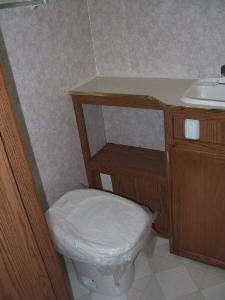
The Bathroom, Toilet side. That’s the lightswitch under the sink.

The Bathroom again, looking up a bit, over the toilet, and to the rear or the trailer. Notice the towel bar, and the largish storage area, between the ceiling and the top of the wall. And of course, the skylight has a 12v fan. I’ve got a shroud over this so I don’t have to close the skylight when it rains. That’s a REAL plus on warm days when we go out; We can leave it open to vent and it’s not so warm in the rig when we get back.
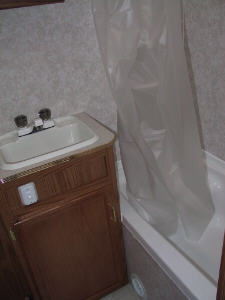
Starting to look the other way, toward the tub. Note the heat duct running under the tub floor.

Here’s the rest of that storage area that runs behind the toilet. You’re looking at the rear sleeping area, or where it would be if it was deployed. The curatains add a bit of privacy when closed; a nice touch. That white thing on the wall to the right is a stereo speaker.
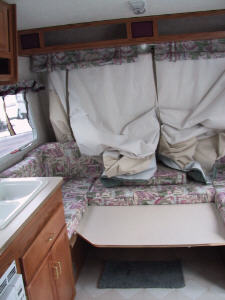
Here, you’re looking at the forward sleeping area, standing about amidships. That long line of cushions is the dining area, or when set up like it is now, makes a nice sleeping area with some re-arrangement of cushions. The thing in the middle, at the moment without cushions, is the dining table, which doubles as a sleeping platform. Turning to the left and looking up, we find…
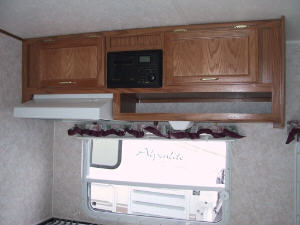
The cabinets over the galley area. Note the exhaust fan, and the Stereo. AM-FM-Tape plus an aux input for the CD or MP3 player. It also gets NOAA weather broadcasts, which is really great.. I used to carry a scanner for that purpose. Never be without such a radio when camping, folks. It handles an extra set of speakers, and allows switching between them, so I’m considering added a set of remotes for outside the trailer on the awning side. They’ll stow in the storage areas to the front and rear of the passenger/awning side. THe radio portion has an antenna mounted on the roof that does quite well.
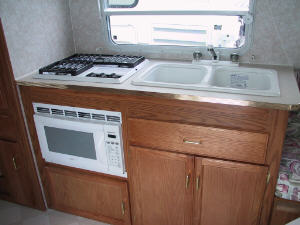
Looking down at the galley, we see a three burner stove, a microwave oven, and a two-cell sink. The sink is fed by either the 30 gallon onboard tank, or the shore connection, plus the ~6gallons of water heater. The unit comes with a cutting board that fits over one of the two sinks, which of course gives you a cutting surface, but doubles as added galley work space. This is the saving grace of the whole unit, and the real cost saver. With smaller rigs, you’re more inclined to go out to eat. It’s a pain to create meals. With this rig, you simply bring your food with you… and store it in the massive storage area, or in the large fridge and freezer, just behind the galley. IN our case, we have a decent fridge mounted in the van, already, so we’re in good shape for food storage.
…and as a result, for our family, the savings ends up being over $100/day on food alone. Now, over the fridge, goes the TV. You don’t see it ,but there’s a directional TV/FM antenna crank over the fridge.
Look off to the left there, and you’ll see the 12v power tap for your entertainment systems, plus a preamplified control on the Antenna. Works wonders on the weak signals you’ll get in the boonies.
Here’s a closer view of the storage area wall which is just to your left, and rearward, of where you enter the rig. Thta’s the open main hatchway to your left. Across the top you have AC power, DC power and the preamplifier control. Also, the inside and outside lightswitches, plus the control center for the tanks (Fresh/Grey/Black) and the battery monitor. This location for the 12v tap means I can’t have 12v supplied cleanly outside the rig with the door closed… a pain in the behind. This is why I want a couple taps mounted outside. Except for the Microwave the whole rig runs off 12v, anyway.

The business end of the tank drain. This is the trailer lowpoint, and it gets awfully low to the road at times. I’ve not hit the thing yet, but it’s a concern… and one I’ve seen noted in reviews of the 21c.
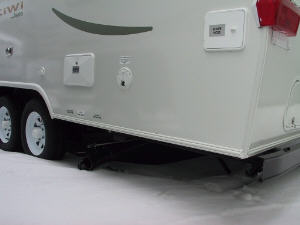
Outside, driver’s side rear.Next to the taillight along the left wall, we see the sewer hose storage area. The round thing in front of that is the 30 amp shore power cable storage. The length of the feed cable is amazing by comparison to what I’ve seen before.

Some of the internal plumbing as viewed through of the five storage portals from outside. Note that these storage areas run all the way through the unit. Those longish things on the right, are the bunk end poles.
 From the front, minus LP tanks, and battery.

Passenger side rear. Note the awning strut hinge. You don’t see it here, but our rig has a storage area that run all along the lower rear of the unit.
The one thing our rig doesn’t have is a spare tire kit; I plan to add that right away.
Well, that’s a quick look. Only a couple months now, until we bring it back home….
Tags: RV Life
Mr. Speaker, Vice President Cheney, Members of Congress, Members of the Supreme Court and diplomatic corps, distinguished guests, and fellow citizens:Today our Nation lost a beloved, graceful, courageous woman who called America to its founding ideals and carried on a noble dream. Tonight we are comforted by the hope of a glad reunion with the husband who was taken from her so long ago, and we are grateful for the good life of Coretta Scott King.
Ah, yes, we know how Bush hates Black people. How much does this guy have to do, to get a little credit for his true feelings on the matter whether so clearly expressed here?
Each time I am invited to this rostrum, I am humbled by the privilege, and mindful of the history we have seen together. We have gathered under this Capitol dome in moments of national mourning and national achievement. We have served America through one of the most consequential periods of our history – and it has been my honor to serve with you.
Preparation, this is. Nothing more. Other, than perhaps a warning that there’s something big coming and you’d better pay attention. Rather like saying “Nice Doggie” while you find a rock
In a system of two parties, two chambers, and two elected branches, there will always be differences and debate. But even tough debates can be conducted in a civil tone, and our differences cannot be allowed to harden into anger. To confront the great issues before us, we must act in a spirit of good will and respect for one another – and I will do my part. Tonight the state of our Union is strong – and together we will make it stronger.
Message transmitted and received. You idiots on the Democrat side are going full goose bozo… and we’re not getting’ anything done that way. Chill; Our union is strong.
In this decisive year, you and I will make choices that determine both the future and the character of our country. We will choose to act confidently in pursuing the enemies of freedom – or retreat from our duties in the hope of an easier life. We will choose to build our prosperity by leading the world economy – or shut ourselves off from trade and opportunity. In a complex and challenging time, the road of isolationism and protectionism may seem broad and inviting – yet it ends in danger and decline. The only way to protect our peo
Tags: BitsBlog