Let’s talk about Iraq, and the tape released the other day from Usama BinLaden… there are several remarkable things about it.
For example, the idea that BinLaden considers himsef to be leading a ‘nation’. Consider his comments… “we are a nation forbidden by God…””
Wait a second.
Hold it.
Full Stop.
Back the truck up.
What nation would THAT be?
Certainly not Afghanistan which he was removed from, not Iraq, (Ditto) and not Pakistan… and so on. What then?
He’s clearly operating under some idea of Pan-Arabism. .. the same kind of Pan-Arabism indicated by the meeting/stroking festival of Iran, Syria and the PA, yesterday.
For another, the similarity between what the Democrats here in the U.S. have been saying and what we heard on the tape. The main thrust of what BinLaden came up with the other day, what Gore came up with a couple of days before, and what the Democrats are been coming up with since before we invaded Iraq, are one in the same. This point and not be qualified, nor danced around.
I take it is assumed out of hand that BinLaden cannot be considered trustworthy. So, too, as do most Democrats, even. Thus, do we see a bit of a problem for the Democrats who now find themselves forced into disagreeing with the nonsense they’ve been putting into our news media since before we invaded Iraq, lest they be seen, properly, as siding with BinLaden.
The purpose of BinLaden releasing that tape is simple; It is to obtain in truce, what he could not on the battlefield. So why did he sound like he was reading Err America press releases?
That’s also pretty basic. He may not know much about American life, but he knows this much: The public relations war here in the US is at least as important as the war that he’s fighting in Iraq. This is not a situation of the Democrats adopting the terrorist plans, but rather OBL, who has adopted the talking points of the left. He knows the biggest friend that he has in the United States is the American left in general, and the Democratic party, in particular. That’s what that entire speech was about; snuggling up to those on the left.
And why would he need to do this? Look at the kind of war BinLaden’s been waging; This is a two front war; BinLaden knows he’s lost on the battlefield. Indeed, he’s always known it… even before 9/11. However, combined with the political pressure of his Democrat freinds, he has a chance of winning; it’s his only chance, in fact. So to win his war, he needs to convince and cheerlead the Democrats to fight for him and remove America form the equation.
Sad to say, give the state of the left in ths country that’s feasable. Democrats are at the moment so open to any idea that is “NotBush”, they’ll follow anything… including BinLaden himself, so long as they think it will elect a Democrat.
BinLaden’s thugs winning or not, now depends utterly on what the willing idiots in the DNC do now. Given the utter stupidity the Democrats have been showing over time, alonng with their lack of perceptio and heir lack of ability to change for the better, this is not encouraging for the future of our country.
Tags: BitsBlog
This is a time of year when I don’t envy the position of members of the cloth.
Such men and women find themselves in the position of having to write a sermon on essentially the same message every year while making that message sound fresh. It’s not an easy thing to do. That’s why, for the last couple of years at Christmastime, I have simply re-posted “A Bithead’s Christmas”. It’s not laziness that drives that but an inability to come up with a fresh angle every year ; when I have an idea firmly in my mind I can explore and goals of that idea until I’m blue in the face and red in the fingers, and my keyboard is suffering under the strain. But often, the fresh ideas simply don’t come.
There’s this too. I have gotten more e-mail in the past six weeks requesting that article be reposted, than any of the 3500 other articles I’ve ever placed on this web site. It’s obvious that what I wrote in that article struck some serious chords, in the readership of this website, and on the web at large, since the vast majority of people reading an article are apparently coming in from Google, looking specifically for it. I am amazed.
Perhaps it’s better that way.
Sometimes the expression of an idea comes out perfectly, and explains it well, no matter how many times it’s repeated. The Christmas story, the Christmas promise, is most certainly one of these. It is precisely as I said last week in this space; Christmas, and thereby, Christianity itself, has been going on for a little over 2000 years, in spite of all the naysayers, protesters and government regulations that history has managed to toss up in those 2000- plus years. It does so, because at the core of it all, is a message that all the naysayers, Protesters and government hacks will never understand, much less conquer. It is a message that will survive the ravages of time, government, and liberals, facists, and anything else long after you and I are no longer even a memory in this world.
The Christmas message, you see, is eternal, and ever green.
(Evergreen. I am suddenly struck with the symbolism here)
There is something of a journalistic precedent for this as well. . I do not pretend to hold myself quite so high in the world has these media outlets, but I’d like for you to consider two examples from some well-regarded media outlets; Papers from around the country this day will be Printing “Yes, Virginia, there is a Santa Claus”. A Wall Street Journal has for years posted the same editorial every Thanksgiving for the last 47 years, and if I’m not mistaken they perform similarly on New Year’s Day as well.
So with all this in mind I will offer once again this year:
I find myself wanting to take more seriously, the challenge of writing to the subject of Christmas, today, than I have in years past. It’s not clear in my mind as to why, but this isn’t unusual… I never really do have a firm grip on why I want to attack a subject in these spaces. In fact, the writing of a coulmn for me has becomes more an effort of exploring a subject; the codification of random thoughts. The act of putting those thoughts into words on a screen allows me to think about, and RE-think about the subject at hand. My thoughts on a given subject often do not fully take shape until such time as I’ve re-written them twice. Often, indeed… usually, the ideas are already there, waiting to be cast into words, but not fully defined until the act of sitting down and typing them out. I suppose this subject is no exception.
To this effort, some blogs, this time of year will quote the great Gospels of Christ’s arrival, and expound on that. And that’s worthy, and right. Some others will take the secular angle of the holiday and go off on that. That too, is fine, though frankly it’s always for me missed the core of the topic, a little.
But not me, for either of those tacks. Not this year. I’m going to go off the beaten path, for this post, at least in context of this blog, given it’s Christmas, and off the beaten path in terms of the Liturgical calendar, given it’s me. I’m going to stick with the meaning of Christmas, but to point it up, I’m going to turn to something a little later… about 30 years later… for my subject. I trust you’ll see why when I’m done.
This story is in Matthew, Mark, and Luke. We’ll use Luke’s version for the purpose.
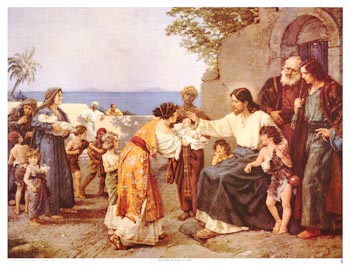
In Luke 18 it reads:
15 Now they were bringing even infants to him that he might touch them; and when the disciples saw it, they rebuked them. 16 But Jesus called them to him, saying, “Let the children come to me, and do not hinder them; for to such belongs the kingdom of God. 17 Truly, I say to you, whoever does not receive the kingdom of God like a child shall not enter it.”
Now, all three versions add a little something to the story, and I suggest you read them yourself to get it all. Most times that Christians hear this text or read it, a child is being baptized. The apparently intended thrust of reading it in those situations is to make a loose connection with the Children being accepted by Christ. And, that’s a valid angle for the story.
But, think about the story line, here, so you can get the flavor of what I’m going to describe to you. There’s a far bigger angle that many miss.
Christ has been playing “superstar” for a while, now. He’s been attracting flat out huge crowds wherever he goes. The disciples are starting to become concerned for the (human) well being of Christ. Children are, then as now, a source of some stress to adults already under stress, so the disciples decide, wordlessly to give the Lord a break. But Jesus says.. “Hey… No.. Let ’em come… It’s OK. ” Apparently, seeing some remaining resistance in their eyes, he reinforces the command with a statement that must have shaken them badly. “It’s to the likes of these as belongs the Kingdom of God.”
Now, It’s not hard for us to imagine what’s going on in the minds of the disciples…. They must have felt a little put back… While not saying so, they must have figured they had an inside track to Heaven. (Shrug) It’s human nature.
The passages don’t record if they said anything, but you just know what they’re thinking, here… “Comon, Jesus… We’re tryin’ to give you a break here! And you elevate these lowest of low, mere children, into the ownership of heaven? You raise a polite nothing to a path to heaven and eternity? What’s THAT about?”
And you know, Jesus knows it too. He knows full well what they’re thinking, because watch what he comes back with: “I’ll tell you the truth;”, he says, “Unless you change… Unless you transform, and accept the kingdom of heaven like a child, you’ll never enter it.”
But what does he mean, here? He’s talking, I’m afraid, about how you lose touch with happiness and the sense of wonder, as you become an adult. That loss prevents us from seeing the Kingdom of heaven as it is.
For most of us, the happiest times of our lives was when we were children. When we’re younger, we have less in the way of cares, and troubles. Let’s admit, too, that as we get older, we become aware of, and allow more and more sadness into our lives.
It’s true; It’s a hard world out there, and being adults we’ve come to understand this, in a way of understanding that only long exposure and experience… and lots of scar tissue, can bring.
It seems that every year we have more worries and concerns.

Oh, yeah, do we EVER worry. We worry about our health, and those concerns increase with advancing age. We worry about our jobs, about our investments, our savings, about the future in general. Retirement is a concern. Will we have enough? We’re too fat, we’re too skinny. We’re too tall, we’re too short, our once wavy hair is still waving… Only, it’s waving bye-bye. We worry about the future our kids will have and the normal growing up problems, but we also worry about the future that we’ve left our kids. We look at the news, and we wonder what kind of a world have we left them? We even worry if we worry too much.
We’ve seen marriages and relationships we thought would pass the test of time, pass away, instead. Things we had hoped would come to pass, didn’t, and those we’d not dreamed, in our wildest nightmares would happen, did. We see loved ones die. Jobs disappear. Hearts get broken.
And friends, those are just the hum-drum… The everyday worries that every generation has had, since Cain bopped his brother’s bean with a rock. Then you get into the problems particular to us and our times; AIDS, oil shortages, cancer, drugs, the way our own technology seems to be spiraling out of our control… And Islamofacists. Ah, yes, there’s nothing at all, to my mind, like the specter of 3000 plus people dying on national television, in Washington, NY and Pennsyvania… while we watch, to remind us that we’re not in control.
And yes…. it’s all about control, if you think on it for long. All these things I’ve listed are worries about things we cannot control, try as we might.
The list of these reverses, these scars, gets longer as the years progress, and it starts eventually, to break down the positive outlook in every one of us… Each according to their ability to resist. Each step, each worry, each bit of emotional scar tissue, if you will, moves us farther away from the relative joy of our comparatively carefree childhood.
By now the sharper among you will notice where I’m going with this; This is where Christmas comes in. This is why Christmas holds a special place in our hearts, and our traditions.
You see, even for the not-so-religious, it is a time of renewal of our fragile human spirit. All of the hurts, small and large, become less pronounced, and fade under the soft glow of the lights, the candles, the fireplace, and the smile of the children.
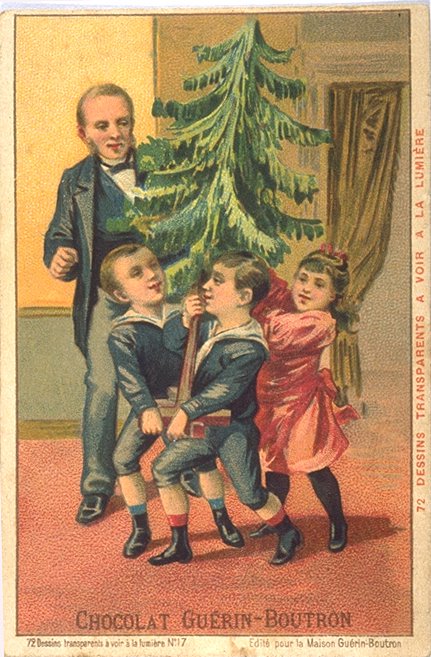 Have you ever noticed that it’s the children, in fact, that do us the most healing? Christmas, it’s said, is for the children. Presidential speechwriter and WSJ columnist Peggy Noonan noted recently about some of the qualities of children:
“They are susceptible to wonder. A child can look at a red toy car in the red-green glow of Christmas tree lights and imagine an entire lifetime. A child can play with a new doll and smell good things being cooked and hear sweet music and it can make that child imagine that life is good, which gives her a template for good, a category for good; it helps her know good exists. This knowledge comes in handy in life; those who do not receive it, one way or another, are sadder than those who do.”
Of course, we move away from that ability as we grow older. Our long experience has hardened us to the realities of the world around us, and perhaps jaded our point of view. But here comes Christmas, which gives us, individually and collectively, the chance of looking at the world though the wonder-filled eyes of a child once again… Becoming childlike ourselves in the process, and becoming healed and renewed.
The experience is a far deeper one for those who have accepted the Christmas promise, and it’s meaning. Reacting to that promise includes allowing someone else to run the controls of our lives. Remember I said it was all about control? Well, I want you to think about the features of being a child. It was Randall Jarrell, I tihnk, who once quipped:
“One of the most obvious facts about grownups to a child is that they have forgotten what it is like to be a child.”
Well, let’s remember.
You’re NOT in control of much of anything. Someone who knows better, and is by far more powerful than we, is running things. And looking back, I’m sure most of us would conclude that having that situation back would be of comfort to us. Haven’t we all wished to resign from the world of adulthood at times?
I guess this would be a good place to slip in a parallel story. Consider the fictional person of Ebeneezer Scrooge. Think about how the story develops; He’s had some serious emotional setbacks in early life… and those have become a self-feeding, never ending circle by the time we meet him, 7 years after his best friend’s death.
 All these setbacks have made him cold, and hard, and for all outward appearances, non-feeling. He’s covered with emotional scar tissue. Being hard, is his way of dealing with what he cannot control.
Only after his overnight experience do all these cares get swept away, along with his anger of not being able to control his situation…. The realization comes to him that he never really WAS in control in the first place, so stop fretting about it all… Think about what are essentially the first words out of his mouth as he realizes that the weight of his worries.. Not unlike worries you and I have had, are gone; “I’m as light as a feather….” The weight of that scar tissue… And all the concerns they represent having been lifted off his shoulders…
“…and as giddy as a Schoolboy!”
Like a child.
“I’ll tell you the truth”, he said, “Unless you change.. Unless you transform, and accept the kingdom of heaven like a child, you’ll never enter it.”
Amazing parallels, aren’t they? I’m reliably informed that Charles Dickens was not as a rule what one would call very religious. Yet, in looking at the parallels in these two story lines, I must wonder in all honesty if he didn’t have some help with “A Christmas Carol”.
Now, you’ll notice I took some liberty with the way the Biblical text was quoted. Some liberty, I say, but not very much, really, since it’s long been pointed out by Bible scholars that the word that earlier versions of the text had as ‘change’ were really translated from the ancient Greek word for “transform”. This is a major point, because it demonstrates what the first step is, and whose it is… yours.
And no, change and transformation are not the same thing. The best description I’ve ever thought of to explain the difference between the two, runs along these lines:
If I take a rock, and in the other hand I take a large hammer, and I hot the rock with the hammer, and break it, I’ve changed that rock.
If I take that same rock, and take a small hammer and chisel, and very carefully, perhaps over a period of decades, sculpt that rock into a flower, I’ve still merely changed that rock.
Transformation, on the other hand, is when the rock itself, as a matter of responding to it’s own will, becomes a flower. And of course that’s beyond the normal power of the rock, by any standard we know. What Christ therefore is saying is, that we must become children, as of a matter of our own will. Which is, as I say, impossible by any standard we know…. Which in turn leads us to the source of all things, who teaches us how, and gives us the power to do it.
You see, the externalities I mentioned, the lights, the fire, the children…and that which Dickens writes of… the giving, the being open to what joys are around us, and so on, helps toward the goal of understanding the Christmas promise, but it’s not the whole deal.
At the core of it all… (and this is a connection that, alas, many people never make…) is that the one whose birth is being celebrated every December the 25th, is the one who takes over that long list of worries.
THAT’S WHY WE CELEBRATE!!
With those worries removed, lives get changed, hearts mended, child-like perspectives restored in a way that the lights, carols and greenery can never do on their own. And the newly remade Children find that the authority and responsibility and all the ponderous weight connected with them, are taken away by the one who said “All authority in heaven and on earth has been given to me”.
Now, I must warn you; There are those who will resist being told all of this… to the point of removing such joy as they find, wherever they may find it, often using the power of governments, and force of arms to have it removed from town squares and schools, mocking, persecuting and yes, even killing those responsible for the spreading of the news of this miracle. It’s a sad truth, that a world used to darkness, you see, will continually fight to see the darkness continued.
That warning given, however, I will say to you also, that it’s no accident, Christmas being called the season of light, and that Christ is called the light of the world.

If I have one wish for this Christmas, it is that you will be open to the light…. With the wondering eyes of a child.
Tags: BitsBlog
10:32 A.M. EST
THE PRESIDENT: Welcome. Please be seated. Thanks.
Last night I addressed the nation about our strategy for victory in Iraq, and the historic elections that took place in the country last week. In a nation that once lived by the whims of a brutal dictator, the Iraqi people now enjoy constitutionally protected freedoms, and their leaders now derive their powers from the consent of the government. Millions of Iraqis are looking forward to a future with hope and optimism.
The Iraqi people still face many challenges. This is the first time the Iraqis are forming a government under their new constitution. The Iraqi constitution requires a two-thirds vote of the parliament for certain top officials. So the formation of the new government will take time as Iraqis work to build consensus. And once the new Iraqi government assumes office, Iraq’s new leaders will face many important decisions on issues such as security and reconstruction, economic reform and national unity. The work ahead will require the patience of the Iraqi people and the patience and support of America and our coalition partners.
As I said last night, this election does not mean the end of violence, but it is the beginning of something new: a constitutional democracy at the heart of the Middle East. And we will keep working toward our goal of a democratic Iraq that can govern and self-sustain itself and defend itself.
Our mission in Iraq is critical in the victory in the global war on terror. After our country was attacked on September the 11th and nearly 3,000 lives were lost, I vowed to do everything within my power to bring justice to those who were responsible. I also pledged to the American people to do everything within my power to prevent this from happening again. What we quickly learned was that al Qaeda was not a conventional enemy. Some lived in our cities and communities, and communicated from here in America to plot and plan with bin Laden’s lieutenants in Afghanistan, Pakistan and elsewhere. Then they boarded our airplanes and launched the worst attack on our country in our nation’s history.
This new threat required us to think and act differently. And as the 9/11 Commission pointed out, to prevent this from happening again, we need to connect the dots before the enemy attacks, not after. And we need to recognize that dealing with al Qaeda is not simply a matter of law enforcement; it requires defending the country against an enemy that declared war against the United States of America.
As President and Commander-in-Chief, I have the constitutional responsibility and the constitutional authority to protect our country. Article II of the Constitution gives me that responsibility and the authority necessary to fulfill it. And after September the 11th, the United States Congress also granted me additional authority to use military force against al Qaeda.
After September the 11th, one question my administration had to answer was how, using the authorities I have, how do we effectively detect enemies hiding in our midst and prevent them from striking us again? We know that a two-minute phone conversation between somebody linked to al Qaeda here and an operative overseas could lead directly to the loss of thousands of lives. To save American lives, we must be able to act fast and to detect these conversations so we can prevent new attacks.
So, consistent with U.S. law and the Constitution, I authorized the interception of international communications of people with known links to al Qaeda and related terrorist organizations. This program is carefully reviewed approximately every 45 days to ensure it is being used properly. Leaders in the United States Congress have been briefed more than a dozen times on this program. And it has been effective in disrupting the enemy, while safeguarding our civil liberties.
This program has targeted those with known links to al Qaeda. I’ve reauthorized this program more than 30 times since the September the 11th attacks, and I intend to do so for so long as our nation is — for so long as the nation faces the continuing threat of an enemy that wants to kill American citizens.
Another vital tool in the war on terror is the Patriot Act. After September the 11th, Congress acted quickly and responsibly by passing this law, which provides our law enforcement and intelligence community key tools to prevent attacks in our country. The Patriot Act tore down the legal and bureaucratic wall that kept law enforcement and intelligence authorities from sharing vital information about terrorist threats. It allows federal investigators to pursue terrorists with tools already used against other types of criminals. America’s law enforcement personnel have used this critical tool to prosecute terrorist operatives and their supporters, and to breakup cells here in America.
Yet, key provisions of this law are set to expire in 12 days. The House of Representatives voted for reauthorization, but last week, a minority of senators filibustered the Patriot Act, blocking the Senate from voting to reauthorize key provisions of this vital law. In fact, the Senate Democratic leader boasted to a group of political supporters that the Senate Democrats had “killed the Patriot Act.” Most of the senators now filibustering the Patriot Act actually voted for it in 2001. These senators need to explain why they thought the Patriot Act was a vital tool after the September the 11th attacks, but now think it’s no longer necessary.
The terrorists want to strike America again, and they hope to inflict even greater damage than they did on September the 11th. Congress has a responsibility to give our law enforcement and intelligence officials the tools they need to protect the American people. The senators who are filibustering the Patriot Act must stop their delaying tactics, and the Senate must vote to reauthorize the Patriot Act. In the war on terror, we cannot afford to be without this law for a single moment.
As we fight the war on terror, we’ll also continue to work to build prosperity for our citizens. Because we cut taxes and restrained non-security spending, our economy is strong and it is getting stronger. We added 215,000 new jobs in November. We’ve added nearly 4.5 million new jobs since May of 2003. The unemployment rate is down to 5 percent, lower than the average of the 1970s, 1980s and 1990s. Despite hurricanes and high gas prices, third quarter growth was 4.3 percent. More Americans own their own homes than at any time in our history. Inflation is low, productivity is high and consumer confidence is up. We’re heading into a new year with an economy that is the envy of the world, and we have every reason to be optimistic about our economic future.
We made other important progress this year on the priorities of American families. We passed a good energy bill, and we’re putting America on the path to make our economy less dependent on foreign sources of oil. We were wise with taxpayer’s money and cut non-security discretionary spending below last year’s level. We passed the Central American Dominican Republic Free Trade Agreement to open up markets and help level the playing field for America’s workers and farmers and small businesses. We passed bankruptcy reform and class action lawsuit reform. I appointed John Roberts as the 17th Chief Justice of the United States. Chief Justice Roberts is poised to lead the Supreme Court with integrity and prudence for decades to come.
We’ve got more work to do in this coming year. To keep our economy growing, we need to keep taxes low, and make the tax relief permanent. We must restrain government spending, and I’m pleased that the House today has voted to rein in entitlement spending by $40 billion, and I urge the United States Senate to join them. We must reduce junk lawsuits and strengthen our education system and give more Americans the ability to obtain affordable health insurance. We must pass comprehensive immigration reform that protects our borders, strengthens enforcement and creates a new temporary worker program that relieves pressure on the border, but rejects amnesty.
I look forward to the Senate holding an up or down vote on Judge Sam Alito and confirming him by January 20th as Associate Justice of the Supreme Court. Judge Alito has more prior judicial experience than any Supreme Court nominee in more than 70 years. He’s a highly respected and principled jurist and he will make our nation proud as a member of the high court.
As we prepare to spend time with our families this holiday season, we also stop to count our blessings. We’re thankful for our courageous men and women in uniform who are spending the holidays away from loved ones, standing watch for liberty in distant lands. We give thanks for our military families who love and support them in their vital work, and who also serve our country. And we pray for the families of the fallen heroes. We hold them in our hearts and we lift them up in our prayers and we pledge that the sacrifice of their loved ones will never be forgotten.
I’ll be glad to answer some questions here, starting with you, Terry.
Q Mr. President, thank you, sir. Are you going to order a leaks investigation into the disclosure of the NSA surveillance program? And why did you skip the basic safeguard of asking courts for permission for these intercepts?
THE PRESIDENT: Let me start with the first question. There is a process that goes on inside the Justice Department about leaks, and I presume that process is moving forward. My personal opinion is it was a shameful act for someone to disclose this very important program in a time of war. The fact that we’re discussing this program is helping the enemy.
You’ve got to understand — and I hope the American people understand — there is still an enemy that would like to strike the United States of America, and they’re very dangerous. And the discussion about how we try to find them will enable them to adjust. Now, I can understand you asking these questions and if I were you, I’d be asking me these questions, too. But it is a shameful act by somebody who has got secrets of the United States government and feels like they need to disclose them publicly.
Let me give you an example about my concerns about letting the enemy know what may or may not be happening. In the late 1990s, our government was following Osama bin Laden because he was using a certain type of telephone. And then the fact that we were following Osama bin Laden because he was using a certain type of telephone made it into the press as the result of a leak. And guess what happened? Saddam — Osama bin Laden changed his behavior. He began to change how he communicated.
We’re at war, and we must protect America’s secrets. And so the Justice Department, I presume, will proceed forward with a full investigation. I haven’t ordered one, because I understand there’s kind of a natural progression that will take place when this kind of leak emerges.
The second part of the question is? Sorry — I gave a long answer.
Q It was, why did you skip the basic safeguards of asking courts for permission for the intercepts?
THE PRESIDENT: First of all, I — right after September the 11th, I knew we were fighting a different kind of war. And so I asked people in my administration to analyze how best for me and our government to do the job people expect us to do, which is to detect and prevent a possible attack. That’s what the American people want. We looked at the possible scenarios. And the people responsible for helping us protect and defend came forth with the current program, because it enables us to move faster and quicker. And that’s important. We’ve got to be fast on our feet, quick to detect and prevent.
We use FISA still — you’re referring to the FISA court in your question — of course, we use FISAs. But FISA is for long-term monitoring. What is needed in order to protect the American people is the ability to move quickly to detect.
Now, having suggested this idea, I then, obviously, went to the question, is it legal to do so? I am — I swore to uphold the laws. Do I have the legal authority to do this? And the answer is, absolutely. As I mentioned in my remarks, the legal authority is derived from the Constitution, as well as the authorization of force by the United States Congress.
Adam.
Q Mr. President, you have hailed the Iraqi elections as a success, but some lawmakers say you are not focusing on the threat of civil war. Do you fear a civil war? And how hard will you push Iraq’s competing political parties to get a government and a constitutional compromise?
THE PRESIDENT: I appreciate that. We look at all contingencies, but my optimism about a unified Iraq moving forward was confirmed when over 10 million people went to the polls under a — and voted for a government under a new constitution. Constitutions tend to bind societies.
Now, there are some things we’ve got to watch, Adam, for certain. One, is we’ve got to help the Iraqi government as best as they need help, to stand up a government as quickly as possible. In other words, we’re urging them: don’t delay, move as quickly as you can, solve the — get the political parties — once the vote is completed, get the political parties together and come up with a government.
And it’s going to take a while, because, first of all, the ballots won’t be fully counted, I guess, until early January. And then, as I mentioned in my remarks, it take a two-thirds vote to — first, to seat certain officials. Sometimes it’s hard to achieve a two-thirds vote in legislative bodies. How about the Senate, for example? (Laughter.) But, nevertheless, it’s going to take a while. And the American people have got to understand that we think in terms of elections, most of our elections end the day after the election. Sometimes they don’t, Adam. (Laughter.) And so you’re going to see a lot of give-and-take, and it’s important for us to get this process moving forward.
Secondly, there is an opportunity to amend the constitution. You remember that was part of the deal with the Iraqis, in order to get this process moving. And we’ll want to make sure we’re monitoring and involved with that part. In other words, involvement doesn’t mean telling the sovereign government what to do; involvement means giving advice as to how to move forward so a country becomes more unified. And I’m very optimistic about the way forward for the Iraqi people.
And the reason why is based upon the fact that the Iraqis have shown incredible courage. Think about what has happened in a brief period of time — relatively brief. I know with all the TV stations and stuff in America, two-and-a-half years seems like an eternity. But in the march of history, it’s not all that long. They have gone from tyranny to an amazing election last December. If I’d have stood up here a year ago, in one of my many press conferences, and told you that in the — next year I make this prediction to you, that over 10 million Iraqis, including many Sunnis, will vote for a permanent government, I think you probably would have said, there he goes again.
But it happened. And it happened because the Iraqis want to live in a free society. And what’s important about this election is that Iraq will become an ally in the war on terror, and Iraq will serve as a beacon for what is possible; a beacon of freedom in a part of the world that is desperate for freedom and liberty. And as I say in my speeches, a free Iraq will serve as such an optimistic and hopeful example for reformers from Tehran to Damascus. And that’s an important part of a strategy to help lay the foundation of peace for generations.
John.
Q Thank you, Mr. President. So many questions, so little time.
THE PRESIDENT: Well, keep your question short, then. (Laughter.)
Q I’ll do my best, sir. But, sir, you’ve shown a remarkable spirit of candor in the last couple of weeks in your conversation and speeches about Iraq. And I’m wondering if, in that spirit, I might ask you a question that you didn’t seem to have an answer for the last time you were asked, and that is, what would you say is the biggest mistake you’ve made during your presidency, and what have you learned from it?
THE PRESIDENT: Answering Dickerson’s question. No, I — the last time those questions were asked, I really felt like it was an attempt for me to say it was a mistake to go into Iraq. And it wasn’t a mistake to go into Iraq. It was the right decision to make.
I think that, John, there’s going to be a lot of analysis done on the decisions on the ground in Iraq. For example, I’m fully aware that some have said it was a mistake not to put enough troops there immediately — or more troops. I made my decision based upon the recommendations of Tommy Franks, and I still think it was the right decision to make. But history will judge.
I said the other day that a mistake was trying to train a civilian defense force and an Iraqi army at the same time, but not giving the civilian defense force enough training and tools necessary to be able to battle a group of thugs and killers. And so we adjusted.
And the point I’m trying to make to the American people in this, as you said, candid dialogue — I hope I’ve been candid all along; but in the candid dialogue — is to say, we’re constantly changing our tactics to meet the changing tactics of an enemy. And that’s important for our citizens to understand.
Thank you. Kelly.
Q Thank you, Mr. President. If you believe that present law needs to be faster, more agile concerning the surveillance of conversations from someone in the United States to someone outside the country —
THE PRESIDENT: Right.
Q — why, in the four years since 9/11, has your administration not sought to get changes in the law instead of bypassing it, as some of your critics have said?
THE PRESIDENT: I appreciate that. First, I want to make clear to the people listening that this program is limited in nature to those that are known al Qaeda ties and/or affiliates. That’s important. So it’s a program that’s limited, and you brought up something that I want to stress, and that is, is that these calls are not intercepted within the country. They are from outside the country to in the country, or vice versa. So in other words, this is not a — if you’re calling from Houston to L.A., that call is not monitored. And if there was ever any need to monitor, there would be a process to do that.
I think I’ve got the authority to move forward, Kelly. I mean, this is what — and the Attorney General was out briefing this morning about why it’s legal to make the decisions I’m making. I can fully understand why members of Congress are expressing concerns about civil liberties. I know that. And it’s — I share the same concerns. I want to make sure the American people understand, however, that we have an obligation to protect you, and we’re doing that and, at the same time, protecting your civil liberties.
Secondly, an open debate about law would say to the enemy, here is what we’re going to do. And this is an enemy which adjusts. We monitor this program carefully. We have consulted with members of the Congress over a dozen times. We are constantly reviewing the program. Those of us who review the program have a duty to uphold the laws of the United States, and we take that duty very seriously.
Let’s see here — Martha. Working my way around the electronic media, here.
Q Thank you, Mr. President. You say you have an obligation to protect us. Then why not monitor those calls between Houston and L.A.? If the threat is so great, and you use the same logic, why not monitor those calls? Americans thought they weren’t being spied on in calls overseas — why not within the country, if the threat is so great?
THE PRESIDENT: We will, under current law, if we have to. We will monitor those calls. And that’s why there is a FISA law. We will apply for the right to do so. And there’s a difference — let me finish — there is a difference between detecting so we can prevent, and monitoring. And it’s important to know the distinction between the two.
Q But preventing is one thing, and you said the FISA laws essentially don’t work because of the speed in monitoring calls overseas.
THE PRESIDENT: I said we use the FISA courts to monitor calls. It’s a very important tool, and we do use it. I just want to make sure we’ve got all tools at our disposal. This is an enemy which is quick and it’s lethal. And sometimes we have to move very, very quickly. But if there is a need, based upon evidence, we will take that evidence to a court, in order to be able to monitor calls within the United States.
Who haven’t I called on, let’s see here. Suzanne.
Q Democrats have said that you have acted beyond law, and that you have even broken the law. There are some Republicans who are calling for congressional hearings and even an independent investigation. Are you willing to go before members of Congress and explain this eavesdropping program? And do you support an independent investigation?
THE PRESIDENT: We have been talking to members of the United States Congress. We have met with them over 12 times. And it’s important for them to be brought into this process. Again, I repeat, I understand people’s concerns. But I also want to assure the American people that I am doing what you expect me to do, which is to safeguard civil liberties and at the same time protect the United States of America. And we’ve explained the authorities under which I’m making our decisions, and will continue to do so.
Secondly, there is a committee — two committees on the Hill which are responsible, and that’s the Intelligence Committee. Again, any public hearings on programs will say to the enemy, here’s what they do; adjust. This is a war. Of course we consult with Congress and have been consulting with Congress and will continue to do so.
Wendell. You got a little problem there, Wendell? (Laughter.)
Q I’m caught, Mr. President.
THE PRESIDENT: Oh, you’re caught. (Laughter.) Liberate him. (Laughter.)
Q You talked about your decision to go to war and the bad intelligence, and you’ve carefully separated the intelligence from the decision, saying that it was the right decision to go to war despite the problems with the intelligence, sir. But, with respect, the intelligence helped you build public support for the war. And so I wonder if now, as you look back, if you look at that intelligence and feel that the intelligence and your use of it might bear some responsibility for the current divisions in the country over the war, and what can you do about it?
THE PRESIDENT: I appreciate that. First of all, I can understand why people were — well, wait a minute. Everybody thought there was weapons of mass destruction, and there weren’t any. I felt the same way. We looked at the intelligence and felt certain that Saddam Hussein had weapons of mass destruction. Intelligence agencies around the world felt the same way, by the way. Members of the United States Congress looked at the National Intelligence Estimate — same intelligence estimate I looked at — and came to the same conclusion, Wendell.
So in other words, there was universal — there was a universal feeling that he had weapons of mass destruction. As a matter of fact, it was so universal that the United Nations Security Council passed numerous resolutions. And so when the weapons weren’t there, like many Americans, I was concerned and wondered why. That’s why we set up the Silberman-Robb Commission to address intelligence shortfalls, to hopefully see to it that this kind of situation didn’t arise.
Now, having said all that, what we did find after the war was that Saddam Hussein had the desire to — or the liberation — Saddam had the desire to reconstitute his weapons programs. In other words, he had the capacity to reconstitute them. America was still his enemy. And of course, he manipulated the oil-for-food program in the hopes of ending sanctions. In our view, he was just waiting for the world to turn its head, to look away, in order to reconstitute the programs. He was dangerous then. It’s the right decision to have removed Saddam.
Now, the American people — I will continue to speak to the American people on this issue, to not only describe the decision-making process but also the way forward. I gave a speech prior to the liberation of Iraq, when I talked about a broader strategic objective, which is the establishment of democracy. And I’ve talked about democracy in Iraq. Certainly it’s not the only rationale; I’m not claiming that. But I also want you to review that speech so that you get a sense for not only the desire to remove a threat, but also the desire to help establish democracy. And the amazing thing about — in Iraq, as a part of a broader strategy, to help what I call “lay the foundation of peace,” democracies don’t war; democracies are peaceful countries.
And what you’re seeing now is an historic moment, because I believe democracies will spread. I believe when people get the taste for freedom or see a neighbor with a taste for freedom, they will demand the same thing, because I believe in the universality of freedom. I believe everybody has the desire to be free. I recognize some don’t believe that, which basically condemns some to tyranny. I strongly believe that deep in everybody’s soul is the desire to live in liberty, and if given a chance, they will choose that path. And it’s not easy to do that. The other day, I gave a speech and talked about how our road to our Constitution, which got amended shortly after it was approved, was pretty bumpy. We tried the Articles of Confederation. It didn’t work. There was a lot of, kind of, civil unrest. But, nevertheless, deep in the soul is the desire to live in liberty, people — make the — have got the patience and the steadfastness to achieve that objective. And that is what we’re seeing in Iraq.
And it’s not going to be easy. It’s still going to be hard, because we’re getting rid of decades of bitterness. If you’re a — you know, you find these secret prisons where people have been tortured, that’s unacceptable. And, yet, there are some who still want to have retribution against people who harmed them.
Now, I’ll tell you an amazing story — at least I thought it was amazing. We had people — first-time voters, or voters in the Iraqi election come in to see me in the Oval. They had just voted that day, and they came in. It was exciting to talk to people. And one person said, how come you’re giving Saddam Hussein a trial? I said, first of all, it’s your government, not ours. She said, he doesn’t deserve a trial; he deserves immediate death for what he did to my people. And it just struck me about how strongly she felt about the need to not have a rule of law, that there needed to be quick retribution, that he didn’t deserve it. And I said to her, don’t you see that the trial, itself, stands in such contrast to the tyrant that that in itself is a victory for freedom and a defeat for tyranny — just the trial alone. And it’s important that there be rule of law.
My only point to you is there’s a lot of work to get rid of the past, yet we’re headed in the right direction. And it’s an exciting moment in history.
Stretch.
Q Thank you, Mr. President. Getting back to the domestic spying issue for a moment. According to FISA’s own records, it’s received nearly 19,000 requests for wiretaps or search warrants since 1979, rejected just five of them. It also operates in secret, so security shouldn’t be a concern, and it can be applied retroactively. Given such a powerful tool of law enforcement is at your disposal, sir, why did you see fit to sidetrack that process?
THE PRESIDENT: We used the process to monitor. But also, this is a different — a different era, a different war, Stretch. So what we’re — people are changing phone numbers and phone calls, and they’re moving quick. And we’ve got to be able to detect and prevent. I keep saying that, but this is a — it requires quick action.
And without revealing the operating details of our program, I just want to assure the American people that, one, I’ve got the authority to do this; two, it is a necessary part of my job to protect you; and, three, we’re guarding your civil liberties. And we’re guarding the civil liberties by monitoring the program on a regular basis, by having the folks at NSA, the legal team, as well as the inspector general, monitor the program, and we’re briefing Congress. This is a part of our effort to protect the American people. The American people expect us to protect them and protect their civil liberties. I’m going to do that. That’s my job, and I’m going to continue doing my job.
Let’s see here — Sanger.
Q Thank you, Mr. President. Following up on Wendell’s question about the intelligence failures ahead of Iraq, one of the side effects appears to have been that the United States has lost some credibility with its allies when it goes to them with new intelligence. You, for example, your administration, has been sharing with some of your allies the contents of a laptop computer that was found in Iran concerning their nuclear program. Yet you are still having —
THE PRESIDENT: Is that classified? (Laughter.) No, never mind, Sanger.
Q Yet you are still having some difficulty convincing people that Iran has a nuclear program. Can you tell us whether or not you think one of the side effects of the intelligence failure has been that it has limited your ability to deal with future threats like Iran, like North Korea, or any other future threats concerning terrorists?
THE PRESIDENT: Sanger, I hate to admit it, but that’s an excellent question. No question, that the intelligence failure on weapons of mass destruction caused all intelligence services to have to step back and reevaluate the process of gathering and analyzing intelligence — no doubt about that. And so there’s been a lot of work done to work with other intelligence agencies to share information about what went right and what went wrong, as well as to build credibility among all services.
I think, David, where it is going to be most difficult to make the case is in the public arena. People will say, if we’re trying to make the case on Iran, well, the intelligence failed in Iraq, therefore, how can we trust the intelligence in Iran? And part of the reason why there needs to be a public message on this is because the first hope and the first step is a diplomatic effort to get the Iranians to comply with the demands of the free world. If they don’t, there’s — along the diplomatic path, there’s always the United Nations Security Council. But that case of making — beginning to say to the Iranians, there are consequences for not behaving, requires people to believe that the Iranian nuclear program is, to a certain extent, ongoing. And so we’re working hard on that. I mean, it’s no question that the credibility of intelligence is necessary for good diplomacy.
Q Do you intend to make that case publicly, too? You haven’t yet laid out the evidence on Iran —
THE PRESIDENT: Well, I think that the best place to make the case now is still in the councils of government and convincing the EU3, for example, to continue working the diplomatic angle. Of course, we want this to be solved diplomatically, and we want the Iranians to hear a unified voice. I think people believe that — I know this: People know that an Iran with the capacity to manufacture a nuclear weapon is not in the world’s interest. That’s universally accepted. And that should be accepted universally, particularly after what the President recently said about the desire to annihilate, for example, an ally of the United States.
And so the idea of Iran having a nuclear weapon is — people say, well, we can’t let that happen. The next step is to make sure that the world understands that the capacity to enrich uranium for a civilian program would lead to a weapons program. And so therefore we cannot allow the Iranians to have the capacity to enrich. One of the reasons why I proposed working with the Russians, the Russian idea of allowing Iran to have a civilian nuclear power plant industry without enriched material — in other words, the enriched materials — without enriching material, the enriching material would come from Russia, in this case, and be picked up by the Russians, was to prevent them from having the capacity to develop a nuclear weapon.
So I think there’s universal agreement that we don’t want them to have a weapon. And there is agreement that they should not be allowed to learn how to make a weapon. And beyond that, I think that’s all I’m going to say.
But, appreciate it. Baker.
Q Thank you, Mr. President. I wonder if you can tell us today, sir, what, if any, limits you believe there are or should be on the powers of a President during a war, at wartime? And if the global war on terror is going to last for decades, as has been forecast, does that mean that we’re going to see, therefore, a more or less permanent expansion of the unchecked power of the executive in American society?
THE PRESIDENT: First of all, I disagree with your assertion of “unchecked power.”
Q Well —
THE PRESIDENT: Hold on a second, please. There is the check of people being sworn to uphold the law, for starters. There is oversight. We’re talking to Congress all the time, and on this program, to suggest there’s unchecked power is not listening to what I’m telling you. I’m telling you, we have briefed the United States Congress on this program a dozen times.
This is an awesome responsibility to make decisions on behalf of the American people, and I understand that, Peter. And we’ll continue to work with the Congress, as well as people within our own administration, to constantly monitor programs such as the one I described to you, to make sure that we’re protecting the civil liberties of the United States. To say “unchecked power” basically is ascribing some kind of dictatorial position to the President, which I strongly reject.
Q What limits do you —
THE PRESIDENT: I just described limits on this particular program, Peter. And that’s what’s important for the American people to understand. I am doing what you expect me to do, and at the same time, safeguarding the civil liberties of the country.
John.
Q Thank you, sir. Looking ahead to this time next year, what are the top three or top five — take your pick — accomplishments that you hope to have achieved? And in particular, what is your best-case scenario for troop levels in Iraq at this time next year?
THE PRESIDENT: This is kind of like — this is the ultimate benchmark question. You’re trying to not only get me to give benchmarks in Iraq, but also benchmarks domestically.
I hope the world is more peaceful. I hope democracy continues to take root around the world. And I hope people are able to find jobs. The job base of this country is expanding, and we need to keep it that way. We want people working. I want New Orleans and Mississippi to be better places. I appreciate very much the progress that Congress is making toward helping a vision of New Orleans rising up and the Gulf Coast of Mississippi being reconstructed. I think we can make good progress down there.
One of the key decisions our administration has made is to make sure that the levees are better than they were before Katrina in New Orleans. That will help — people will have the confidence necessary to make investments and to take risk and to expand.
I appreciate the Congress, and I’m looking forward to the Senate affirming the U.S. Congress’ decisions to fund the education or reimburse states for education. There’s some good health care initiatives in the bill. We want to make sure that people don’t get booted out of housing. We want to work carefully to make sure people understand that there are benefits or help available for them to find housing. We want to continue to move temporary housing on the Gulf Coast of Mississippi so people can get better — closer to their neighborhoods, and get their homes rebuilt. We want to start helping Mayor Nagin get temporary housing near New Orleans so as this economy comes back people will be able to find jobs.
I appreciate the fact that the Congress passed the GO Zone tax incentives in order to attract capital into the region. So one of my hopes is, is that people are able to find hope and optimism after the Katrina disaster down there, that people’s lives get up and running again, that people see a brighter future. I’ve got a lot of hopes, and I’m looking forward to working with Congress to get those — to achieve some big goals.
Joe.
Q (Inaudible.)
THE PRESIDENT: You see, I hope by now you’ve discovered something about me, that when I say we’re not going to have artificial timetables of withdrawal, and/or try to get me out on a limb on what the troop levels will look like — the answer to your question on troop levels is, it’s conditions-based. We have an objective in Iraq, and as we meet those objectives, our commanders on the ground will determine the size of the troop levels.
Nice try. End of your try.
Joe.
Q Mr. President, you said last night that there were only two options in Iraq — withdraw or victory. And you asked Americans, especially opponents of the war, to reject partisan politics. Do you really expect congressional Democrats to end their partisan warfare and embrace your war strategy? And what can you do about that to make that happen?
THE PRESIDENT: Actually, I said that victory in Iraq is much larger than a person, a President, or a political party. And I’ve had some good visits with Senate and House Democrats about the way forward. They share the same concerns I share. You know, they want our troops out of Iraq as quickly as possible, but they don’t want to do so without achieving a victory. These are good, solid Americans that agree that we must win for the sake of our security. And I’m interested in, Joe, their ideas, and will continue to listen carefully to their ideas.
On the other hand, there are some in this country that believe, strongly believe that we ought to get out now. And I just don’t agree with them. It’s a wrong strategy, and I’d like to tell you again why. One, it would dishearten the Iraqis. The Iraqis are making a great — showing great courage to setting up a democracy. And a democracy in Iraq — I know I’ve said this, and I’m going to keep saying it because I want the American people to understand — a democracy in Iraq is vital in the long run to defeating terrorism. And the reason why is, is because democracy is hopeful and optimistic.
Secondly, it sends the wrong signal to our troops. We’ve got young men and women over their sacrificing. And all of a sudden, because of politics or some focus group or some poll, they stand up and say, we’re out of there. I can’t think of anything more dispiriting to a kid risking his or her life than to see decisions made based upon politics.
Thirdly, it sends the wrong signal to the enemy. It just says, wait them out; they’re soft, they don’t have the courage to complete the mission — all we’ve got to do is continue to kill and get these images on the TV screens, and the Americans will leave. And all that will do is embolden these people. Now, I recognize there is a debate in the country, and I fully understand that, about the nature of the enemy. I hear people say, because we took action in Iraq, we stirred them up, they’re dangerous. No, they were dangerous before we went into Iraq. That’s what the American people have got to understand. That’s why I took the decision I took on the NSA decision, because I understand how dangerous they are. And they want to hit us again.
Let me say something about the Patriot Act, if you don’t mind. It is inexcusable for the United States Senate to let this Patriot Act expire. You know, there’s an interesting debate in Washington, and you’re part of it, that says, well, they didn’t connect the dots prior to September the 11th — “they” being not only my administration, but previous administrations. And I understand that debate. I’m not being critical of you bringing this issue up and discussing it, but there was a — you might remember, if you take a step back, people were pretty adamant about hauling people up to testify, and wondering how come the dots weren’t connected.
Well, the Patriot Act helps us connect the dots. And now the United States Senate is going to let this bill expire. Not the Senate — a minority of senators. And I want senators from New York or Los Angeles or Las Vegas to go home and explain why these cities are safer. It is inexcusable to say, on the one hand, connect the dots, and not give us a chance to do so. We’ve connected the dots, or trying to connect the dots with the NSA program. And, again, I understand the press and members of the United States Congress saying, are you sure you’re safeguarding civil liberties. That’s a legitimate question, and an important question. And today I hope I’ll help answer that. But we’re connecting dots as best as we possibly can.
I mentioned in my radio address — my live TV radio address — that there was two killers in San Diego making phone calls prior to the September the 11th attacks. Had this program been in place then, it is more likely we would have been able to catch them. But they’re making phone calls from the United States, overseas, talking about — who knows what they’re talking about, but they ended up killing — being a part of the team that killed 3,000 Americans. And so — I forgot what got me on the subject, but nevertheless I’m going to — we’re doing the right thing.
April.
Q Mr. President, in making the case for domestic spying, could you tell us about the planned attacks on the U.S. that were thwarted through your domestic spying plan? And also, on the issue of race, since you brought up the issue of Katrina, 2005 gave us your defense of yourself on race, and some are still not sold on that. In 2006, what are you giving to the nation on the issue of race, as we’re looking to the renewal of the Voting Rights Act in 2007 and things of that nature?
THE PRESIDENT: Yes, thanks. April, the fact that some in America believe that I am not concerned about race troubles me. One of the jobs of the President is to help people reconcile and to move forward and to unite. One of the most hurtful things I can hear is, Bush doesn’t care about African Americans, for example. First of all, it’s not true. And, secondly, I believe that — obviously I’ve got to do a better job of communicating, I guess, to certain folks, because my job is to say to people, we’re all equally American, and the American opportunity applies to you just as much as somebody else. And so I will continue to do my best, April, to reach out.
Now, you talked about — and we have an opportunity, by the way, in New Orleans, for example, to make sure the education system works, to make sure that we promote ownership. I think it is vitally important for ownership to extend to more than just a single community. I think the more African Americans own their own business, the better off America is. I feel strongly that if we can get people to own and manage their own retirement accounts, like personal accounts and Social Security, it makes society a better place. I want people to be able to say, this is my asset. Heretofore, kind of asset accumulation may have been only a part of — a single — a part of — a segmented part of our strategy. We want assets being passed from one generation to the next. I take pride in this statistic, that more African Americans own a home or more minorities own a home now than ever before in our nation’s history, not just African Americans; that’s positive.
I still want to make sure, though, that people understand that I care about them and that my view of the future, a bright future, pertains to them as much as any other neighborhood.
Now, you mentioned it’s the Voting Rights Act. Congress needs to reauthorize it and I’ll sign it.
The other question was?
Q Sir —
THE PRESIDENT: You asked a multiple-part question.
Q Yes, I did.
THE PRESIDENT: Thank you for violating the multiple-part question rule.
Q I didn’t know there was a law on that. (Laughter.)
THE PRESIDENT: There’s not a law. It’s an executive order. (Laughter.) In this case, not monitored by the Congress — (laughter) — nor is there any administrative oversight. (Laughter.)
Q Well, without breaking any laws, on to — back on domestic spying. Making the case for that, can you give us some example —
THE PRESIDENT: Oh, I got you. Yes, sorry. No, I’m not going to talk about that, because it would help give the enemy notification and/or, perhaps, signal to them methods and uses and sources. And we’re not going to do that, which is — it’s really important for people to understand that the protection of sources and the protections of methods and how we use information to understand the nature of the enemy is secret. And the reason it’s secret is because if it’s not secret, the enemy knows about it, and if the enemy knows about it, adjusts.
And again, I want to repeat what I said about Osama bin Laden, the man who ordered the attack that killed 3,000 Americans. We were listening to him. He was using a type of cell phone, or a type of phone, and we put it in the newspaper — somebody put it in the newspaper that this was the type of device he was using to communicate with his team, and he changed. I don’t know how I can make the point more clear that any time we give up — and this is before they attacked us, by the way — revealing sources, methods, and what we use the information for simply says to the enemy: change.
Now, if you don’t think there’s an enemy out there, then I can understand why you ought to say, just tell us all you know. I happen to know there’s an enemy there. And the enemy wants to attack us. That is why I hope you can feel my passion about the Patriot Act. It is inexcusable to say to the American people, we’re going to be tough on terror, but take away the very tools necessary to help fight these people. And by the way, the tools exist still to fight medical fraud, in some cases, or other — drug dealers. But with the expiration of the Patriot Act, it prevents us from using them to fight the terrorists. Now, that is just unbelievable. And I’m going to continue talking about this issue and reminding the American people about the importance of the Patriot Act and how necessary it is for us in Washington, D.C. to do our job to protect you.
Let’s see, who else? Jackson — Action Jackson. Got him a new job and everything.
Q Thank you, sir. One of the things we’ve seen this year is the reduction in your approval rating. And I know how you feel about polls, but it appears to be taking something out of your political clout, as evidenced by the Patriot Act vote. What do you attribute your lower polls to, and are you worried that independents are losing confidence in your leadership?
THE PRESIDENT: David, my job is to confront big challenges and lead. And I fully understand everybody is not going to agree with my decisions. But the President’s job is to do what he thinks is right, and that’s what I’m going to continue to do.
Secondly, if people want to play politics with the Patriot Act, it’s — let me just put it — it’s not in the best interests of the country, David. And yesterday — or this morning I spoke to the Speaker, who called me. He said, Mr. President, we had a pretty good couple of days; got your budget passed, got the Katrina relief package going forward; we’re supporting our troops; we’ve got the free trade — we talked about passing CAFTA in the past. I mean, we’ve done a lot. And it’s good for the country, by the way.
So I’m just going to keep doing my job. Maybe you can keep focusing on all these focus groups and polls, and all that business. My job is to lead, keep telling the American people what I believe, work to bring people together to achieve a common objective, stand on principle, and that’s the way I’m going to lead. I did so in 2005, and I’m going to do so in 2006.
Thank you all for coming, and happy holidays to you. Appreciate it.
Tags: BitsBlog
C.S. Lewis, the late Christian apologist and Oxford don who is the author of the seven-book Narnia series, has been the subject of critical, even contemptuous, pieces in The New Yorker and The New York Times Magazine. The press coverage of the movie has emphasized how a (tiny) proportion of its marketing budget has been directed at – gasp! – Christians.
The British author Philip Pullman has said the Narnia books are based on ”reactionary prejudice,” and the British paper The Guardian attacked the stories for representing ”everything that is most hateful about religion.”
For anyone who has been enchanted by the stories (100 million copies sold), this reaction must be bizarre. Who is afraid of C.S. Lewis, and why?
His frank Christianity has a lot to do with it. To put it in terms of the current war over season’s greetings, the Narnia books aren’t ”happy holidays” kinds of stories, but instead verily shout ”Merry Christmas!” (Father Christmas is a character in them.)Lewis’ friend J.R.R. Tolkien, also a believer, thought Lewis laid on the Christian allegory too thick. But it is also Lewis’ sensibility that irks the elite guardians of a culture that so treasures skepticism and irony. In the Narnia stories, Lewis is making the case for the opposite, for a child’s openness to what might seem impossible to the narrow ”adult” mind…..
….. Lewis and Tolkien wanted to re-invigorate the powers of the imagination so it would be primed to detect the hints of a higher and deeper reality – ”further up, further in,” as Lewis put it.
Indeed, this is the very point I wrote about last Christmas:
16 But Jesus called them to him, saying, “Let the children come to me, and do not hinder them; for to such belongs the kingdom of God.</span>
17 Truly, I say to you, whoever does not receive the kingdom of God like a child shall not enter it.”
He’s talking, I’m afraid, about how you lose touch with happiness and the sense of wonder, as you become an adult. That loss prevents us from seeing the Kingdom of heaven as it is.
For most of us, the happiest times of our lives was when we were children. When we’re younger, we have less in the way of cares, and troubles. Let’s admit, too, that as we get older, we become aware of, and allow more and more sadness into our lives.
It’s true; It’s a hard world out there, and being adults we’ve come to understand this, in a way of understanding that only long exposure and experience… and lots of scar tissue, can bring.
I’ve noticed just now that I’m getting quite a few hits on that writing, daily this last few weeks, so I’ll link it here for your reading. I’d urge you to read it because it will give you a better foundation for my next comments;
 Say what you will about John Gibson hyping his book. But the fact was and remains that the current tussle over this movie… and Lewis, for that matter, are part and parcel of the anti-Christian bias of today’s society, of which the legal wrangles over nativity scenes in public places, the reluctance to say “Merry CHRISTmas” as opposed to the more generic (and less offensive to anti-Christians) “Happy Holidays” are merely a token. Gibson does do a fair job of documenting the abuses connected with these tokens, but doesn’t connect them with the anti-Christian biases that run so high in western society today.
Sample for example of this bias, of this war, one Amazon Reviewer of Gibson’s book:
Okay, this nation is full of insanity. The cause: Christianity. It’s why a moron is in the White House. Christmas wasn’t originally about the birth of Jesus (their savior, like a person should be worshipped), it was the celebration of the Winter Solstice. The Christians deemed that a pagan celebration so they turned it into a religious holiday.
I think there no more solid evidence than that, of the war I speak.
I won’t go further into examples of those battling against Christmas and thereby against Christ. You see the examples around you every day, and can pick them out as well as anyone else can, assuming you look around you at all.
What I do want to point out here, though, is something I’ve been writing about on and off for years; that being that in so doing, such people are also are attacking the culture of the west. It is undeniable that Christianity and the culture of the west are inexorably tied. Our founders as they were riding our founding documents found it necessary and right to acknowledge the relationship between God and man, stating flatly, that rights, and thereby freedoms, are given of God, not of government.
Considering that over the last eighty years we have watched the selfsame people… social liberals, for the most part… who are declaring war on Christmas, also declare war on our rights one by one, one would think the connection would be made more easily in our public discourse between the removal of Christianity and its dominance from our society, and the removal of rights from our society. The culture that we live in, the culture that gave this country life, was and still is heavily influenced by Christianity. If we remove Christianity from our society and from our culture, denying its role in our culture’s foundation, and thereby, our country’s foundation, we are in effect removing one of the bricks from the foundation of the house. And every builder on the planet will tell you that the foolhardy operation. Yet, this is precisely what the social left is asking us to do, and enforcing it with the power of government. In short they are using the power of our government to destroy us as a people.
I suppose it’s true; a world used to darkness will continually struggled to see that darkness continued. And, I also suppose one cannot help but get discouraged by all of this.
However, I will point out that Christmas, and thereby, Christianity itself, has been going on for a little over 2000 years, in spite of all the naysayers, protesters and government regulations that history has managed to toss up in those 2000- plus years. It does so, because at the core of it all, is a message that all the naysayers, Protesters and government hacks will never understand, much less conquer. It is a message that will survive the ravages of time, government, and liberals, facists, and anything else long after you and I are no longer even a memory.
As a result there is only one conclusion that one can draw from all this; if the social left in this country and around the world… in short, those who cannot see ”further up, further in,” … if these are successful in removing that brick from our foundation what will fall is not Christianity or the Christmas message; these are eternal.
What will fall, is America. The damage has already started. It’s time to fight back.
I’ll start with the first blow:
Merry Christmas
Tags: BitsBlog
11:16 A.M. ESTTHE PRESIDENT: Thank you all. (Applause.) Thank you. Thanks for the warm welcome. Thank you for the chance to come and speak to the Philadelphia World Affairs Council. This is an important organization that has, since 1949, has provided a forum for debate and discussion on important issues. I’ve come to discuss an issue that’s really important, and that is victory in the war on terror.
President George W. Bush walks onto the stage during his introduction before delivering remarks on the War on Terror in front of members of the Word Affairs Council of Philadelphia, Monday, Dec. 12, 2005. White House photo by Eric Draper And that war started on September the 11th, 2001, when our nation awoke to a sudden attack. Like generations before us, we have accepted new responsibilities, we’re confronting dangers with new resolve. We’re taking the fight to those who attacked us and to those who share their murderous vision for future attacks. We will fight this war without wavering, and we’ll prevail.
The war on terror will take many turns, and the enemy must be defeated on many — on every battlefield, from the streets of Western cities to the mountains of Afghanistan, to the tribal regions of Pakistan, to the islands of Southeast Asia and to the Horn of Africa. Yet the terrorists have made it clear that Iraq is the central front in their war against humanity, so we must recognize Iraq is the central front in the war on terror.
Last month, my administration released a document called the “National Strategy for Victory in Iraq” — and in recent weeks I’ve been discussing our strategy with the American people. At the U.S. Naval Academy, I spoke about our efforts to defeat the terrorists and train Iraqi security forces so they can provide safety for their own citizens. Last week before the Council on Foreign Relations, I explained how we are working with Iraqi forces and Iraqi leaders to help Iraqis improve security and restore order, to rebuild cities taken from the enemy, and to help the national government revitalize Iraq’s infrastructure and economy. Today I’m going to speak in depth about another vital element of our strategy: our efforts to help the Iraqi people build a lasting democracy in the heart of the Middle East. I can think of no better place to discuss the rise of a free Iraq than in the heart of Philadelphia, the city where America’s democracy was born.
I want to thank the — Buntzie Churchill and Bill Sasso for letting me come. Thank you all for welcoming me. I got something to say, I’m looking forward to saying it here. I’m traveling with United States Senators — they’re always quick to hop a ride on Air Force One. (Laughter.) Particularly when they don’t have to reimburse the government. (Laughter.) But I’m proud to be a friend of Arlen Specter and Rick Santorum. They’re fine, honorable members of the United States Senate. (Applause.) I’m also pleased that Jim Gerlach and Mike Fitzpatrick and Joe Pitts of the United States Congress are with us. Thanks for serving. Thanks for being here. (Applause.)
A few blocks from here stands Independence Hall, where our Declaration of Independence was signed and our Constitution was debated. From the perspective of more than two centuries, the success of America’s democratic experiment seems almost inevitable. At the time, however, that success didn’t seem so obvious or assured.
The eight years from the end of the Revolutionary War to the election of a constitutional government were a time of disorder and upheaval. There were uprisings, with mobs attacking courthouses and government buildings. There was a planned military coup that was defused only by the personal intervention of General Washington. In 1783, Congress was chased from this city by angry veterans demanding back-pay, and they stayed on the run for six months. There were tensions between the mercantile North and the agricultural South that threatened to break apart our young republic. And there were British loyalists who were opposed to independence and had to be reconciled with America’s new democracy.
Our founders faced many difficult challenges — they made mistakes, they learned from their experiences, and they adjusted their approach. Our nation’s first effort at governing — a governing charter, the Articles of Confederation, failed. It took years of debate and compromise before we ratified our Constitution and inaugurated our first president. It took a four-year civil war, and a century of struggle after that, before the promise of our Declaration was extended to all Americans.
It is important to keep this history in mind as we look at the progress of freedom and democracy in Iraq. No nation in history has made the transition to a free society without facing challenges, setbacks, and false starts. The past two-and-a-half years have been a period of difficult struggle in Iraq, yet they’ve also been a time of great hope and achievement for the Iraqi people.
Just over two-and-a-half years ago, Iraq was in the grip of a cruel dictator who had invaded his neighbors, sponsored terrorists, pursued and used weapons of mass destruction, murdered his own people, and for more than a decade, defied the demands of the United Nations and the civilized world. Since then, the Iraqi people have assumed sovereignty over their country, held free elections, drafted a democratic constitution, and approved that constitution in a nationwide referendum. Three days from now, they go to polls for the third time this year, and choose a new government under the new constitution.
President George W. Bush delivers his remarks on the War on Terror before members of the World Affairs Council of Philadelphia, Monday, Dec. 12, 2005. White House photo by Eric Draper It’s a remarkable transformation for a country that has virtually no experience with democracy, and which is struggling to overcome the legacy of one of the worst tyrannies the world has known. And Iraqis achieved all this while determined enemies use violence and destruction to stop the progress. There’s still a lot of difficult work to be done in Iraq, but thanks to the courage of the Iraqi people, the year 2005 will be recorded as a turning point in the history of Iraq, the history of the Middle East, and the history of freedom.
As the Iraqi people struggle to build their democracy, adversaries continue their war on a free Iraq. The enemy in Iraq is a combination of rejectionists and Saddamists and terrorists. The rejectionists are ordinary Iraqis, mostly Sunni Arabs, who miss the privileged status they had under the regime of Saddam Hussein. They reject an Iraq in which they’re no longer the dominant group. We believe that over time most of this group will be persuaded to support a democratic Iraq led by a federal government that is strong enough to protect minority rights, and we’re encouraged that many Sunnis plan to actively participate in this week’s election.
The Saddamists are former regime loyalists who harbor dreams of returning to power, and they’re trying to foment anti-democratic sentiment amongst the larger Sunni community. Yet they lack popular support, and over time, they can be marginalized and defeated by the people and security forces of a free Iraq.
The terrorists affiliated with or inspired by al Qaeda are the smallest, but most lethal group. Many are foreigners coming to fight freedom’s progress in Iraq. They are led by a brutal terrorist named Zarqawi — al Qaeda’s chief of operations in Iraq — who has stated his allegiance to Osama bin Laden. The terrorists’ stated objective is to drive U.S. and coalition forces out of Iraq and gain control of that country, and then use Iraq as a base from which to launch attacks against America, overthrow moderate governments in the Middle East, and establish a totalitarian Islamic empire that reaches from Spain to Indonesia.
The terrorists in Iraq share the ideology of the terrorists who struck the United States on September the 11th. They share the ideology with those who blew up commuters in London and Madrid, murdered tourists in Bali, and killed workers in Riyadh, and slaughtered guests at a wedding in Amman, Jordan. This is an enemy without conscience, and they cannot be appeased. If we were not fighting and destroying this enemy in Iraq, they would not be leading quiet lives as good citizens. They would be plotting and killing our citizens, across the world and here at home. By fighting the terrorists in Iraq, we are confronting a direct threat to the American people, and we will accept nothing less than complete victory. (Applause.)
President George W. Bush answers a question from the audience after delivering remarks on the War on Terror before members of the World Affairs Council of Philadelphia, Monday, Dec. 12, 2005. White House photo by Eric Draper We are pursuing a comprehensive strategy in Iraq. Our goal is victory, and victory will be achieved when the terrorists and Saddamists can no longer threaten Iraq’s democracy, when the Iraqi security forces can provide for the safety of their own citizens, and when Iraq is not a safe haven for terrorists to plot new attacks against our nation.
Our strategy in Iraq has three elements: On the economic side, we’re helping the Iraqis restore their infrastructure, reform their economy, and build the prosperity that will give all Iraqis a stake in a free and peaceful Iraq. On the security side, coalition and Iraqi forces are on the offense against the enemy. We’re working together to clear out areas controlled by the terrorists and Saddam loyalists, and leaving Iraqi forces to hold territory taken from the enemy. And as we help Iraqis fight these enemies, we are working to build capable and effective Iraqi security forces, so they can take the lead in the fight, and eventually take responsibility for the safety and security of their citizens without major foreign assistance.
We’re making steady progress. The Iraqi forces are becoming more and more capable. They’re taking more responsibility for more and more territory. We’re transferring bases to their control so they can take the fight to the enemy. And that means American and coalition forces can concentrate on training Iraqis, and hunting down the high-value targets like the terrorist Zarqawi and his associates.
Today, I want to discuss the political element of our strategy: our efforts to help the Iraqis build inclusive democratic institutions that will protect the interests of all the Iraqi people. By helping Iraqis to build a democracy, we will win over those who doubted they had a place in a new Iraq, and undermine the terrorists and Saddamists. By helping Iraqis to build a democracy, we will gain an ally in the war on terror. By helping Iraqis build a democracy, we will inspire reformers across the Middle East. And by helping Iraqis build a democracy, we will bring hope to a troubled region, and this will make the American people more secure.
From the outset, the political element of our strategy in Iraq has been guided by a clear principle: Democracy takes different forms in different cultures. Yet in all cultures, successful free societies are built on certain common foundations — rule of law, freedom of speech, freedom of assembly, a free economy, and freedom to worship. Respect for the belief of others is the only way to build a society where compassion and tolerance prevail. Societies that lay these foundations not only survive, but thrive. Societies that do not lay these foundations risk backsliding into tyranny.
When our coalition arrived in Iraq, we found a nation where almost none of these basic foundations existed. Decades of brutal rule by Saddam Hussein had destroyed the fabric of Iraqi civil society. Under Saddam, Iraq was a country where dissent was crushed. A centralized economy enriched a dictator instead of the people; secret courts meted out repression instead of justice; and Shia Muslims, and Kurds and other groups were brutally oppressed. And when Saddam Hussein’s regime fled Baghdad, they left behind a country with few civic institutions in place to hold Iraq society together.
To fill the vacuum after liberation, we established the Coalition Provisional Authority. The CPA was ably led by Ambassador Jerry Bremer, and many fine officials from our government volunteered to serve in the EPA — CPA. While things did not always go as planned, these men and women did a good job under extremely difficult and dangerous circumstances — helping to restore basic services, making sure food was distributed, and reestablishing government ministries.
One of the CPA’s most important tasks was bringing the Iraqi people into the decision-making process of their government after decades of tyrannical rule. Three months after liberation, our coalition worked with the United Nations and Iraqi leaders to establish an Iraqi Governing Council. The Governing Council gave Iraqis a voice in their own affairs, but it was unelected. It was subordinate to the CPA and, therefore, it did not satisfy the hunger of Iraqis for self-government. Like free people everywhere, Iraqis wanted to be governed by leaders they had elected, not foreign officials.
So in the summer of 2003, we proposed a plan to transfer sovereignty to the Iraqi people. Under this plan, the CPA would continue to govern Iraq while appointed Iraqi leaders drafted a constitution, put that constitution before the people, and then held elections to choose a new government. Only when that elected government took office would the Iraqis regain their sovereignty.
This plan met with the disapproval of the Iraqis. They made it clear that they wanted a constitution that was written by elected leaders of a free Iraq, and they wanted sovereignty placed in Iraqi hands sooner. We listened, and we adjusted our approach. In November of 2003, we negotiated a new plan with the Governing Council, with steps for an accelerated transition to Iraqi self-government. Under this new plan, a Transitional Administrative Law was written by the Governing Council and adopted in March of 2004. This law guaranteed personal freedoms unprecedented in the Arab world, and set forth four major milestones to guide Iraq’s transition to a constitutional democracy.
The first milestone was the transfer of sovereignty to an Iraqi interim government by the end of June 2004. The second was for Iraqis to hold free elections to choose a transitional government by January of 2005. The third was for Iraqis to adopt a democratic constitution, which would be drafted no later than August 2005, and put before the Iraqi people in a nationwide referendum no later than October. And the fourth was for Iraqis to choose a government under that democratic constitution, with elections held December 2005.
The first milestone was met when our coalition handed over sovereignty to the Iraqi leaders on June 28th, 2004 — two days ahead of schedule. In January 2005, Iraqis met the second milestone when they went to the polls and chose their leaders in free elections. Almost eight-and-a-half million Iraqis defied the car bombers and assassins to cast their ballots, and the world watched in awe as jubilant Iraqis danced in the street and held ink-stained fingers and celebrated their freedom.
The January elections were a watershed event for Iraq and the Middle East, yet they were not without flaws. One problem was the failure of the vast majority of Sunni Arabs to vote. When Sunnis saw a new 275-member parliament taking power in which they had only 16 seats, many realized that their failure to participate in the democrat process had hurt their chances and hurt their groups — it hurt their constituencies. And Shia and Kurdish leaders who had won power at the polls saw that for a free and unified Iraq to succeed, they needed Sunni Arabs to be part of the government. We encouraged Iraq’s leaders to reach out to Sunni leaders, and bring them into the governing process. When the transitional government was seated in the spring of this year, Sunni Arabs filled important posts, including a vice president, a minister of defense, and the speaker of the National Assembly.
The new government’s main political challenge — next political challenge was to meet the third milestone, which was adopting a democratic constitution. Again, Iraq’s leaders reached out to Sunni Arabs who had boycotted the elections and included them in the drafting process. Fifteen Sunni Arab negotiators and several Sunni Arab advisors joined the work of the constitutional drafting committee. After much tough debate, representatives of Iraq’s diverse communities drafted a bold constitution that guarantees the rule of law, freedom of assembly, property rights, freedom of speech and the press, women’s rights, and the right to vote. As one Arab scholar put it, the Iraqi constitution marks “the dawn of a new age in Arab life.”
The document that initially emerged from the committee did not unify Iraqis, and many Sunnis on the constitutional committee did not support the draft. Yet Iraq’s leaders continued working to gain Sunni support. And thanks to last-minute changes — including a new procedure for considering amendments to the constitution next year — a deal was struck four days before the Iraqis went to the polls. The revised constitution was endorsed by Iraq”s largest Sunni party. It was approved in referendum that attracted over a million more voters than in the January elections. Many Sunnis voted against the constitution, but Sunnis voted in large numbers for the first time. They joined the political process. And by doing so, they reject the violence of the Saddamists and rejectionists. Through hard work and compromise, Iraqis adopted the most progressive, democratic constitution in the Arab world.
On Thursday, Iraqis will meet their fourth milestone. And when they do go to the polls and choose a new government under the new constitution, it will be a remarkable event in the Arab world. Despite terrorist violence, the country is buzzing with signs and sounds of democracy in action. The streets of Baghdad, and Najaf and Mosul, and other cities are full of signs and posters. The television and radio air waves are thick with political ads and commentary. Hundreds of parties and coalitions have registered for this week’s elections, and they’re campaigning vigorously. Candidates are holding rallies and laying out their agendas and asking for the vote.
Our troops see this young democracy up close. First Lieutenant Frank Shriley of Rock Hall, Maryland, says, “It’s a cool thing riding around Baghdad and seeing the posters — it reminds me of being home during election time. After so many years of being told what to do, having a real vote is different.”
Unlike the January elections, many Sunnis are campaigning vigorously for office this time around. Many Sunni parties that opposed the constitution have registered to compete in this week’s vote. Two major Sunni coalitions have formed, and other Sunni leaders have joined national coalitions that cross religious, ethnic, and sectarian boundaries. As one Sunni politician put it, this election “is a vote for Iraq; we want a national Iraq, not a sectarian one.”
To encourage broader participation by all Iraqi communities, the National Assembly made important changes in Iraq’s electoral laws that will increase Sunni representation in the new assembly. In the January elections, Iraq was one giant electoral district, so seats in the transitional assembly simply reflected turnout. Because few Sunnis voted, their communities were left with little representation. Now, Iraq has a new electoral system, where seats in the new Council of Representatives will be allocated by province and population — much like our own House of Representatives. This new system is encouraging more Sunnis to join in the democratic process because it ensures that Sunnis will be well-represented, even if the terrorists and Saddamists try to intimidate voters in the provinces where most Sunnis live.
More Sunnis are involved because they see Iraqi democracy succeeding. They have learned a lesson of democracy: They must participate to have a voice in their nation’s affairs. A leading Sunni who had boycotted the January vote put it this way: “The Sunnis are now ready to participate.” A Sunni sheik explains why Sunnis must join the process: “In order not to be marginalized, we need power in the National Assembly.” As more Sunnis join the political process, the Saddamists and remaining rejectionists will be marginalized. As more Sunnis join the political process, they will protect the interests of their community.
Like the Shia and Kurds, who face daily attacks from the terrorists and Saddamists, many Sunnis who join the political process are being targeted by the enemies of a free Iraq. The Iraqi Islamic Party — a Sunni party that boycotted the January vote and now supports elections — has seen its offices bombed. And a party leader reports that at least 10 members have been killed since the party announced it would field candidates in Thursday’s elections. Recently a top Sunni electoral official visited the Sunni stronghold of Baquba. He went to encourage local leaders to participate in the elections. During his visit, a roadside bomb went off. It rattled his convoy, but it didn’t stop it. He says this about the attempt on his life: “The bomb is nothing [compared to] what we’re doing. What we’re doing is bigger than the bomb.”
By pressing forward and meeting their milestones, the Iraqi people have built momentum for freedom and democracy. They’ve encouraged those outside the process to come in. At every stage, there was enormous pressure to let the deadlines slide, with skeptics and pessimists declaring that Iraqis were not ready for self-government. At every stage, Iraqis proved the skeptics and pessimists wrong. At every stage, Iraqis have exposed the errors of those in our country and across the world who question the universal appeal of liberty. By meeting their milestones, Iraqis are defeating a brutal enemy, rejecting a murderous ideology, and choosing freedom over terror.
This week elections won’t be perfect, and a successful vote is not the end of the process. Iraqis still have more difficult work ahead, and our coalition and the new Iraqi government will face many challenges, including in four critical errors — areas: ensuring Iraqi security, forming an inclusive Iraqi government, encouraging Iraqi reconciliation, and maintaining Iraqi democracy in a tough neighborhood.
The first key challenge is security. As democracy takes hold in Iraq, the terrorists and Saddamists will continue to use violence. They will try to break our will and intimidate the Iraqi people and their leaders. These enemies aren’t going to give up because of a successful election. They understand what is at stake in Iraq. They know that as democracy takes root in that country, their hateful ideology will suffer a devastating blow, and the Middle East will have a clear example of freedom and prosperity and hope.
So our coalition will continue to hunt down the terrorists and Saddamists. We’ll continue training Iraqi security forces to take the lead in the fight, and defend their new democracy. As the Iraqi security forces stand up, coalition forces can stand down. And when victory is achieved, our troops will then return home with the honor they have earned.
The second key challenge is forming an inclusive government that protects the interests of all Iraqis, and encourages more in the rejectionist camp to abandon violence and embrace politics. Early next year, Iraq’s new parliament will come to Baghdad and select a prime minister, and a presidency council, and a cabinet of ministers. Two-thirds of the new parliament must agree on the top leadership posts, and this will demand negotiation and compromise. It will require patience by America and our coalition allies. This new government will face many tough decisions on issues such as security and reconstruction and economic reform. Iraqi leaders will also have to review and possibly amend the constitution and ensure that this historic document earns the broad support of all Iraqi communities. By taking these steps, Iraqi leaders will build a strong and lasting democracy. This is an important step in helping to defeat the terrorists and the Saddamists.
The third key challenge is establishing rule of law and the culture of reconciliation. Iraqis still have to overcome longstanding ethnic and religious tensions, and the legacy of three decades of dictatorship. During the regime of Saddam Hussein, Shia, Kurds and other groups were brutally oppressed, and for some there is now a temptation to take justice into their own hands. Recently, U.S. and Iraqi troops have discovered prisons in Iraq where mostly Sunni men were held, some of whom have appeared to have been beaten and tortured. This conduct is unacceptable, and the Prime Minister and other Iraqi officials have condemned these abuses, an investigation has been launched, and we support these efforts. Those who committed these crimes must be held to account.
We will continue helping Iraqis build an impartial system of justice that protects all of Iraq’s citizens. Millions of Iraqis are seeing their independent judiciary in action, as their former dictator, Saddam Hussein, is put on trial in Baghdad. The man who once struck fear in the hearts of Iraqis has heard his victims recount the acts of torture and murder that he ordered. One Iraqi watching the proceedings said: “We all feel happiness about this fair trial.” Slowly but surely, with the help of our coalition, Iraqis are replacing the rule of a tyrant with the rule of law, and ensuring equal justice for all their citizens.
Oh, I know some fear the possibility that Iraq could break apart and fall into a civil war. I don’t believe these fears are justified. They’re not justified so long as we do not abandon the Iraqi people in their hour of need. Encouraging reconciliation and human rights in a society scarred by decades of arbitrary violence and sectarian division is not going to be easy and it’s going to happen overnight. Yet the Iraqi government has a process in place to resolve even the most difficult issues through negotiate, debate and compromise. And the United States, along with the United Nations and the Arab League and other international partners, will support these efforts to help resolve these issues. And as Iraqis continue to develop the habits of liberty, they will gain confidence in the future, and ensure that Iraqi nationalism trumps Iraqi sectarianism.
A fourth key challenge is for Iraqis to maintain their newfound freedoms in a tough neighborhood. Iraq’s neighbor to the east, Iran, is actively working to undermine a free Iraq. Iran doesn’t want democracy in Iraq to succeed because a free Iraq threatens the legitimacy of Iran’s oppressive theocracy. Iraq’s neighbor to the west, Syria, is permitting terrorists to use that territory to cross into Iraq. The vast majority of Iraqis do not want to live under an Iranian-style theocracy, and they don’t want Syria to allow the transit of bombers and killers into Iraq — and the United States of America will stand with the Iraqi people against the threats from these neighbors. (Applause.)
We’ll continue to encourage greater support from the Arab world and the broader international community. Many Arab states have kept the new Iraq at arms’ distance. Yet as more Arab states are beginning to recognize that a free Iraq is here to stay, they’re starting to give Iraq’s new government more support. Recently, Saudi Arabia, Egypt, and Jordan have welcomed the Iraqi Prime Minister on official visits. Last month, the Arab League hosted a meeting in Cairo to promote national reconciliation among Iraqis, and another such meeting is planned for next year in Baghdad.
These are important steps, and Iraq’s neighbors need to do more. Arab leaders are beginning to recognize that the choice in Iraq is between democracy and terrorism, and there is no middle ground. The success of Iraqi democracy is in their vital interests because if the terrorists prevail in Iraq, they will then target other Arab nations.
International support for Iraq’s democracy is growing, as well. Other nations have pledged more than $13 billion in assistance to Iraq, and we call on them, those who have pledged assistance, to make good on their commitments. The World Bank recently approved its first loan to Iraq in over 30 years, lending the Iraqi government $100 million to improve the Iraqi school system. The United Nations is playing a vital role in Iraq — they assisted in last January’s elections, and the negotiations for the constitution, and in the recent constitutional referendum. And at the request of the Iraqi government, the U.N. Security Council unanimously approved a resolution extending the mandate of the multinational force in Iraq through 2006. Earlier this year, the European Union co-hosted a conference for more than 80 countries and international organizations, so they can better coordinate their efforts to help Iraqis rebuild their nation. Whatever differences there were over the decision to liberate Iraq, all free nations now share a common interest — building an Iraq that will fight terror, and be a source of stability and freedom in a troubled region of the world.
The challenges ahead are complex and difficult, yet Iraqis are determined to overcome them and build a free nation. And they require our support. Millions of Iraqis will put their lives on the line this Thursday in the name of liberty and democracy. And 160,000 of America’s finest are putting their lives on the line so Iraqis can succeed. The American and Iraqi people share the same interests and the same enemies — and by helping democracy succeed in Iraq, we bring greater security to our citizens here at home.
The terrorists know that democracy is their enemy, and they will continue fighting freedom’s progress with all the hateful determination they can muster. Yet the Iraqi people are stepping forward to claim their liberty, and they will have it. When the new Iraqi government takes office next year, Iraqis will have the only constitutional democracy in the Arab world, and Americans will have a partner for peace and moderation in the Middle East.
People across the broader Middle East are drawing, and will continue to draw inspiration from Iraq’s progress, and the terrorists’ powerful myth is being destroyed. In a 1998 fatwa, Osama bin Laden argued that the suffering of the Iraqi people was justification for his declaration of war on America. Now bin Laden and al Qaeda are the direct cause of the Iraqi people’s suffering. As more Muslims across the world see this, they’re turning against the terrorists. As the hope of liberty spreads in the Middle East, the terrorists will lose their sponsors, lose their recruits, and lose the sanctuaries they need to plan new attacks.
A free Iraq is not going to be a quiet Iraq — it will be a nation full of passionate debate and vigorous political activity. It will be a nation that continues to face some level of violence. Yet Iraqis are showing they have the patience and the courage to make democracy work — and Americans have the patience and courage to help them succeed.
We’ve done this kind of work before; we must have confidence in our cause. In World War II, the free nations defeated fascism and helped our former adversaries, Germany and Japan, build strong democracies — and today, these nations are allies in securing the peace. In the Cold War, free nations defeated communism, and helped our former Warsaw Pact adversaries become strong democracies — and today, nations of Central and Eastern Europe are allies in the war on terror.
Today in the Middle East, freedom is once again contending with a totalitarian ideology that seeks to sow anger and hatred and despair. And like fascism and communism before, the hateful ideologies that use terror will be defeated by the unstoppable power of freedom. (Applause.)
And the advance of freedom in the Middle East requires freedom in Iraq. By helping Iraqis build a lasting democracy, we will spread the hope of liberty across a troubled region, and we’ll gain new allies in the cause of freedom. By helping Iraqis build a strong democracy, we’re adding to our own security, and, like a generation before us, we’re laying the foundation of peace for generations to come.
Not far from here where we gather today is a symbol of freedom familiar to all Americans — the Liberty Bell. When the Declaration of Independence was first read in public, the Liberty Bell was sounded in celebration, and a witness said: “It rang as if it meant something.” Today, the call of liberty is being heard in Baghdad and Basra, and other Iraqi cities, and its sound is echoing across the broader Middle East. From Damascus to Tehran, people hear it, and they know it means something. It means that the days of tyranny and terror are ending, and a new day of hope and freedom is dawning.
Thank you for letting me come. (Applause.)
I thought I might answer some questions. (Laughter.) Yes, ma’am.
Q Since the inception of the Iraqi war, I’d like to know the approximate total of Iraqis who have been killed. And by Iraqis I include civilians, military, police, insurgents, translators.
THE PRESIDENT: How many Iraqi citizens have died in this war? I would say 30,000, more or less, have died as a result of the initial incursion and the ongoing violence against Iraqis. We’ve lost about 2,140 of our own troops in Iraq.
Yes.
Q Mr. President, thank you —
THE PRESIDENT: I’ll repeat the question. If I don’t like it, I’ll make it up. (Laughter and applause.)
Q — Thank you for coming to the city where liberty was born. Central to your policy in Iraq is the role of the Iraqis. We hear widely different tales about how the Iraqis are doing in their own area of defense. Could you give us your perspective on how they’re doing, how well the military is doing, what you feel the capability is to do the task that you want them to do, to include some of the widely different impressions that we hear about.
THE PRESIDENT: No, I appreciate that. When we first began training — our strategy all along has been to train Iraqis so they can take the fight and succeed in what we’re trying to do, which is a democracy — a democracy which will serve as an example for others; a democracy which will join us in the fight on terror; a democracy which will help us prevent other countries from becoming safe haven for terrorists who still want to kill us. That’s — that was our objective. And all along we wanted the Iraqis to be able to do — take the fight.
When we first got going we said we’ll train an army that will be able to deal with external threats, and a civil defense corps that will be able to deal with internal threats. And the problem with that strategy was that the internal threats were a heck of a lot more severe than the external threats, and the army — the civilian corps we trained was not properly trained and equipped.
So we adjusted. We trained everybody for the army and — recognizing that the army is going to have to not only take the fight to the enemy — or the new army take the fight to the enemy, but when we clear enemies out of places like Mosul, that there has to be an Iraqi army presence to earn the confidence of the people.
When the war first got going, we’d move into Mosul, clear out an enemy, leave, and the enemy would return. And so the Iraqi people had no confidence in the future. They were — they didn’t dare, for example, tell coalition forces or Iraqi forces the names of those who were killing their citizens because they didn’t have the confidence there would be a force to protect them. And so we began the process of clearing out and holding with more and more trained Iraqi forces. And now the Iraqi forces are helping to rebuild these cities. Democracy is only going to succeed if people say, my life is going to be better. I mean, no different a campaign here — you know, vote for me, I want to help improve your life.
And that’s what — and so the strategy has been to — let me say, we adjusted our strategy, and there’s about 200,000-plus capable units. Now, not all of them are ready to take the fight to the enemy. In order to have a division or a battalion ready to fight, you’ve got to be able to communicate, you’ve got to be able to move, you’ve got to be able to have logistical supplies. But more and more of the Iraqis are in the lead in the fight, and more and more Iraqis are being trained so they can hold the positions once we clear.
We are not completed — we haven’t completed the job of training the Iraqis. But what is beginning to happen is, is that you’re beginning to see our troops step back from the fight. I don’t know if you realize, we had some 90 bases in Iraq, and I think we’ve closed about 40 — or turned over — closed or turned over 40 of those bases to the Iraqis. In other words, our profile is beginning to move back as the Iraqis get trained up — so that we can continue working on training, and also help them chase down Zarqawi and his buddies. They’re — these guys are very tough and they’re cold-blooded killers.
The enemy has got one weapon. See, they can’t defeat us militarily. What they can do is they can — and will — kill innocent people in the hopes of trying to get the United States of America to leave the battlefield early. The only way we can lose is if we lose our nerve. And they know that. And they’ve stated that publicly.
And — but the training is going much better than it was in the first year. The — and we’ve just got more to do, and we need to do it, because a free Iraq, again, will be an important ally in this war. This is a global struggle we’re in. It’s — this isn’t an enemy that is isolated, kind of angry group of people. These are people that have got a totalitarian vision. They’ve got designs and ambitions. They’ve laid out their strategy and they explained their tactics. And we’ve got to listen to them and take them seriously. And part of their tactics is to create vacuums so that their hateful ideology flows in.
They — listen, the attack of September the 11th was a part of a broad strategy to get us to retreat from the world. And that — people say, well, he’s making it up that they want to establish a totalitarian empire that stretches from Spain to Indonesia. I’m telling you what they said; not me. This is what Zawahiri has said — the number-two man in al Qaeda. It seems like to me we need to take it seriously when the enemy says something.
Kind of getting off subject, here, but — yes, sir.
Q Mr. President, I’m a proud U.S. citizen, naturalized, and card-carrying Republican. I voted for you both times. I grew in India, a Sunni. In fact, the President of the Republic of India is a Sunni. And I think it’s a great testimony to this nation that was — the vision of which was laid out within a few — half a mile of here, that somebody like me can be in a position of leadership and be successfully engaged in contributing to the current and future economic well-being of this nation. Mr. President, I support your efforts in Iraq. But I’d like to know what are we going to do in the broader battle in creating a favorable image and reaching out to people across the world, so that people like me all over the world can be passionate supporters of the United States.
THE PRESIDENT: Yes, I appreciate that. First of all, success will help the image of the United States. Look, I recognize we got an image issue, particularly when you got television stations, Arabic television stations that are constantly just pounding America, creating — saying America is fighting Islam, Americans can’t stand Muslims, this is a war against a religion. And we’ve got to, obviously, do a better job of reminding people that ours is not a nation that rejects religion; ours is a nation that accepts people of all faith, and that the great strength of America is the capacity for people to worship freely.
It’s difficult. I mean, their propaganda machine is pretty darn intense. And so we’re constantly sending out messages, we’re constantly trying to reassure people, but we’re also — we’re also acting. And that’s what’s important for our citizens to realize. Our position in the world is such that I don’t think we can retreat. I think we have a duty and an obligation to use our vast influence to help.
I cite two examples of where I think it will make a big — of where American image in the Muslim world will be improved. One is the tsunami. The tsunamis hit; it was the United States military, through the USS Abraham Lincoln, that provided the logistical organization necessary to get the — to get the — to save a lot of lives. We moved. A lot of people kind of sat around and discussed; not us. We saw a problem and we moved.
Same in Pakistan. The earthquake in Pakistan is devastating. The United States of America was first on the scene. We got a lot of kids flying choppers all around that country providing help and aid.
And so I guess what I’m saying to you is, is that a proper use of influence that helps improve people’s lives is the best way to affect — to change the image of country, and to defeat the propaganda. Having said all that, a lot of people want to come to America. The image may be bad, but give them a chance, all you who want to come to America, raise your hand — there’s a lot wanting to come. That’s another issue, which is immigration reform.
But thank you for that. One thing America must never do is lose our capacity to take people from all walks of life and help them become an American, first and foremost. That’s what distinguishes us from other cultures and other nations. You can come from wherever you are, and I can come from Texas, and we both share the same deal — we’re Americans first and foremost. I happen to be a Methodist. You’re a Sunni. (Laughter.)
Yes, ma’am.
Q Mr. President, I would like to know why it is that you and others in your administration keep linking 9/11 to the invasion of Iraq when no respected journalist or Middle Eastern expert confirmed that such a link existed.
THE PRESIDENT: What did she — I missed the question. Sorry. I didn’t — I beg your pardon, I didn’t hear you. Seriously.
Q I would like to know why you and others in your administration invoke 9/11 as justification for the invasion of Iraq —
THE PRESIDENT: Yes —
Q — when no respected journalists or other Middle Eastern experts confirm that such a link existed.
THE PRESIDENT: I appreciate that. 9/11 changed my look on foreign policy. I mean, it said that oceans no longer protect us, that we can’t take threats for granted; that if we see a threat, we’ve got to deal with it. It doesn’t have to be militarily, necessarily, but we got to deal with it. We can’t — can’t just hope for the best anymore.
And so the first decision I made, as you know, was to — was to deal with the Taliban in Afghanistan because they were harboring terrorists. This is where the terrorists planned and plotted. And the second decision, — which was a very difficult decision for me, by the way, and it’s one that I — I didn’t take lightly — was that Saddam Hussein was a threat. He is a declared enemy of the United States; he had used weapons of mass destruction; the entire world thought he had weapons of mass destruction. The United Nations had declared in more than 10 — I can’t remember the exact number of resolutions — that disclose, or disarm, or face serious consequences. I mean, there was a serious international effort to say to Saddam Hussein, you’re a threat. And the 9/11 attacks extenuated that threat, as far as I — concerned.
And so we gave Saddam Hussein the chance to disclose or disarm, and he refused. And I made a tough decision. And knowing what I know today, I’d make the decision again. Removing Saddam Hussein makes this world a better place and America a safer country. (Applause.)
Last question. I’ve actually got something to do. (Laughter.) You’re paying me all this money, I’d better get back to work. (Laughter.)
Hold on a second. Got a guy here.
Q Mr. President, I’m from the Phelps School; I’m a supporter of yours.
THE PRESIDENT: Oops, that kind of prejudices your question. (Laughter.)
Q Well I have a question for you. Do you feel that since invading Iraq, the threat of terrorism on U.S. soil has been reduced significantly?
THE PRESIDENT: I think it’s been reduced; I don’t think we’re safe. What will really give me confidence to say that we’re safe is when I can tell the American people we’ve got the capacity to know exactly where the enemy is moving. This is a different kind of war. These people hide. They — they’re patient and they’re sophisticated. And that’s why our intelligence-gathering is really important.
You know, occasionally they come out and want to fight like they’re doing in Iraq. This guy, Zarqawi, has sworn his allegiance to bin Laden. He has — he’s declared his intentions. But there’s a lot of them who lurk and hide. And what we’ve really got to do is continue to hone our intelligence-gathering to make sure that we can, as best as possible, understand their intents and watch their movements. And this requires international cooperation.
I will tell you the international cooperation, when it comes to sharing intelligence, is good. It requires us being able to cut off their money and move money around. They can’t — it turns out, they can’t launch attacks without money. And so we’re doing the best we can to work with others to find out where their money is moving. And that way, it will be a — give us a chance to find out where they are.
The long run in this war is going to require a change of governments in parts of the world. It’s — and this is why it’s very important for me to continue to remind the American people about what’s taking place in history. One of my favorite stories is to tell people about — or go-bys — is to tell people about my relationship with Koizumi, Prime Minister Koizumi of Japan. He’s an interesting guy. He likes Elvis, for example, which is — (laughter) — interesting — (laughter). He’s a friend. He’s also a friend when it comes to peace. He’s a reliable, steady ally when it comes to dealing with North Korea. North Korea is a country that has declared boldly they’ve got nuclear weapons, they counterfeit our money, and they’ve starving their people to death. And it’s good to have an ally that understands human rights and the condition of the human being are vital for this world and world peace.
And yet, 60 years ago, my dad fought against the Japanese — many of your relatives did, as well. They were the sworn enemy of the United States. I find it amazing — I don’t know if you find it amazing — I find it amazing that I sit down with this guy, strategizing about how to make the world a more peaceful place when my dad and others fought him.
And so what happened? Now, 60 years seems like a long time, particularly if you’re 59, like me. (Laughter.) But it’s not all that long in history, when you think about it. And what happened was a Japanese-style democracy emerged. Democracies yield the peace. That’s what history has shown us. That’s what I tried to say in my peroration in this speech. That’s a long word. I’m doing it for Senator Specter here. (Laughter and applause.) Just showing off, Senator. Just trying to look good in front of the folks here at home. (Laughter.) But it’s an accurate portrayal of what has happened. Democracies yield the peace.
So the fundamental question is, do we have the confidence and universal values to help change a troubled part of the world. If you’re a supporter of Israel, I would strongly urge you to help other countries become democracies. Israel’s long-term survival depends upon the spread of democracy in the Middle East. I recognize people have — (applause) — I fully recognize that some say it’s impossible, that maybe only a certain kind of people can be — can accept democracy. I just — I reject that. I don’t agree with that. I believe democracy — the desire to be free is universal. That’s what I believe. And if you believe that, then you’ve got to act on it. That doesn’t mean militarily. But that means using the influence of the United States to work with others to help — to help freedom spread.
And that’s what you’re seeing in Iraq. And it’s hard. It’s hard for a country that has come from dictatorship two-and-a-half years ago to become a democracy. It is hard work. There’s a lot of resentment and anger and bitterness. But I believe it’s going to happen. And the only way it won’t happen is if we leave, if we lose our nerve, if we allow the terrorists to achieve their objective. The only way we can lose this is for us to say to the terrorists, maybe you aren’t dangerous, after all — you know, by leaving, maybe that you’ll become hospitable, decent citizens of the world. That’s not reality. And my job as the President is to see the world the way it is, not the way we hope it is. (Applause.)
I, again, want to thank you for giving me the chance to come and deliver this speech. I’m grateful for your interest. May God bless you all, and may God continue to bless America. (Applause.)
END 12:14 P.M. EST
(Text taken directly from WhiteHouse.gov servers, pictures by Eric Draper of the WhiteHouse.)


Tags: BitsBlog
I’m not sure that put into words: the feeling this thoughts and emotions surrounding this Thanksgiving day, is something I can properly do. But since it’s been a couple of weeks since I’ve put “pen to paper” for this blog, I am obligated to try.
As it turned out Thanksgiving Day was the first serious weather here in western New York, for this winter season. The importance of that point will become apparent as we move along here.
Thanksgiving dinner for our family was held at My Mom’s.
This was of some importance to me of itself, since I haven’t had Thanksgiving dinner in the house I grew up in, in many years. Things being what they are it’s likely that I won’t get many more chances to do that. My sister and my brother in law were at his parents’s place in Pennsylvania, and my brother was visiting his boy who now lives in Ohio, so we had a number less people who were going to be around, this year. Still, we had enough to make a pleasant day of it.  My mom was there course, as were my aunt and her husband. They are both astoundingly good cooks, and so you’ll understand that it’s a high praise indeed, when I say the food was exactly as expected.
We had expected my other uncle and his wife to join us, as well, but they could not because of the prior engagement… My uncle’s wife has a part time job which she had to work on Thanksgiving. Bummer.
 A fine time was had by all. The kids even behaved themselves. We sat we talked, we ate, we enjoyed each other’s company, and we reconnected. In short, we availed ourselves of some of those things which we spent the day being thankful for. To my mind, this has always been a central theme in our family Thanksgiving days… reconnecting with family, family certainly being at the top of the list of things to be thankful for.
At the end of the day, we had some driving to do. You see, during my days as a broadcaster I’ve worked enough Thanksgiving Days and Christmas days, birthdays, July 4th’s and so on to know how lonely a task that can be. So after the meal was over and just about everybody had gone home, I helped Mom into BitsBox, and off we went to 60 miles south to were my uncle’s wife was working, along with a care package filled with Thanksgiving dinner. They can’t come to the party? Fine. We take the party to THEM.
Which is not to say the trip was uneventful… Around here we can to get Lake effect snow more than any other kind of snow. The closer to lake on you get, the more prevalent that kind of snow is bound to be. Such was true for this first serious weather day of the 2005/2006 winter season. We ended up with near blizzard conditions blowing and drifting north of interstate 90 and almost nothing but pure wind south of interstate 90. There’s somehting about me you oughta know… I do tend to like moving the wheel myself when changing lanes. THe wind, however, had other ideas. The trip that usually took me 45 minutes during the summer, took about double that amount of time, on this trip, but we were greeted with warm smiles which made the whole thing worthwhile.
There’s really not much else to report about my Thanksgiving this year. Perhaps though, that’s a story in itself. There is something to be said, I think, for the consistency and the traditions surrounding Thanksgiving day, and the way families gather on that day.
Except this year, with so many of my family spread all over the northeastern section of this country, and some faces missing, from my view, today, I am reminded just how precious that relationship is, and how important it has always been to me to have all those wonderful faces looking back at me across the holiday table.
Need you really ask, what it is I’m thankful for?
Tags: BitsBlog

Let’s expand a bit on the discussion of what’s happening in France, and by extension, the remainder of the western world. First stop, history.
Consider Germany following WW1. In many ways, Germany was a cultural shambles following that war. I have described in these spaces, many times, what happens to a country whose culture is essentially destroyed. I have warned that the same problems can happen here, or anywhere in the western world, for that matter… anywhere where socialism, and some forms of libertarianism, are in sway. In the case of Germany however, that cultural destruction is precisely what gave rise to Hitler, and the Nazis. Disaffected Germans felt they needed something to rally behind. People in such a situation will tender rally behind just about anybody.
It strikes me that in many ways the situation in the France of today is quite similar. Yet, that situation is taking on a somewhat different dynamic. Those disaffected are those who were second class citizens within the socialist empire France has become. All this kindling needed was a match to set it aflame, someone who was willing to manipulate the cultural divide to his own advantage. In the case of Germany, that match was Adolf Hitler. In the case of Muslims in France, is that match Usama BinLaden? The similarity of the rise to power, the methods, and the madness, are striking.
Let me be clear here. I think the current problems in France did not start as a jihad. Rather, it started as a weakness. As Jack Kelly says in this morning’s Post Gazette:
The elephant in France -- whose name begins with the dreaded M-word journalists dare not mention -- hasn't been allowed in the living room. He's been locked in the shed out back.
This gives liberals an excuse to blame the rioting in France -- which has finally died down after two weeks -- on the standard liberal villains, poverty and racism.
But if racism is a cause of the rioting, poverty isn't. As Theodore Dalrymple noted in a prescient article in the City Journal three years ago ("The Barbarians at the Gates of Paris"), those whom the media choose to describe as "French youths" have cell phones, cars, boom boxes, gold chains around their necks. "They enjoy a far higher standard of living than they would in the countries of their parents' or grandparents' origin, even if they labored there 14 hours a day."
The economic part of the problem is a lack of social mobility, compounded by idleness. An idle mind is indeed the devil's playground.
Since the lack of social mobility is a product of the welfare state, the standard liberal "solutions" -- appeasement, coupled with great gobs of taxpayer money -- are unlikely to be effective.
There is no social mobility in France because the economy is stagnant. Unemployment is high. If French scientists have to emigrate to find work, what chance do those with few job skills have of grabbing a rung on the shrinking corporate ladder, much less of climbing it?
For the children of immigrants to have the same opportunities in France they do in the United States, taxes must be cut, regulations slashed, the minimum wage reduced, trade restrictions eased, labor unions weakened. But no politician in France would dare propose such remedies.
(Aside; Sounds like the US, after 80 years of leftist rule, doesn’t it?)
 So what now? Predators tend to prey on the weak. Islam is a predator, much the same as Nazism was a predator. The weakness that this predator is sensing is a cultural one. In the case of France it becomes a cultural issue by power of sheer numbers as I wrote a couple of weeks ago. These numbers are building dramatically. They are doing so the cause of the fact that we in the west refuse to insist upon those coming to live in our western societies become actual parts of that society. Even the people who come to our countries legally…( and they comprise less than half of the people that show up on our shores)… do so with no intent whatsoever of actually becoming part of our society. Rather, they insist upon bringing their society with them and imposing their society on us.
Again, from Jack Kelley;
"A vast army of young unemployed Muslims ... stands at the disposal of the would be Napoleons of radical Islam, and they have no choice but to lead it," wrote the Asia Times commentator known simply as "Spengler." "The outcome well might be a new Algerian war, fought on French soil."
It’s clear that the troubles in France did start much the same as our own civil rights riots in the sixties started; because one group of people was fed closed and housed by the largess of government, who because of the nature of government could do no more. Thus, those under the care of the government became second class citizens.
The difference here is that in this case, those second class citizens happened to be cultural Muslims. The Christian Science Monitor has reported that anti-semitic violence in France these days is perpetrated in the largest degree by North African immigrants. These are people who don’t fit into French society and so identify themselves with the global Muslim community for what they see apparently as a lack of a better choice. “The kids don’t practice Islam, but they use it to give themselves an identity,” says the mayor of a small town in one report I’ve seen recently. Because they do identify themselves as Muslim, however, I think all that’s necessary to turn this into a full scale Jihad in France is for Al Quieda to take advantage of the cultural split.
What frightens me is, I think BinLaden knows this, too.
There’s another aspect of this that is rather striking, to me. To my mind there’s never been any stronger proof that freedom is a cultural artifact… that rights in reality descend from culture, than what is going on currently in France. Freedom you see, is only possible when all of, or at least the majority of individuals within the society subscribe to a certain set of moral guidelines, a common sense of right, and wrong.
Each culture has its own set of moral guidelines, its own morality. I am by no means suggesting by saying this, that all cultures should be treated equally or even that all cultures are just, true, and right. Far from it. This difference is in fact why some cultures last longer than others and do better than others in a long run. But to survive any culture must have primacy in its own country. Without it, not only to opposing cultures clash, but cultures that were once good are melded with cultures that are less good, the total result of which is less than desirable.
France at this moment is a prime example of what happens when cultural clash occurs. In France’s case, as in so many before it, the existing culture is being overrun by the interloper. Herein lies the biggest problem; France’s “respect for other cultures” has become so prevalent that they no longer have respect for their own culture. In this way;
Time was when someone went outside the cultural boundaries of right and wrong the majority culture would label such people “criminal”. Funny how it took the French a few nights of burning neighborhoods to figure out that they weren’t dealing with other cultures which deserve respect, but a criminal element which at the very least deserved jail time. At this stage of the game it is arguable whether not the French waited too long to come to that conclusion. The really sad part here is the French have brought this on themselves.
Finally, there is the issue of illegal immigration. It took awhile for this part of the story to come to the fore, but it appears by some reports that a goodly number of the rioters in France are not only immigrants, but illegal immigrants. This would seem to bring on a whole new dimension to the argument, at least from an American perspective, given our own illegal immigration problems at the moment.
All of these subplots add up to a pack of trouble for any government not willing to listen and learn from France’s errors.
 For France I fear it is too late to do anything about it. And if it is, we certainly have a new dynamic in the international arena; Another Muslim majority nation with the atomic bomb at its disposal. If we are concerned over the prospect of Iran and it’s brand of radical Islam, getting the bomb, what of the takeover of an ostensibly western nation by the same radicals? It’s basicly a race now to see which happens first.
Even if I’ve misjudged this, and it’s not too late for France, even if France manages to drag it’s croissants out of the fire, we still have some major issues to deal with in the remainder of the western world, because it’s not just France where this kind of thing is happening.
France is given us a very good example of what not to do.
The question is, have we learned that lesson?
Tags: BitsBlog

My wife’s favorite time of year, Fall.
I’ve never really understood just why. Perhaps that’s because I’m a summer person.
I guess that the perception is a product of how I grew up. I always associated summer time with ample free time to do what was I wanted to do… mostly hang with my friends… and with open-ended road trips which my family took often.
To this very day summer is my time of year, and is mostly linked to road trips camping on to the stars and in general, not freezing my buttocks off.
Still, all here in western New York does have its attractions. The colors mostly, I think. The fall festivals are usually very good. Living in my neighborhood also gives us the opportunity to watch migratory birds as they head north and south with the seasons. As I write this I’m listening to a group of peace as they fly overhead perhaps 100 of them, their huge V should squadron stretching approximately a quarter mile in each direction.
The colors of the trees are so striking that they can be seen from space as shown in this NASA photograph. But look just to the east of us in Vermont and New Hampshire. See those white streaks? That’s snow. It’s coming, and make no mistake; I’m going to have to shovel the stuff.

A kind of heartbreaking event for us is by having to winterize camper for the season. It’s in storage now, and we won’t see it until April or perhaps May.
 Oh, well. For the meantime, we have Halloween, and other seasonal events to keep us entertained. The kids have no shortage of fun during this period of the year either, Having the leaves to play in, and of course Halloween. picking and carving your own pumpkin, and of course the annual candy extortion.
Of course living here in Western NY means that most of the kids will be wearing costumes…. under their winter coats. It never fails.
OK, there’s nothing overtly political, here, this time; no great philosophy behind this writing. There is, I suppose, something to take away, though. Life goes on.
You see, while this is a political blog, in most respects, once in a while, priorities must be re-etsablished. Politics, you see, is merely a tool; Our politics, ideally, is a reflection of our personal values. I’ll get into the specifics of this at some future time… but in general, life itself must at times take the lead. Rather like keeping your eye on the donut and not on the hole.
While the snow is outside I’ll have lots of time to mull that one over, from a philosophical point of view, and I’ll perhaps be able to get deeper into that line of thought.
But for now, I’m about enjoying the world around me.

Tags: BitsBlog
Those of you read the posts that put up above lake Erie state park will recall that I made mention of the idea that that might be our last run for the year given weather conditions around western New York. Sad to say that was exactly what happened the following two weekends did nothing but rain for 200 miles around. So in the second weekend, I threw in the towel and commenced getting the trailer ready for winter.
Essentially, I started with four gallons of Antifreeze, and lots of plastic. I drew antifreeze through all the lines, leaving perhaps a half a gallon in each tank. Made sure all the windows were closed and locked, drained the water heater, and got some 2*4’s to set the thing on for the winter.
I then went about looking for a place to put it, for the winter. Initially we had given consideration to putting it on some property in the southern tier owned by my family. However, this proved to be problematic at best since the ground was soft from the last two weeks of rain. Normally this wouldn’t be a problem. However we have planned to have the trailer up and running in mid April if possible and therefore, ground that gets that soft is going to be a real problem, come spring, with all the snow melt off
We actually did put the trailer down on that property for about a week. However we did manage to find somebody who was capable of storing the trailer for the winner on ground that was far less volatile. So, that’s that then, the trailer will spend the winter months about 60 miles south of our house. So ends our first camping season, abbreviated though it is.
That doesn’t mean however that this blog will be silent … not by any stretch. It’s my intent of what all of our planning processes and things we purchase for the camping life over the winter months. I plan to have the trailer back in our driveway on April 1. However I plan to do a significant number of purchases between now and then forgetting our rig more road ready.
It’s been my intent to use this blog not only is it means transmit my thoughts and comments on camping and trailering to you, but to get some discussion going about such things.
Keep watching.
Tags: RV Life
Think about what would happen, were I to say:
“We have to exterminate Black people off the face of the planet to solve this problem. … So we just have to just set up our own system and stop playing and get very serious and not be diverted from coming up with a solution to the problem, and the problem on the planet is Black people.”
I’d be shouted off the Blogging world… and denounced by passerby. The News media would get involved at report on the white racist, and how ‘he’s a Republican, too, and has even dared to support George W. Bush in the past.”
So, enter Kamau Kambon, an author who teaches North Carolina State’s Africana Studies program. who said on Oct. 14 during a conference at Howard University in Washington:
 “We have to exterminate white people off the face of the planet to solve this problem. … So we just have to just set up our own system and stop playing and get very serious and not be diverted from coming up with a solution to the problem, and the problem on the planet is white people.”
So, where is the outcry about this racist? Nowhere to be found, except in the ‘sphere, I’m afraid.
Even my own reaction is somewhat muted because idiots like this keep popping up with some regularity. Twenty years ago, back in the BBS days, I’ve made a big deal out of this story as told and linked by the Lovely Michelle. I’d have done so because of the time it was almost unheard of that anybody who skin was black could be considered a racist. To even think of a black person as a racist was about as welcome in our public discourse as a fart in church.
These days however, the concept is somewhat more generally accepted and certainly less argued about in public, so, stories like this generally don’t make as much of the splash anymore. This is unfortunate because the lack of complaints tends to suggest an acceptance of this kind of nonsense. The problem is, how many times can you write the same thing over twenty years and not lose a little impact on the topic?
But at least, there’s been enough of this kind of incident over the last twenty years however to start picking up some patterns… disturbing ones.
John Sanders over at Carolina Journal puts up a couple of interesting facts about this professors history that I didn’t know. For one thing, he’s apparently part of a black studies program at North Carolina State University.
This is interesting, because it points up something that I’ve started noticing over the last five are six years. When black extremist racists show up in the news of late they are either part of the government, or else there teaching at some state school . This apparently is no exception, as John points out.
We’ve seen professors of black studies going off the deep end before and remarked about it. However, we have never addressed the issue of what it is about black professors in black study programs that engenders this kind of antisocial, racist, and behavior.
There seems to me a question of sympathies involved here. The question further involves what kind of background the teacher has and what kind of political outlook they have going forward. Is there something about black study programs that attracts these kinds of people? In short, must one be an extreme leftist and black racist activist to teach a black studies program at the college level? Such Programs do seem to attract more than their share of this type of individual. But why?
By way of comparison, I daresay we can have studies surrounding world war two without having the teacher be a former leader of the Third Reich. Similarly, we can study the former USSR, without the need of a Stalinist teaching the course. Yes, I know that’s going to raise some higher among some of my black leaders… the comparison of black studies teachers to Stalinists and Nazis. But what kind of behavior would you call using a professorship at a state run college or anything containing unnamed college, to call for the extermination of an entire race, if not totalitarian?
Certainly, we have studies of politics and events within the United States with, I suppose, the vast majority of the teaching staff not being sympathetic to America its causes, its values, and its goals. That last, perhaps is another topic unto itself. Or, is it?
The pattern that we’re seeing here is one that is much larger than simply racial, and certainly not focused on black studies alone. Our arguments have always been not about race, but about culture. The fact of the matter is, they always have been.
I raise the issue of studies of politics and events within the United States and how such are taught at colleges and universities, to point out a pattern… a pattern that is of a kind with the call for the extermination of the “white race”… the prevalence of animosity towards the United States, and Western Culture in general that’s being taught our young people in our supposed of higher learning.
I mentioned yesterday about the amount of static coming from the far left, (And, the resulting political scramble) over the burning of a couple of Taiban rader bodies in Afghanistan a few days ago. It strikes me as interesting and revealing, that the people screaming the loudest about this event, are the very same people whom I was speaking of yesterday when I said:
The problem is these high minded fruit flies don’t have the foggiest idea what on reality is based in not a clue what the reasoning behind it was and thereby have no idea how what morality is regardless of what they consider to be moral or immoral.
In spite of all the blithing on and on about people coming out of schol being able to think for themsel;ves and question everything, the fact is that all these numbskulls are doing is, predictably, mouthing the anti-American crap they’ve been taught. The reason that these people are so blind as regards the history of this country and the basis of its morality is because that’s what they’ve been taught, by the very places that were supposed to equip them to further both themselves and the society as a whole. Instead, they’re crippling it with socialism… because that’s exactly what they’ve been taught to do. Even more frightening is the idea that what they’re being taught isn’t getting better… it’s getting worse.
I have often enough said that the biggest crime in this country has been to use the power of government in an attempt to force of bedrock change in its culture. The pattern being discussed here shows is clearly that that effort has not been lessened. The left is still using the power of government, including its educational institutions, in its attempt to force bedrock change in the culture. This results in the occasional stepping over the line by the purveyors of that Anti-American, anti-Western philosophy. Thus the stories like the one under discussion today.
At least part of the solution, of course, is the removal of government from the educational process. However the first task, I think, is identifying and correctly are reacting to the anti- American and anti western goals of the left.
Tags: BitsBlog
Our third trip in this new camper was over the Columbus Day Weekend, and was to Lake Erie State Park, which is just to the south of Buffalo. Weather was a little chilly; in the middle low 50’s during the day and low 40’s at night.
 My wife decided to get a prime spot. Zoom up on the map linked above, and look for the elbow in the northwest corner of the camping area; that’s where we took; site number 13. You can even see the lake over the cliff from the site in this off-angle shot.
 You’ll notice we managed to get the awning lights before leaving on this trip. They’re lighthouses, since Donna’s into those. Here’s a closer look. I was presented with an interesting problem with these. They’re a 12vdc string of lights. I gather that’s not unusual. However, our Kiwi only presents one 12vdc tap, and that’s inside the trailer… just inside the door. I solved the problem with a 12vdc power supply that was originally supposed to run my Coleman powered cooler. This will work OK until I manage to get a couple or three 12vdc taps mounted on the outside of the rig.

They actually looked pretty good, once nightfall came, though my available -light photography doesn’t show it very well.
Here’s a flash shot, which doesn’t look too bad.
When we pulled in, the first thing we noted was that it looked like a Kiwi convention; literally, every other rig was a Kiwi.
Standing on that Elbow I pointed out on the map, and looking along the lake shore, here’s our rig.
 Now, notice that up behind the van is another trailer. That’s about a 35 footer… a family from Buffalo. Looking beyond that rig, we notice in the 2nd spot over, another Kiwi.
 This one’s a bit newer than ours and has a slider. Now next to him was a Class A from Kansas, whose people we never DID see… and in the spot next to HIM was, you guessed it, yet another Kiwi.
 These folks were apparently up from Erie. They’d apparently brought a truckload of wood with them, because they had a HUGE fire going every night.
All these Kiwis in such a small space, and under less than ideal camping conditions… Well, it made me feel just a bit better about things. Because….
 Yep… It ain’t warm, out here.
I’ve written about LESP before, and conditions really have not changed much since the last time there. The only real difference was the amount of now-dead bugs in the showers. Which given we have our own shower, now, didn’t mean much to us.
As you can see on the map in the first link, there’s a major rail line that runs nearby; Between 100 and 150 trains per day run over those lines. In our case, it worked fine; we spent a fair enough amount of time railfanning. In some the case of some other campers, it may not work so well.
The sites themselves are level, and well-kept, as a rule. It’s one of our favorite stops.
After the first night, which went very well indeed… We’d planned on running down to the Erie area, where we’d planned on giving the Presque Isle SP a look. Turns out to be a rather pretty place. Presque Isle is French for “almost an island”, and it turns out to be a fairly accurate description. There’s more beaches per acre than anyplace I’ve ever seen… They’ve only got half of ’em named… The rest are just numbers, for pity’s sake.
 Of course with the temps in the high 40’s and low 50’s it’s not exactly bikini weather, but that’s OK. My wife wanted to see the lighthouse we’d heard about. And we found it.
The wind was up at around 45mph in gusts, though, and between that and the fall chill, this was not a day to go walking out along the water. Sad; I would have liked that. Oh, well, perhaps we can swing down here again over the summer sometime.
A summer’s evening walk out along this pier would be romantic, I think.
Even the Seagulls didn’t like it, and they LIVE here.  You can see the waves are up a bit in this shot, too. I gather that’s a bit unusual for this far into the bay.
There’s supposed to be a fair enough number of Herons and other water birds…. Herons being the other think about seashores my wife likes. We often make trips just to go bird-watching. But these rather disgusted looking gulls were all we saw while here. Of course, if all I had to eat were storm-kill fish, I suppose I’d not be too happy about it all, either.
 On the way out we saw one of the more fascinating sites I’ve seen in terms of housing, in years…. Boat-houses… Floats, more or less.
Here’s a newer one just being built, or perhaps remodeled. A whole string of these were in the bay. They were decorated much as you’d see any suburban house in America decorated, except that all of them were smaller.
After leaving Presque, we decided to make a run for Coneaut, OH which is only about 30 miles away, so the boys could do a little railfanning. Coneaut is a favorite place of mine for several reasons I won’t get into here, but one big reason is NKP755, which is displayed here at the old rail station in Coneaut, and is right next to the CSX main line.
 They’ve turned the place into a really fine rail museum. It’s been that since about 1962, when the NYC dontated the station, and the Nickle Plate Railroad donated the 755. 755 is a huge 2-8-4 type. And I mean HUGE… It’s bigger than most diesel locos of today, even, and in fighting trim would certainly outperform most of ’em, too.
There are others of that type which are still running… There’s one at Steamtown, for example. I have a picture of that particular one pulling the Freedom train back in 1976, as it got up past 80mph in Kansas. I’ve stood in the cab of that beast as it rested years ago in Steamtown, and can only hint at the wonder you feel for such a beast moving at all, much less doing 80, and pulling a train loaded with several hundred people. The Museum is free (Donations would be nice) and open to the public, though you should be aware that it’s usually open only during the summer months.
We got some lunch and headed back to New York, and the Park. We were there in less than an hour.

While enroute, we picked up a few supplies at Brocton, NY, which is just to the south and west of the camp. When you drive through Brocton, you’ll know it because of the unique feature at the 4 corners of town. This picture, culled from the towns official website doesn’t show it, but this huge arch lights up at night, and is a very colorful sight. It was built in the 20’s as I gather it, and has been up ever since.
 Once back, we had some dinner and started a fire. A cold night like this, more or less requires one to get a good fire going to counteract the chill. Good for us that not only did they have a fair enough amount of wood available in the park, but also, a few tons of driftwood on the beach, which we spent a couple hours picking over, and moving the better bits of it to the site. By the time an hour had gone by, we had a great fire going, and we sat around talking and just being together for several hours afterward.
We found that the heater wasn’t called for quite so much on this second night. We were also amazed that there wasn’t a problem with condensation on the tent walls, as there had been in the pop-up.
Monday morning came all too soon. But I had the rather rare chance to walk around the campsites after the rush had left on Sunday afternoon. Most of the campers had left. So, it was me, and the lake, and the gulls. The quiet was an amazing experience. One begins to wonder how many millions of years this lake has been here. And you very much get the sense that you’re merely a visitor.
In walking around, I found the remenants of kids who had stayed the weekend; hopscotch maps on the driveway. I hadn’t noticed the kids in this section of the park, but clearly they were here. In looking it over, I was taken back to a time not so many years ago, at Brinks Interstate Park in Kentucky and Tennesee, when the pre-teen girls in the next site over were doing this the whole time they were there. I remember watching them from the awning of our 1961 Apache Chief pop-over. Funny how little things like that will trigger a memory.
We had breakfast, folded the rig (This time without issue… we’re getting used to this rig, I think)
We went back up to the Indian Reservation at Irving, NY, and filled the tank… and then drove across the reservation, and east, eventually picking up SR39. We decided to do this for several reasons, not least of which to see some fall colors. We weren’t disappointed.
Another reason was that the I-90 coming down here is pretty much flat, and I wanted to see how the truck would deal with the trailer on the hills. A quiet Monday morning, where there was a minimum of other traffic seemed a good time to try. SR39 does have some of the stiffest hills north of the Pennsy state line.
Remember that the 4.3 Vortec in the Astro/Safari frame, is a true to gosh truck engine. Not a whole mess of horsepower, but gobs and gobs of torque, mostly in the low and middle RPM ranges. So, keeping that in mind, I found that there are a few tricks to driving in the hills with this rig.
* Momentum is very much your friend.
* Don’t worry about the brakes too much, just don’t overheat ’em
* Don’t try to push the rig too hard going up hills… Just plunk the revs in the middle-band where the engine is the strongest, and let it pull for you. And pull it will, too. Make no mistake, this engine’s a workhorse. You won’t get there as fast as that guy in the Firebird, but you’ll get there.
I found most everyone willing to accommodate me going up hills, too… a point which surprised me a bit.
Total MPG with the trailer was 13mpg, including the hills. Not too bad, really.
We only have one or two more weekends we can shoot for for an area overnight, and we’ve been getting a lot of rain up here on the weekends, so this may very well be my last trip posting of the year.
But we’ll see as the next weekend approaches.
Tags: RV Life
Help yourself.
Abusers will be neutered with rusty pliers.
Tags: RV Life
No trip today… we’re just going over some websites trying to choose a campsite for next weekend… Columbus Day weekend. That’s a trip that will likely be the last before we put the trailer up for the winter. (It was…. Bit)
I have an answer to some email I got since I put this page up, and thought I’d post the answer publicly. The author of the letter was concerned about the costs of fuel, and wondered if I’d not be better off with a smaller car and taking a hotel instead of towing around a heavy camper, with what amounts to a heavy truck.
The answer is, no. First of all, I won’t drive the tinfoil boxes they’re passing off as ‘fuel efficient’, these days. They’re simply not safe, in my opinion. I’ve seen too many freinds die in them, thank you.
Beyond that admittedly caustic point, I’m sure there are many who think the purchase of a trailer of this size… (Indeed, the vehicle required to haul such a trailer)… when gas is running at just under $3.00 a gallon, to be something of a financial extravagance. Well, with all respect, I disagree. The fact is that the trailer is still by far, the cheapest way to travel, particularly with kids, as opposed to doing the Hotel and Restaurant thing.
Think about it;
I have at my disposal with this rig, a complete galley in which I can create any kind of meal you like, and in which I have a refrigerator that will carry food from home. A gas stove, microwave, etc. This is far more important to the bottom line than one might think… in this way;
We have in our family, four people. Myself, my wife, and the two boys. These four people eat between $30.00 and $50.00 worth of food each time they sit down, depending on the eatery we stop at. Or, if you’d like to stop McDonald’s three meals a day, we might be able to get that cost down a bit to $25.00 total per meal. (Sarcasm=Level 3) And of course, the benefits of road food are well known. (/sarcasm)
In the trailer on the other hand, we bring all our food from home. What we eat while on the road is exactly the same thing we would have been eating had we stayed home. Therefore, it doesn’t cost anything extra, food wise, to travel. This amounts to in truth about $50 to $100 worth of savings per day while on the road. This savings alone offsets the added cost in fuel that the truck and trailer might consume over a day’s travel. The savings are even higher if you’re going to stay in an area for a day or three.
Trailing also saves money when stopping for the night. Consider the amount of money involved in most hotels. A reasonable minimum would be $70.00 to $80.00 per night a family of four. The highest price I’ve ever played on a per night bases to park my trailer is $40.00 and that was during the festival, and included full hookups. $20.00 per night through $38.00 a night for the higher price spreads like KOA for example, are pretty much the norm. The State Parks are cheaper, and so are the usual stops, if we can help it.
When you get to where you’re going at the end of the day’s travels, your living quarters are right there with him along with all your close and personal items.
Of course there are some advantages too, depending on the kind of trailer you’ve got. With our trailer we can stop just about anywhere whgen we’re on the road… a parking lot, even… and cook a meal for lunch. Can’t do that with a popup.
But regardless of the current a camper that you have, there is one advantage that any trailer can provide that no hotel motel or what have you can provide; the outdoors. There is nothing on the face of this planet that can match the outdoors for getting people to sleep at night and get them up in the morning. Nothing like the feeling you get out among the stars at night. The freshness of the early morning air being filled with the sounds of birds, or of the ocean waves, as you wake up.
Yes, there is the added investment in a tow vehicle; not every vehicle is able to tow a camper… particularly one of the size we have… and there is the added investment in the trailer itself. Usually this ends up being a moderate cost approximately the cost of a new vehicle. Whwn our Kiwi was new, It ran for around $20,000.00. Thing is, that cost was split over ten to twenty years. You can do that and thereby come up with lower monthly payments because it’s a dwelling. In our case the monthlies are around $120.00 a month for the trailer. That’s a figure you can easily blow out of the water with one night stay in a hotel.
There’s one additional advantage to having a camping trailer that many people will overlook. It’s cheap insurance. In this way;
The recent storms Rita and Katrina show us a serious advantage in having mobile emergency shelter. The best defense I can think of for family against catastrophic events is the ability to “drop hitch”, and go. With our trailer and truck, combo, a tank of fuel will put us about 400 miles from home within seven hours. Now granted, we are in western New York, and the chances of us coming up with a hurricane here are nigh on nil. Then again, fire, flood, and a nuclear power plant screwup are not out of the question. Regardless of the problem, I can get my family out of the way. And because I’m carrying my own food my family’s good on that for about a week or so.
You begin to understand, I think, why I consider a travel trailer to be something less of an extravagance than some people might.
Tags: RV Life
I’m not sure which is more terrifying; seeing the world of Islam covering the whole of Europe, or the whole of Europe and the whole of the anti-American left denying that that’s what’s happening… and more, denying that such events will affect us.
 As recently as 50 years ago people coming to the United States of America were required to have the ability of speaking at least a smattering of English and demonstrate some understanding of America’s history and its culture. People coming here had a willingness, nay, a joy in adopting American culture has their own. As a result, America grew into and continues to be at the moment the strongest nation in the world… that shining city on the hill that Ronald Reagan reminded us of.
What we see going on in western Europe today however, gives one serious pause. The Europeans seemingly, have neglected their own civilization, their own culture, to the point of its demise. People arriving from middle eastern countries, legally or illegally, have been accepted with one arts and open arms by their European brothers and sisters. Trouble is, they’ve been accepted without any stipulations that if you want to join our club you need to be one of us and adapt our cultural values and in short, be a part of our country. The result is alarming, even in terms of raw numbers.
Paul Harvey commented on the news Friday noon, that the number of French citizens who practice Islam was… get this… fourteen times higher than the amount of evangelical Christians in France. France is has the largest Muslim population, at around 5 million, as of 2002, and trhat number has grown to a point today where there are by some reports, upwards of 8 million there that the French know about. Thing is, last I saw there were similarly all arming numbers in Germany, and in the whole of Europe for that matter. Also on the list are Luxembourg, Denmark and the Netherlands. All are supporting extraordinary numbers of Islamics these days.
Now before you get started;
Yes, it is arguably problematic to suggest that the number of Islamics as a whole, directly translates to the number of followers of radical Islam. However it would be far more problematic to suggest that this large shift in numbers over the last 100 years or so does not represent a threat to western civilization, even from a merely cultural standpoint.
I would go one step farther, however; The implications of this huge disparity in cultural influence, in the countries of old Europe, raise serious questions about the very survival of what we now consider to be western civilization.
Now, if that sounds overdramatic, I’d like you to consider something. Radical middle east leaders have for decades been trying to lay their hands on nuclear weapons for what would seem obvious reasons to most people; the destruction of the west.  It deserves to be pointed out however, that there are several ways by which you can obtain such nuclear weapons. You could certainly steal them, you could buy them on the black market regardless of U.N. sanctions, you could build them yourself again ignoring the U.N. sanctions, you could get them from friends…… or you could suddenly find yourself with a voting majority in a country that already has nuclear weapons say… mmmmmmmmm…. France, for example….
(Cartoon courtesy of Cox and ForkumBookmark their site; it’s worth it.)
It doesn’t take a great deal of brain power to understand why Chriac was so worried about being seen as supporting us in Iraq. There is already a huge Islamic voting bloc in France… enough, in that fractured political system, to create an Islamic Majority before long. Chirac clearly saw himself as vulnerable to that huge bloc of Islamic voters. He is; He could be voted out by them. Unfortunately, he’s more right than he knows and completely ignores the larger threat; what he could be replaced with.. And it’s not just him in danger, but his beloved France as well as the rest of the western world.
The lesson here is one about our own immigration policies and our attitudes towards accepting foreigners into our country who are not willing to accept our way of life as their own. France has been doing this for many years. I’m sure to this day that they still consider this attitude, and this open policy, a noble gesture to our foreign bretheren. All very open minded and whatnot. Fact is, they’re slitting their own cultural throat along with that of the rest of western society. That throat-cutting is already starting to get all too literal, too, if the recent events in the Netherlands are of any indication.
In France it’s already a serious issue. In his Tech Central Station article, Jean-Christophe Mounicq tells us:
In France young Muslims may burn synagogues: nobody will dare to name the perpetrators and identify them as Muslims. Hundreds of young Muslims can scream "Death to the Jews" at a Jewish singer during a concert organized by Bernadette Chirac for ill children, but the First Lady will not react, pretending to be as deaf as her husband.

We here in the United States have considered their policies vary broadminded and very much worth emulating, and have gone to great lengths in the namke of political correctness to do so. However, the indications that we have now are that such policies are neither worthy, nor desirable, particularly if cultural survival is at all on our menu. Such policies, such a way of thinking, is in fact self destructive.
Michelle Malkin has of late been beating the drum rather vigorously for increased border security. She and I are in large agreement on the point she raises about that. I have great respect for this lady, as I think I have mentioned previously.
But she doesn’t seem to be going quite far enough in this area, I think. She should be campaigning at least as vigorously for such immigrants to these United States to adopt the culture and the cultural values of these United States.
A quick look at that lady will tell you that she is a member of a racial minority. Yet I can’t think of anyone who would qualify as being “more American” than she. She knows in a very personal way the values of immigrants adopting American society has their own. She is a fine example of what one can achieve when one does so. She is, therefore, the worldwide lefts worst nightmare. And yes I include radical Islam in that statement. One would think Michelle would be speaking louder on that aspect of Americanism.
And yes, I know, that there are several interpretations as to what constitutes radical Islam. Indeed, in his TCS article, Jean-Christophe Mounicq suggests we should be freindly to the ‘moderate’ Muslims. Thereby, there are serious questions as to what kind of threat this Islamic takeover of the European Union constitutes. Perhaps the fastest and most effective way of answering those questions however is to come at this from the opposite angle, with a question: what constitutes moderate Islam? Is there such an animal? And if there is, how many wolves are in that sheep’s pen?
Lawrence Auster wrote an interesting article called the search for moderate Islam in front page magazine recently. He argues not only that there is no such animal as moderate Islam as an identifiable political movement but that it simply cannot exist. And he makes a strong case. Read the whole thing.
So how can we seperate the radical from the warm and fuzzy Islamic? We cannot, because there is nothing even approaching the latter, out here in the real world.
Ann Coulter, a woman with a reputation for cutting through the bull, once noted
100 percent of the successful terrorist attacks on commercial airlines for 20 years have been committed by Arabs.
When there is a 100 percent chance, it ceases to be a profile. It's called a "description of the suspect." This is not a psychological judgment about an ethnic group; it is an all-points bulletin: Warning! The next terrorist to board a commercial flight will be an Arab or Muslim male.
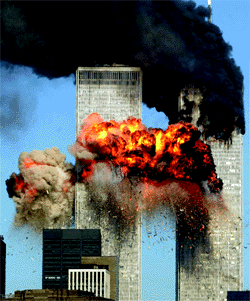 Look, gang… the patterns on this are already well-established. We know who the perps are, and they’re showing us everything they intend to do. France has already dug it’s own grave, along with, perhaps most of the EU countries.
Must the US follow them into oblivion?
Tags: BitsBlog
