Lynn Sweet, Sun-Times (Chicago) reports the BO campaign is trying some imaginative rebranding and is attempt to foist BO off as a reincaranted version of both John F. Kennedy and Ronald Reagan:
WASHINGTON–A German friend passed along the news Saturday that local sources in Berlin are confirming that the Obama campaign was in contact with city authorities to discuss the possibility of presumptive Democratic nominee Sen. Barack Obama (D-Ill.) delivering an outdoor address in front of the Brandenburg gate. The thinking is Obama would follow in the footsteps of two very famous Cold War-era speeches of U.S. presidents speaking in Germany: JFK “Ich bin ein Berliner” and Reagan “tear down this wall.” It would probably be Obama’s only public speech during upcoming visits to Germany, France and England on a swing to include stops in Israel and Jordan. There is still no date for the trip. German news sources are reporting the Obama team is working on a visit during the “second half of this month”.
Cut me a farking break. Kennedy understood that words could be used to motivate people, “Ask not what you country can do for you, but rather what you can do for your country.” It has never crossed BO’s mind to inspire anybody to do more for his country, save paying yet more in taxes.
As for the Gipper, Reagan understood both the sound and the meaning of his words. Reagan knew what his words meant. All BO is capable of grasping is that he words sound pretty when he says them. Believe me BO, we knew Reagan and you are no Gipper.
¼/p>
Tags: Barack Obama, bin ein berliner, brandenburg gate, democratic nominee, ich bin ein berliner, john f kennedy, Lynn Sweet, reagan tear down this wall, rebranding, Ronald Reagan, ronald reagan washington, sun times chicago, u s presidents, Washington
From the Detroit News, we see:
DETROIT — Federal investigators have electronic surveillance evidence that allegedly links Detroit City Council President Pro Tem Monica Conyers with receiving a payment or payments in connection with a city-approved sludge contract, two people familiar with the investigation said.
Conyers — who changed her position from speaking in opposition to the sludge contract to voting in favor of it — and at least one other council member are under FBI investigation in connection with possible bribes related to the $47 million contract with Synagro Technologies Inc. of Houston, one of the people familiar with the investigation said Friday. Bribes allegedly paid to people connected with the city but not members of the City Council also are under investigation, one person said.
I wonder if some enterprising young reporter isn’t looking at the voting record of husband John Conyers, in relation to all of this?
Tags: bribes, city council president, council member, detroit city council, detroit news, electronic surveillance, fbi, fbi investigation, federal investigators, John Conyers, monica conyers, sludge, synagro technologies inc
A few years ago, the Canadian recording group “the Poppy Family” came up with a hit in “Which Way you going, Billy?” Written by Terry Jacks, (He of “Seasons in the Sun” fame, the top40 cover of Rod McKuen’s poetry) the admittedly syrupy tune wound it’s way into the top 40 here in the ‘states in 1969. It tells the story of a girl who has just discovered that her man is about to leave her:
You are my whole, babe
My heart and my soul, babe
I’d have nothing to show, babe
If you should go
Given the almost lover status between much of the left today, and Obama a guy seemingly bent on leaving the far left to lick it’s wounds for the next four years, the lyrics seem to fit the situation rather well, for such is the reaction of the far left to Obama’s shifting his basic message.
So then, from Commentary, yesterday, comes Jennifer Rubin to put a slightly more analytical edge to things:
There was much discussion this Sunday over whether Barack Obama is shifting ground. Over at This Week, Mark Halperin, Ted Koppel and host George Stephanopoulos were not shy about pointing out the divergence between the old and new Obama. Halperin termed an effort to adopt the surge “fundamentally at odds” with his primary stance. Stephanopoulos, sounding like another observer, noted: “He basically wants it both ways. He wants that position without getting accused of changing positions. I think he’s afraid if he gets accused of changing position that will communicate some uneasiness as commander in chief. ”
Mara Liasson, no right-wing critic, had this to say on Fox News Sunday:
LIASSON: Well, that’s the big question. And what I think is so interesting is how few people seem to know which one it is.
I mean, Paul Krugman, who’s a liberal columnist, wrote this week, “Gee, is he a centrist just masquerading as someone who’s a transformational progressive figure or is he really the opposite?” You know, people just don’t know. He’s a blank slate.
Well, look, this is nothing new, for Obama. Notice what gets blown right by, here.
He’s a blank slate.
And so he is; So, the question we’ve been asking for some months, now; “What change? Which direction is he going?” The fact is, even his own supporters don’t know, and never have.
It’s all well and good to express a desire for change, assuming you don’t forget that the logical question “Which way you going, Barack?” gets asked at some point prior to the commitment cerimony. Clearly, in this case, that’s not occurred. THe left is now starting to udnerstand it'[s not hitched itself to a far left ideolouge, but instead to alliberal pol of no particular principles at all. Yes, he’s a socialist, (at least,at need) but the over-riding principle of his existance is gaining power, and every other idea, thought or motivation succumbs to that one thing. In short, he’s a Democrat.
Obama, for his part, can’t bring himself to break away from these jilted Democrats completely,. But it’s clear to me, and Rubin apparently agees, that his own belief… whatever level of that he had, that Iraq is unwinnable, has been seriously shaken. He’s been operating under a lie for several months, now, when he continued to mouth the leftist plattitudes about withdrawal in 16 months. He was forced to face his own doubts when McCain cleverly demanded he go to Iraq to see for himself. He’s started coming around before the trip is even planned, apparently understanding what he’ll find there, his earlier positions not withstanding. He’s also found himself forced to toss long held Democrat talking points under the bus as reality intrudes.
Now, I’ve been doing this political commentary thing a long time, and one pattern I’ve noticed would seem to apply here. Democrats, particularly those on the far left, will argue against a premise until they’re blue in the face. (Pardon the pun) against the obvious, until you take the facts and beat said leftist about the head and shoulders with said facts for a while. Once you get them to admit the facts, they then raise the sour grapes arguments…”Well, it really didn’t matter anyway, and here’s why”. Obama hasn’t gotten to tha stage yet. Mostly, that’s because unlike his supporters, he sees it DOES matter. He really is in a box of his own making, and it’s almost comical to watch.
However that part of it falls out, Obama clearly has lost the ability to argue this stuff on the basis of his ‘new politics’, because his politics are looking increasingly like the political combination of the worst of Jimmy Carter and the Clintons. As he adjusts his politics to the reality of IRaq, which he must now do, he’s going to find himself thought just another fool by both the right, who has known him as such all along, and the left, who is just now coming to grips with the fact that their dream canddiate is more of a nightmare.
As a result, the rebellion of the Clintonistsas is the least of his problem within the Democrat party. HIs own supporters are the larger concern, now. Which in turn is why Obama is making moves on red state voters; He can’t trust his own base. Mostly, because they no longer trust HIM, either.
Tags: blank slate, fox news sunday, george stephanopoulos, Iraq, jennifer rubin, Jimmy Carter, liberal columnist, mara liasson, Mark Halperin, Obama, Paul Krugman, poppy family, rod mckuen, seasons in the sun, ted koppel, Terry Jacks, The Clintons
Marie Colvin at The London Times, reports on troop movements and successes in Iraq. Of course nobody in the domestic press has bothered to notice, since apparently success isn’t the picture the domestic mainstream media has decided it wants to paint in this election year. Still;
In the past week, as the weapons finds slowed to a trickle and the attacks declined to just 13, Americans and Iraqis alike were elated but not complacent. A car bomb that killed 18 people and wounded 80 in Mosul 10 days ago served as a reminder that the enemy has yet to be eliminated.
Nevertheless, the speed of Al-Qaeda’s decline in Iraq – not only in the north but throughout the country – has taken many military strategists and observers by surprise.
In Zarqawi’s day, a ruthless campaign of suicide bombings, abductions and beheadings paralysed the country and thwarted US efforts to pacify it. By the end of 2006 some were predicting an American defeat.
The reversal of fortunes is attributed to the “surge” strategy of General David Petraeus, the commander of US forces, who targeted Al-Qaeda in Iraq above all else after securing an extra 30,000 troops last year.
His officers exploited local resentment of the terrorists and promised to protect those who resisted them. Under Petraeus’s plan, they established awakening councils, or groups calling themselves concerned local citizens. These Sunni groups helped to drive Al-Qaeda from many of its bastions.
US and Iraqi forces were then able to retake large swathes of the country and complete the “clearing” of cities such as Ramadi and Falluja and large areas of Baghdad. The overall number of attacks in Iraq has fallen by 80% in the past year alone.
Nouri al-Maliki, the prime minister, has gone on in recent months to reassert control over Basra in the south and Baghdad’s Sadr City, the two main strongholds of the Shi’ite Mahdi Army.
As for Mosul, the battle has been crucial to both sides and the Americans believe that it could have repercussions for Al-Qaeda beyond Iraq. “Al-Qaeda has its propaganda value from fighting the infidels and this is the central operating theatre for that battle,” said Brown. “If they are pushed out of Iraq that is a huge defeat for them.”
And so they are in fact being pushed out. Remember, dear reader, there are those who figured we had no chance of winning, and wanted us to pull out, Vietnam style. Apparently, however, we have learned the lessons of Vietnam well; “Don’t listen to the anti-war crowd. Keep going until you win.”
The reaction of the left to our victory in Iraq is mildly amusing to watch… they seem to be focused on trying to justify their months and months of calls for our withdrawal, and their saying we need to withdraw because we cant win. Now that we’ve won the thing, they seem lost in their own excuses.
Tags: abductions, al qaeda in iraq, Baghdad, Basra, beheadings, david petraeus, election year, General David Petraeus, Iraq, LONDON, london times, mainstream media, Maliki, marie colvin, military strategists, mosul, nouri al maliki, sadr city, success, successes in iraq, suicide bombings, Sunni, surge, troop movements, Vietnam, Zarqawi
I’ve been watching the deterioration of Matt Yglesias for several months now. What is bols down to is the level of excuses Yglesias, or any liberal, for that matter, is willing to make to keep himself blissfully ignorant of the consequences of his politics.
American liberals and American conservatives are both Americans so our American patriotism is very similar. We just have different ideas about politics.
Not so, Matthew. Not even close.. First off, perhaps politic itself should be defined before going forward, since you appear to toss it around like the word has no value whatever;politics, and the governments and laws resulting from politics are supposed to be reflections of our deepest values, and both the cultural and a personal level. This is why morality and law are so often linked. Indeed, I have made the point that they are inexorably linked. So, too, is religion linked. That’s because religion, is supposed to be DRIVING our deepest values.
The values generally expressed and demonstrated by the left of late are particularly UNamerican in nature. As an example, in your own words:
Specifically, I would say that liberals do a better job of recognizing that much as we may love America there’s something arbitrary about it — we’re just so happen to be Americans whereas other people are Canadians or Mexicans or French or Russian or what have you.
Utter crap. I have no kinder words for it. For all of the protests about overt nationalism the left offers up, the fact is you’re diving closer to the working definition of nationalism here than anyone on the right that I’ve ever heard speak on the subject. Anyone who can mouth that nonsense clearly hasn’t a clue what patriotism is all about. It’s the kind of non-thought that leads one into the eventual illusion that government largess is ‘charity’ for example.
Leftists particularly find troublesome in their worldview the concept that American exceptionalism is valid… and Americans are unique both currently and historically, being the first to recognize the rights of the individual to the degree that we have. In that recognition, we were also the first to remove ourselves from the yoke of hereditary government, and government which does not represent us, to the situation of government by the governed. To the degree to which we have managed to keep the left (As in, people like Yglesias) out of governmental roles, is the exact degree to which we’ve managed to maintain that government of the people, by the people and for the people.
Your comparison to other countries falls on it’s face because you fail to reckon with those factors.
And, Matt? If you cannot grasp the implications of all of this, you’re about what I figured you to be.
Tags: America, american conservatives, american exceptionalism, american liberals, american patriotism, canadians, consequences, definition of nationalism, deterioration, kinder words, leftists, matt yglesias, mexicans, morality and law, nonsense, personal level, protests, worldview
The Ottawa Citizen reports that former Ambassador Joe Wilson lied:
A Canadian company has purchased more than 500 tonnes of yellowcake uranium, once controlled by the late Iraqi dictator Saddam Hussein.
The Saskatoon-based Cameco Corp., negotiated the purchase from the Iraqi government over the last few months, according to a report from The Associated Press. The government inherited the uranium from Saddam’s now-defunct nuclear program
This is the same yellowcake Wilson swore that Saddam Hussien was not attempting to obtain and the same yellowcake which Wison swore the President lied about in his State of the Union. So when is Henry Waxman going to investigate the liar Joe Wilson?
?
Tags: Ambassador Joe Wilson, Henry Waxman, Saddam, Saddam Hussein, Saddam Hussien
Decided to upload the fireworks from last night. These are taken from Henrietta NY, from about a half a mile away.
[wp_youtube]-7HMVZQZEMg[/wp_youtube]
Tags: fireworks, henrietta ny
I note this morning Megan McArdle:
Now the gun controllers pour out of the woodwork to claim that you’re more likely to kill yourself or a family member with a gun than a criminal.
Some of the people deploying this statistic really ought to know better. Composition fallacy, anyone?
These are not double blind experiments. Guns may be the weapon of choice for all sorts of crimes; that does not mean that they cause the crimes.
Men like to kill themselves with guns. (This is not culture-specific; women tend to choose poison everywhere, presumably because of some deep fear of disfigurement). Gun suicides tend to be successful. But this does not mean that if you took away the guns, people wouldn’t commit suicide.
True, and in much the same way as we see in places where guns are banned outright… (OK, but you get the idea)… the tool of choice tends to be knives or other implements of destruction, which are just as deadly.
I suppose however that it should surprise nobody that these old tired arguments get dragged out once again.
The issue of course at the center of all of this, and it’s one that liberals will seldom mention, is the point that people are ultimatelyy responsible for their actions as opposed to their environment or objects that happened to surround them. As an example, have you ever noticed how often the SUV gets blamed for a traffic accident? A true except that guns are not the central issue, and the people are responsible for their own actions, is to rip the foundation of the liberal believes surrounding their wealth redistribution and social engineering.
All of it comes out at this, however; the murder rate in DC is going to drop over the next couple of years, and the left is not going to have any reasonable explanation for it, other than the fact that people are allowed to have firearms to protect themselves and their property. The resulting nonsensical argument that they will doubtless employ at that point will be amusing if unavailing.
In the end what’s going on here is they’re running out of arguments. Trouble is, they haven’t run out of anti-gun zeal, yet. Liberals, after all, are generally speaking unaffected by mere fact.
Tags: crimes, firearms, gun controllers, gun suicides, guns, implements of destruction, knives, liberals, megan, Megan McArdle, murder rate, social engineering, SUV, wealth redistribution, weapon of choice
Senator John Warner, Rep – VA, is suggesting a national speed limit of fifty-five:
WASHINGTON (AP) — An influential Republican senator suggested Thursday that Congress might want to consider reimposing a national speed limit to save gasoline and possibly ease fuel prices.
Sen. John Warner, R-Virginia, asked Energy Secretary Samuel Bodman to look into what speed limit would provide optimum gasoline efficiency given current technology. He said he wants to know if the administration might support efforts in Congress to require a lower speed limit.
Senator Warner, if you think we taxpayers and drivers are using too much gasoline, I suggest you get out and walk. Until such time as you are leading by example, walking, bicycling, or using public transportion, it is simply none of your bloody business how fast, or where I drive. Get to the business of solving our nation energy problem, which is largely a result the failure of Congress of allow for domestic energy production. You need to solving our problems, not aggrevating them. I will not slow down just to allow you to fly around at my expense.
?
Tags: Secretary Samuel Bodman, Sen. John Warner, Senator John Warner, Senator Warner, Virginia, Warner, Washington
The Guardian has a story up saying:
Biofuels have forced global food prices up by 75% – far more than previously estimated – according to a confidential World Bank report obtained by the Guardian.
The damning unpublished assessment is based on the most detailed analysis of the crisis so far, carried out by an internationally-respected economist at global financial body.
The figure emphatically contradicts the US government’s claims that plant-derived fuels contribute less than 3% to food-price rises. It will add to pressure on governments in Washington and across Europe, which have turned to plant-derived fuels to reduce emissions of greenhouse gases and reduce their dependence on imported oil.
OK, let’s do this right, this time. Premise; The way to reduce our intake of forign oil is to drill domestically. Note that at no time did I mention anything about turning food into gasoline.
Any questions, class?
Tags: analysis, biofuel, biofuels, dependence, food crisis, food price, food prices, global food, greenhouse gases, guardian, us government, world bank, world bank report
From Rush H. Limbaugh, Jr. (Father of notable EIB radio host, Rush.)
“…our lives, our fortunes, our sacred honor…”
It was a glorious morning. The sun was shining and the wind was from the southeast. Up especially early, a tall, bony, redheaded young Virginian found time to buy a new thermometer, for which he paid three pounds, fifteen shillings. He also bought gloves for Martha, his wife, who was ill at home.Thomas Jefferson arrived early at the statehouse. The temperature was 72.5: and the horseflies weren’t nearly so bad at that hour. It was a lovely room, very large, with gleaming white walls. The chairs were comfortable. Facing the single door were two brass fireplaces, but they would not be used today.The moment the door was shut, and it was always kept locked, the room became an oven. The tall windows were shut, so that loud quarreling voices could not be heard by passersby. Small openings atop the windows allowed a slight stir of air, and also a large number of horseflies. Jefferson records that “the horseflies were dexterous in finding necks, and the silk of stocking was as nothing to them.” All discussion was punctuated by the slap of hands on necks.
 On the wall at the back, facing the President’s desk, was a panoply–consisting of a drum, swords, and banners seized from Fort Ticonderoga the previous year. Ethan Allen and Benedict Arnold had captured the place, shouting that they were taking it “in the name of the Great Jehovah and the Continental Congress!”
Now Congress got to work, promptly taking up an emergency measure about which there was discussion but no dissension. “Resolved: That an application be made to the Committee of Safety of Pennsylvania for a supply of flints for the troops at New York.”
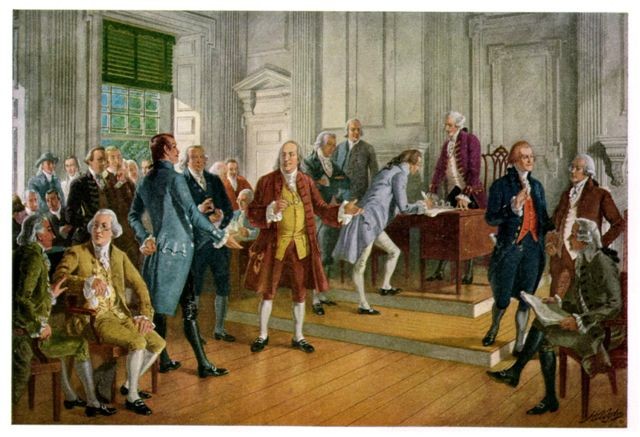
Then Congress transformed itself into a committee of the whole, The Declaration of Independence was read aloud once more, and debate resumed. Though Jefferson was the best writer of all of them, he had been somewhat verbose. Congress hacked the excess away. They did a good job, as a side-by-side comparison of the rough draft and the final text shows. They cut the phrase “by a self-assumed power.” “Climb” was replaced by “must read,” then “must” was eliminated, then the whole sentence, and soon the whole paragraph was cut. Jefferson groaned as they continued what he later called “their depredations.” “Inherent and inalienable rights” came out “certain unalienable rights,” and to this day no one knows who suggested the elegant change.
A total of 86 alterations were made. Almost 500 words were eliminated, leaving 1,337. At last, after three days of wrangling, the document was put to a vote.
Here in this hall Patrick Henry had once thundered: “I am no longer a Virginian, Sir, but an American.” But today the loud, sometimes bitter argument stilled, and without fanfare the vote was taken from north to south by colonies, as was the custom. On July 4, 1776, the Declaration of Independence was adopted.
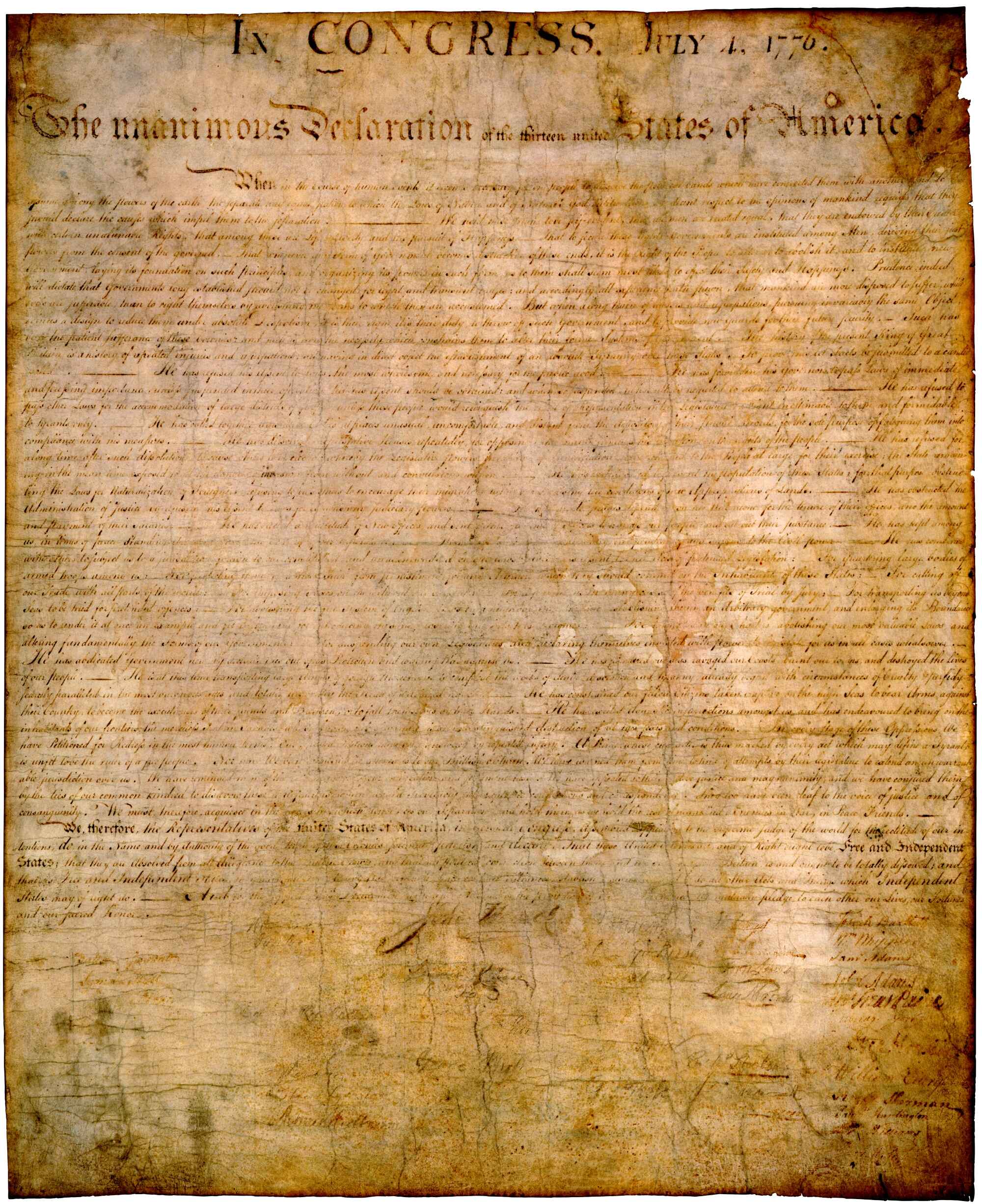 There were no trumpets blown. No one stood on his chair and cheered. The afternoon was waning and Congress had no thought of delaying the full calendar of routine business on its hands. For several hours they worked on many other problems before adjourning for the day.
Much to Lose
What kind of men were the 56 signers who adopted the Declaration of Independence and who, by their signing, committed an act of treason against the Crown? To each of you the names Franklin, Adams, Hancock, and Jefferson are almost as familiar as household words. Most of us, however, know nothing of the other signers. Who were they? What happened to them?
I imagine that many of you are somewhat surprised at the names not there: George Washington, Alexander Hamilton, Patrick Henry. All were elsewhere.
Ben Franklin was the only really old man. Eighteen were under 40; three were in their 20s. Of the 56, almost half–24–were judges and lawyers. Eleven were merchants, 9 were land-owners and farmers, and the remaining 12 were doctors, ministers, and politicians.
With only a few exceptions, such as Samuel Adams of Massachusetts, these were men of substantial property. All but two had families. The vast majority were men of education and standing in their communities. They had economic security as few men had in the 18th century.
Each had more to lose from revolution than he had to gain by it. John Hancock, one of the richest men in America, already had a price of 500 pounds on his head. He signed in enormous letter so “that his Majesty could now read his name without glasses and could now double the reward.” Ben Franklin wryly noted: “Indeed we must all hang together, otherwise we shall most assuredly hang separately.” Fat Benjamin Harrison of Virginia told tiny Elbridge Gerry of Massachusetts: “With me it will all be over in a minute, but you, you will be dancing on air an hour after I am gone.”
These men knew what they risked. The penalty for treason was death by hanging. And remember: a great British fleet was already at anchor in New York Harbor.
They were sober men. There were no dreamy-eyed intellectuals or draft card burners here. They were far from hot-eyed fanatics, yammering for an explosion. They simply asked for the status quo. It was change they resisted. It was equality with the mother country they desired. It was taxation with representation they sought. They were all conservatives, yet they rebelled.
It was principle, not property, that had brought these men to Philadelphia. Two of them became presidents of the United States. Seven of them became state governors. One died in office as vice president of the United States. Several would go on to be U.S. Senators. One, the richest man in America, in 1828 founded the Baltimore and Ohio Railroad. One, a delegate from Philadelphia, was the only real poet, musician and philosopher of the signers (it was he, Francis Hopkinson–not Betsy Ross–who designed the United States flag).
Richard Henry Lee, a delegate from Virginia, had introduced the resolution to adopt the Declaration of Independence in June of 1776. He was prophetic is his concluding remarks:
“Why then sir, why do we longer delay? Why still deliberate? Let this happy day give birth to an American Republic. Let her arise not to devastate and to conquer but to reestablish the reign of peace and law. The eyes of Europe are fixed upon us. She demands of us a living example of freedom that may exhibit a contrast in the felicity of the citizen to the ever increasing tyranny which desolates her polluted shores. She invites us to prepare an asylum where the unhappy may find solace, and the persecuted repose. If we are not this day wanting in our duty, the names of the American legislators of 1776 will be placed by posterity at the side of all of those whose memory has been and ever will be dear to virtuous men and good citizens.”
Though the resolution was formally adopted July 4, it was not until July 8 that two of the states authorized their delegates to sign, and it was not until August 2 that the signers met at Philadelphia to actually put their names to the Declaration.
William Ellery, delegate from Rhode Island, was curious to see the signers’ faces as they committed this supreme act of personal courage. He saw some men sign quickly, “but in no face was he able to discern real fear.” Stephen Hopkins, Ellery’s colleague from Rhode Island, was a man past 60. As he signed with a shaking pen, he declared: “My hand trembles, but my heart does not.”
“Most Glorious Service”
 Even before the list was published, the British marked down every member of Congress suspected of having put his name to treason. All of them became the objects of vicious manhunts. Some were taken. Some, like Jefferson, had narrow escapes. All who had property or families near British strongholds suffered.
Francis Lewis, New York delegate, saw his home plundered and his estates, in what is now Harlem, completely destroyed by British soldiers. Mrs. Lewis was captured and treated with great brutality. Though she was later exchanged for two British prisoners through the efforts of Congress, she died from the effects of her abuse.
William Floyd, another New York delegate, was able to escape with his wife and children across Long Island Sound to Connecticut, where they lived as refugees without income for seven years. When they came home, they found a devastated ruin.
Phillips Livingstone had all his great holdings in New York confiscated and his family driven out of their home. Livingstone died in 1778 still working in Congress for the cause.
Louis Morris, the fourth New York delegate, saw all his timber, crops, and livestock taken. For seven years he was barred from his home and family.
John Hart of Trenton, New Jersey, risked his life to return home to see his dying wife. Hessian soldiers rode after him, and he escaped in the woods. While his wife lay on her deathbed, the soldiers ruined his farm and wrecked his Homestead. Hart, 65, slept in caves and woods as he was hunted across the countryside. When at long last, emaciated by hardship, he was able to sneak home, he found his wife had already been buried, and his 13 children taken away. He never saw them again. He died a broken man in 1779, without ever finding his family.
Dr. John Witherspoon, signer, was president of the College of New Jersey, later called Princeton. The British occupied the town of Princeton, and billeted troops in the college. They trampled and burned the finest college library in the country.
Judge Richard Stockton, another New Jersey delegate signer, had rushed back to his estate in an effort to evacuate his wife and children. The family found refuge with friends, but a sympathizer betrayed them. Judge Stockton was pulled from bed in the night and brutally beaten by the arresting soldiers. Thrown into a common jail, he was deliberately starved. Congress finally arranged for Stockton’s parole, but his health was ruined. The judge was released as an invalid, when he could no longer harm the British cause. He returned home to find his estate looted and did not live to see the triumph of the revolution. His family was forced to live off charity.
Robert Morris, merchant prince of Philadelphia, delegate and signer, met Washington’s appeals and pleas for money year after year. He made and raised arms and provisions which made it possible for Washington to cross the Delaware at Trenton. In the process he lost 150 ships at sea, bleeding his own fortune and credit almost dry.
George Clymer, Pennsylvania signer, escaped with his family from their home, but their property was completely destroyed by the British in the Germantown and Brandywine campaigns.
Dr. Benjamin Rush, also from Pennsylvania, was forced to flee to Maryland. As a heroic surgeon with the army, Rush had several narrow escapes.
John Morton, a Tory in his views previous to the debate, lived in a strongly loyalist area of Pennsylvania. When he came out for independence, most of his neighbors and even some of his relatives ostracized him. He was a sensitive and troubled man, and many believed this action killed him. When he died in 1777, his last words to his tormentors were: “Tell them that they will live to see the hour when they shall acknowledge it [the signing] to have been the most glorious service that I rendered to my country.”
William Ellery, Rhode Island delegate, saw his property and home burned to the ground.
Thomas Lynch, Jr., South Carolina delegate, had his health broken from privation and exposures while serving as a company commander in the military. His doctors ordered him to seek a cure in the West Indies and on the voyage He and his young bride were drowned at sea.
Edward Rutledge, Arthur Middleton, and Thomas Heyward, Jr., the other three South Carolina signers, were taken by the British in the siege of Charleston. They were carried as prisoners of war to St. Augustine, Florida, where they were singled out for indignities. They were exchanged at the end of the war, the British in the meantime having completely devastated their large land holdings and estates.
Thomas Nelson, signer of Virginia, was at the front in command of the Virginia military forces. With British General Charles Cornwallis in Yorktown, fire from 70 heavy American guns began to destroy Yorktown piece by piece. Lord Cornwallis and his staff moved their headquarters into Nelson’s palatial home. While American cannonballs were making a shambles of the town, the house of Governor Nelson remained untouched. Nelson turned in rage to the American gunners and asked, “Why do you spare my home?” They replied, “Sir, out of respect to you.” Nelson cried, “Give me the cannon!” and fired on his magnificent home himself, smashing it to bits. But Nelson’s sacrifice was not quite over. He had raised $2 million for the Revolutionary cause by pledging his own estates. When the loans came due, a newer peacetime Congress refused to honor them, and Nelson’s property was forfeited. He was never reimbursed. He died, impoverished, a few years later at the age of 50.
Lives, Fortunes, Honor
Of those 56 who signed the Declaration of Independence, nine died of wounds or hardships during the war. Five were captured and imprisoned, in each case with brutal treatment. Several lost wives, sons or entire families. One lost his 13 children. Two wives were brutally treated. All were at one time or another the victims of manhunts and driven from their homes. Twelve signers had their homes completely burned. Seventeen lost everything they owned. Yet not one defected or went back on his pledged word. Their honor, and the nation they sacrificed so much to create, is still intact.
And, finally, there is the New Jersey signer, Abraham Clark. He gave two sons to the officer corps in the Revolutionary Army. They were captured and sent to the infamous British prison hulk afloat in New York harbor known as the hell ship “Jersey,” where 11,000 American captives were to die. The younger Clarks were treated with a special brutality because of their father. One was put in solitary and given no food. With the end almost in sight, with the war almost won, no one could have blamed Abraham Clark for acceding to the British request when they offered him his sons’ lives if he would recant and come out for the King and parliament. The utter despair in this man’s heart, the anguish in his very soul, must reach out to each one of us down through 200 years with his answer: “No.”
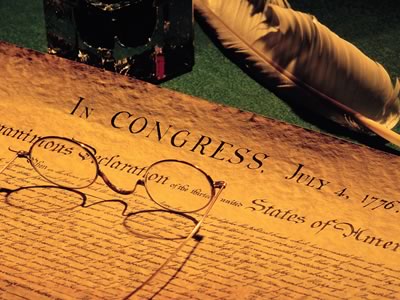 The 56 signers of the Declaration of Independence proved by their every deed that they made no idle boast when they composed the most magnificent curtain line in history. “And for the support of this Declaration with a firm reliance on the protection of divine providence, we mutually pledge to each other our lives, our fortunes and our sacred honor.”
The Federalist® All rights reserved.
The Federalist is a Town Hall Citizen Organization & copy;Publius Press, Inc.
Tags: America, American Republic, Baltimore, Ben Franklin, benedict arnold, Benjamin Harrison, Betsy Ross--who, BitsBlog, Connecticut, continental congress, Dr. John Witherspoon, emergency measure, ethan allen, Europe, fort ticonderoga, great jehovah, John Hart, Judge Richard Stockton, Judge Stockton, Livingstone, Long Island, Massachusetts, Mrs. Lewis, New Jersey, new york, New York Harbor, Ohio, Philadelphia, Princeton, Rhode Island, Richard Henry Lee, Robert Morris, rush h limbaugh, Stephen Hopkins, United States, Virginia, Washington, white walls, William Ellery, William Floyd
Former Senator Jesse Helms has died of natural cause at age eighty-six, MSNBC:
RALEIGH, North Carolina – Former Republican Sen. Jesse Helms, a leading conservative from North Carolina who served 30 years in the Senate before retiring in 2003, has died, the Jesse Helms Center said Friday. He was 86.
Senator Helms was a strong conservative voice in Washington for thirty years, a friend of the taxpayers and a thorn in the side of the politically correct. Rest in peace.
Tags: North Carolina, RALEIGH, Sen. Jesse Helms, Senator Helms, Senator Jesse Helms, Washington
On our recent trip to Western Ohio, we noted something on the NY-PA border that doesn’t put NY in the best of light. Consider, here.
Travel I-90 westbound. into PA, and you get hit with a freshly redone highway, and a brand new rest area, complete with super-clean restrooms, lots of tourist info, picnic areas, a dog walk, and a rather nice view of the nearby vineyard, all before you’re out of the shadow of the border.
 Upon returning to NY, at the same border traveling I-90 eastbound, you’re greeted by signs advertising adult book stores, and a toll booth, and a sign suggesting the nearest rest stop is another 40 minutes away.
Oh… and they do have this sign.
And you know, I’ll bet they wonder why NY state is losing tourism dollars.
Tags: adult book stores, nice view, pa border, picnic areas, redone, rest area, rest stop, roadway, signs, toll booth
How stupid do you have to be to write for AFP. The wire service is running a story titled, ” Pregnant man’ gives birth to girl: reports:”
A US man who was born a woman before undergoing gender realignment surgery has given birth to a baby girl, US media reported Thursday.
Thomas Beatie, who is legally male but decided to keep his female sex organs during chest reconstruction surgery and testosterone therapy, attracted worldwide attention in April after revealing his pregnancy.
News flash, born a woman, die a woman. Sex is immutable. Evidently intelligence is quite mutable. Does AFP hire writers this stupid or is it on the job brain damage?
?
Tags: birth, Thomas Beatie, U.S.
- McQ notes that Wind power isn’t the Panacea that the left likes to make it out to be. He also make the rather obvious observation that there’s no real Democrat plan for our energy needs. Good that someone’s noticing.
- Iraq has signed a $5BUSD contract with Boeing for commercial airliners. Hmmm. Looks like the idea of the supposed ‘war for oil” is going further down the tubes.
- Did you note this car lease of $1300 per month… at Government expense, currently held by Rep Laura Richardson? She’s got a foreclosure going, too, that’s been in the news of late. But note that very few of the news stories surrounding this woman’s financial nonsense, ever mention she’s a Democrat./ Maybe they’re sheilding Democrats in the press, or perhaps with corruption of this scale, it goes without saying.
- I rather expect this kind of sludge from Joe Klein and Time Magazine… It’s also uncomfortably close to Obama rattling on about how we should change our energy use to what the UN thinks is OK. But don’t say they’re biased, oh, no.
- No, American left; America’s days are NOT numbered.
- We’ve written about Rbt Mugabe in the past here. Interesting that the left in the west is starting to understand that their usual blather about this slime was dead wrong. Not that they’d ever SAY that, per se’. But there’s a change in attitude. Now if they’d adopted this attitude years ago, a lot of lives could have been saved.
- Interesting artcle emailed me by a erader, written by Marty Feldstien. We can lower oil prices now, says he.
- Speaking of energy, I got a note in the mail over the last few days from Andrew Peters from “The Wilderness Society” over ANWR. Of course he provides all the usual excuses about why we shouldn’t be drilling there. I told him:
Extremist Environmentalists such as your group bear direct responsibility for crippling America. Fortunate we are that the American people are starting to catch on to the damage you’ve caused. Hopefully, they’ve not caught on too late.
I suppose I won’t be hearing from him again.
- Got a note as well, from the Reagan Foundation. Always nice to hear from them.
- It’s the 4th tomorrow. of course. I’ll have soemthing for then posted.
Tags: andrew peters, ANWR, blather, car lease, commercial airliners, Energy, energy use, environmentalists, foreclosure, government expense, joe klein, laura richardson, left in the west, mail, Marty Feldstien, McQ, mugabe, Nightly Ramble, Obama, oil prices, panacea, rbt, Reagan, slime, time magazine, wilderness society, wind power
