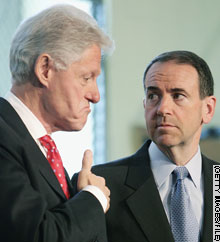
 Maybe it is something in the Arkansas water? Mike Huckabee wants a free pass on the examination of his liberal record. If you criticize the Huckster’s record, he calls it dirty politics. Now the other dope from Hope, B.J. Clinton is trying to get a free pass on his chronc lying.
Howard Wolfson as quoted by Greg Sargent, TPM:
This is getting interesting. In an interview with me a couple of minutes ago, senior Hillary adviser Howard Wolfson claimed that Obama’s assertion this morning that Bill Clinton is fibbing about his campaign is a “right wing talking point.”
Wolfson was responding to my questions about Obama’s Good Morning America appearance this morning, in which Obama claimed that Bill has been dissembling badly about Obama campaign tactics. Obama also charged that Bill has been dissembling regularly about the Illinois Senator’s consistent opposition to the Iraq war and about Obama’s claim that the GOP has been the “party of ideas.”
Look who is not buying it, Matthew Yglesias, Atlantic:
This is pretty neat. According to Howard Wolfson, pointing out that Bill Clinton is lying is a “right-wing talking point” and thus all good liberals have a duty to grant Clinton a blanket license to fib. So when Clinton said he opposed the Iraq War, that must have been true, because I’m a liberal. And when Clinton said Barack Obama didn’t oppose the Iraq War, that must have been true too, because I’m a liberal.
As Wolfson’s argument goes, anytime anyone points out anything that the former president said that isn’t true, they’re necessarily using “right-wing talking points.” But that’s silly – by this logic, Bill Clinton could make up outrageous charges against Obama, and Obama couldn’t respond at all without sounding like a Republican hack. It sounds like an effort to silence critics, regardless of merit.
Most of the time, I really enjoy watching an exciting primary fight between three great candidates. But once in a while, I really understand why most Americans find politics frustrating.
The Clintons will not tell the truth, and it looks like even left isn’t going take it any longer.
Tags: Arkansas, B.J. Clinton, Barack Obama, Bill Clinton, BitsBlog, BO, Campaign, campaigns, Clinton, election, Elections, fight, hope, Huckabee, Iraq, Iraq War, Liberal, liberals, Men, Mike Huckabee, Mr. and Mrs. Clinton, NY, Obama, politics, primary, Republican, The Clintons, The GOP, truth, UN
Confederate Yankee has been working for some time on the Scott Beauchamp thing. Yes, still. And he’s managed to obtain through that, the original statements of the soldiers who were questions by the Army over Beauchamp’s claims.
Technorati Tags: Beauchamp, shock troops, new republic
Memeorandum has more.
If there were ever a bigger and more fanciful case of wishful thinking than Krugman’s New York Times article, today, I’ve never seen it. He’s going well over and above his usual fantasy mongering, here:
Maybe Mr. Obama was, as his supporters insist, simply praising Reagan’s political skills. (I think he was trying to curry favor with a conservative editorial board, which did in fact endorse him.) But where in his remarks was the clear declaration that Reaganomics failed?
For it did fail. The Reagan economy was a one-hit wonder. Yes, there was a boom in the mid-1980s, as the economy recovered from a severe recession. But while the rich got much richer, there was little sustained economic improvement for most Americans. By the late 1980s, middle-class incomes were barely higher than they had been a decade before – and the poverty rate had actually risen.
When the inevitable recession arrived, people felt betrayed – a sense of betrayal that Mr. Clinton was able to ride into the White House.
Oh, please.
Krugman’s relationship with the facts can only be described as having it’s roots in an alternate universe. First of all, you will recall I said over the weekend that most American voters wanted another Reagan. Clearly, Kurgman senses this, too, and sees what a threat it is to liberalism. So how does he react? By downplaying Reagan and his positive impact on the country, both in terms of economics, but everything else. In his desperation to downplay Reagan, however, he is as usual lacking fact.Consider that Krugman holds Jimmy Carter in high esteem and let’s let it pass at that.
But there’s more of course. More, in the form of actual economic facts… ones that Krugman won’t tell you.
Let’s break these out one at a time:
Yes, there was a boom in the mid-1980s, as the economy recovered from a severe recession. But while the rich got much richer, there was little sustained economic improvement for most Americans.
We turn to Lawrence B Lindsey
We often hear that “under Ronald Reagan the rich got richer and the poor got poorer,” and that the 1981 tax cuts were a big windfall for the rich and only for the rich. it would seem to be common knowledge. But what everyone knows isn’t always true, and in this bit of common knowledge there is no more than a tiny kernel of truth.During the early part of Reagan’s first term, the rich did get richer while most of the rest of the country stayed even. Some lost ground. The causes were not the tax cuts but record high interest rates and the back-to-back recessions of 1980-82. When interest rates go up, lenders get richer and borrowers get poorer. Since the lenders tend to have more money than the borrowers in the first place, high interest rates do make the rich richer. Recessions reinforce this process because recessions are costliest to middle-and working-class people who lose their jobs, while the rich rarely become unemployed.
Common knowledge stumbles at this point because rising interest rates and higher unemployment began well before Reagan became president. For example, a common bit of evidence used by Reagan critics is that the poverty rate rose after the tax cuts. Actually, the poverty rate bottomed out at 11.4 percent in 1978. It hit 13 percent in 1980 and 14 percent in 1981, the year Reagan took office but before his economic program was in place. The poverty rate peaked at 15.2 percent in 1983, by which time the tax cut was still only three-quarters in place. In short, two-thirds of the rise in the poverty rate occurred before Reagan’s tax and budget policies could take hold, and all the rise occurred before ERTA [the Economic Recovery Tax Act of 1981] was fully in place. By 1985 the poverty rate was back down to the level it was at when Reagan took office. It dropped even further during his last three years in office. Thus, though the poverty rate rose in three of [Jimmy] Carter’s four years as president, it fell in six of Reagan’s eight years.
Consider the “rich got richer” critique.
When interest income rises as a share of national income the rich get richer. This is because the rich derive more of their income from investments than most people. Interest income did increase its share of national income during Reagan’s first term. Again, however, the trend had started under Carter. In 1976, the year before Jimmy Carter took office, interest income was 9.2 percent of personal income. By 1981, when Ronald Reagan entered the White House, it was up to 13.3 percent. The interest share of personal income peaked in 1985 at 14.4 percent of income. Thus three-quarters of this windfall to the rich occurred before Reagan took office. Like the poverty rate, interest income as a share of personal income fell in the latter half of the Reagan presidency.
Who got richer under Reagan? Taking into consideration data from both Reagan terms, the answer is that, on average everyone did. The real income of the median family rose over $3,000 under Reagan, after falling that same amount between 1973 and 1981 (the largest such retreat since the Great Depression). Continuing the trend of the late 1970s, families above the median did best early in the administration, with everyone else catching up later as the economic recovery continued apace. This situation had more to do with macroeconomic trends than with the direct effect of the tax cuts however.
The phrase “tax cuts for the rich” has become a staple of the rhetoric of anti-Reagan politicians. Even the most cursory look at the evidence, however, shows ERTA raised the share of the tax burden borne by the rich. The top 0.1 percent of all taxpayers (roughly speaking those making over $200,000 a year) saw their share of income tax payments rise from 7 percent in 1981 to 14 percent in 1986.
The share of taxes borne by the top 2 percent of taxpayers (roughly those making over $60,000) rose from 26 percent in 1981 to 34 percent in 1986. Taxpayers on the bottom half of the income scale saw their share of tax payments fall from 7 percent at the start of the decade to only 6 percent by 1986. The great American middle class, people earning between $20,000 and $60,000 in the early 1980s saw their tax share fall from 67 percent to 60 percent between 1981 and 1986. They received the bulk of the Reagan tax cuts. If the rich ended up paying a bigger share of taxes, everyone else must have taken a bigger cut than the rich.
We’ll reinforce this, with a little of the talkmeister himself, Rush Limbaugh, from his book “See, I told you so”:
* Average real family income grew by well over 15 percent from 1982 to 1989, according to the U.S. Bureau of the Census.
* For the poorest fifth of Americans, real income grew almost 12 percent.
* Families earning more than $50,000 (in 1990 dollars) went from less than 25 percent of families in 1980 to 31 percent in 1990.
* The percentage of families earning less than $15,000 dropped.
* According to the U.S. Treasury’s Office of Tax Analysis, of those who were in the bottom-fifth income brackets during the 1980s. In fact, more made it all the way to the top than stayed in the poorest group.
* Taxpayers were five times more likely to increase their income than have it fall.
* Federal Reserve data show that families with incomes between $10,000 and $50,000 a year experienced a higher percentage of growth in net worth than those in the top-one-fifth income group.
* The top 1 percent paid more than 25 percent of all federal income taxes in 1990, a 40 percent increase over 1980, accordingly to the Congressional Budget Office. The bottom 60 percent paid 11 percent of federal taxes in 1990—20 percent less than in 1980. (“Don’t do a double take here. You hear me correctly. The rich did pay their fair share in the eighties, and Clinton knows it. More on this in a moment.)
* The black middle class grew rapidly, from 2.6 million households with incomes of $25,000 or more in 1979, to 3.9 million in 1989.
* Between 1983 and 1989, the total population under the poverty line decreased by 3.8 million people, with an unprecedented number of poor entering the work force.
* The proverbial misery index took a nosedive: We experienced sustained economic growth without inflation, low unemployment, and low interest rates. Also, some 20 million new jobs were created, 82 percent of which were in the higher-skilled, higher-paying occupations.
* The poor were not neglected: Federal spending on the poor for income, food, health care, housing, education, training, and social services increased.
* Between 1978 and 1982 the number of poor blacks rose by more than 2 million; between 1982 and 1989 the number of poor blacks fell by 400,000.
* The 1980s was a decade of greatly increased personal and corporate charitable giving.
* Despite the change that the rich got richer, the poor got poorer, and the middle class was almost decimated during the 1980s, all income groups from the poorest to the richest experienced real income gains. Yet during the Carter years-when liberalism was flourishing-only the income of the top 1 percent grew. The share of income gains going to the top 1 percent of families was 160 percent higher under Carter than under Reagan.Between 1982 and 1989, real after-tax income per person rose by 15.5 percent, and real median income of families, before taxes, went up 12.5 percent. * Despite the charge that “the rich got richer and pay less tax, the poor got poorer and pay more,” between 1980 and 1992 the wealth not only paid more income taxes in actual dollars, but they paid a greater share of income taxes as a percentage of their income, compared to other income groups. The income taxes as a percentage of their income of all income groups was reduced, with reach of the four lowest quintile groups experiencing greater percentage reductions than those income groups above them. In other words, all income groups paid less taxes as a percentage of their income during the Reagan years, but the poor received the most relief, the middle class the next, and the right, the least. Further the rich paid a greater share of all taxes paid in the 1980s than in the Carter years.
But Rush, you may ask, isn’t it a fact that Reagan cut poverty programs? Didn’t he destroy the social “safety net”?
No. That’s absolutely false. Federal spending on poverty programs in 1991 dollars increased from $140 billion in 1982 to $180 billion in 1991, an annual growth rate of 3 percent. In other words, the welfare state grew under Reagan-and the liberals are still complaining!
But, you may say, l this is all well and good, but during those years the federal deficit skyrocketed. That, my friends, is undeniable; in fact, the deficit did rise to $230 billion in 1985-86; but it was not because of the tax cuts. It was because of unchecked growth in entitlement spending. And don’t blame that on Reagan, either. He tried his best to reduce spending, but every one of his budgets was problem pronounced “dead on arrival” by the Democratic Congress. Plus, if you look at 1987, 1988, and 1989, when the real economic growth reached full steam, the deficit fell to $150 billion, even with the unchecked spending. It fell because of economic growth that crated a bigger base of taxpayers and, therefore, more tax revenue. If Congress had made any strides toward curbing skyrocketing spending during this period, there would have been no deficit by the end of the Reagan presidency.
In the interest of illuminating the present discussion about deficit reduction, it should be pointed out that even President Reagan begrudgingly agreed to sign on to a couple of “deficit reduction” tax increases, one of which was, at the time, the largest tax increase in the nation’s history, which included $2 of spending cuts for every $1 in increased tax revenue. But guess what? In a foreshadowing of its double-cross of George Bush in 1990, the Congress failed to make the budget cuts it had pledged. We are still waiting for them. And you think the promised cuts of 1993 are going to happen? Heh, heh, heh! So I don’t mind telling you that I’m growing weary-in fact, angry-at the duplicitous assertion that the tax cuts caused the deficit to increase. News commentator Sam Donaldson must say it very other week on “This Week with David Brinkley.” Syndicated newspaper columnist George Will is even tired of arguing with him about it. In fact, during the Reagan tax-cut era, IRS collections actually nearly doubled. When Ronald Reagan took office in 1981, the top marginal tax rate was at 70 percent. When he left office in 1989, the top marginal rate was down to 28 percent. Liberal logic (an oxymoron if ever there was one) would thus suggest that the government would collect less money in taxes because the rates have been cut. Right? Wrong. Actual revenues nearly doubled, from $550 billion to about $991 billion. How did that happen? If the liberals would stop ridiculing so-called “trickle-down” economics for a while and take an honest look at reality, they would understand.
It seems clear Krugman isn’t much of an economist and less of a historian. But he does make a nice liberal political hack, doesn’t he?
More, Memeorandum
Tags: Ayers, BO, Bush, Carter, change, Clinton, Congress, Democrat, Economics, economy, Education, food, health care, Income, Jimmy Carter, krugman, Leftist, leftist hack, Liberal, liberals, Men, Money, moron, myths about the 80's, new york, New York Times, NFL, NY, Obama, Reagan, rich, Rich got Richer, Ronald Reagan, Rove, Rush Limbaugh, tax cuts, taxes, truth, UN, unemployment, welfare, welfare state, White House
 One thing me and Bit have not hestitated to do is to call the Clintons, B.J. and Mrs., liars. Well it now appears that Barack Obama is about to rip a page out the Bitsblog play book, Carrie Budoff Brown, Politico:
“[B.J. Clinton] continues to make statements that are not supported by thefacts – whether it’s about my record of opposition to the war in Iraq or our approach to organizing in Las Vegas. This has become a habit, and one of the things that we’re gonna have to do is to directly confront Bill Clinton when he’s making statements that are not factually accurate.”
Do you think the Obama campaign should list us as consultatents?
Hat Tip: Memeorandum.
Tags: B.J. Clinton, B.J. Clnton, Barack Obama, Bill Clinton, BitsBlog, BO, Campaign, Clinton, election, Iraq, Men, Obama, The Clintons
I mean, not like this stuff wasn’t expected. I’ve been talking about this kind of thing for years. But it does give us an idea of the kind of nonsense we’re in for: From the London Times:
AMERICA’S favourite television presenter is paying a painful price for her intervention in the US presidential campaign last month. Oprah Winfrey has been dubbed a “traitor” by some of her female fans for supporting Barack Obama instead of Hillary Clinton.
Winfrey’s website, Oprah.com, has been flooded with a barrage of abuse since the queen of daytime chat shows joined Obama on a tour of Iowa, New Hampshire and South Carolina in mid-December.
Her intervention was widely credited with broadening Obama’s national appeal – especially among women – and with helping him to an upset victory over Clinton in the first vote of the election year in Iowa.
Now look; It’s even money that what we’re seeing on Oprah’s site is orchestrated by the Hillary Clinton camp. That point aside, and for the moment, I’ll consider that what she’s getting is a genuine response. If that’s true, then what we have here is Identity politics in full cry. Oprah is a ‘traitor’ because she supports a candidate who isn’t a woman. Leaving aside for the moment, the obvious questions on that score about Hillary, that kind of response would seem to open the door to attacks on her had she SUPPORTED Clinton, with people calling her a traitor because she didn’t support the black in the race. Or any number of other, reasons even less connected with reality.
What this is, also, however, is an example of stars alienating their followings. I’ve noticed for years that stars of whatever caliber, when they start talking politics, tend to end their careers. The list is huge of people who have dropped off the superstardom map about the time they go political. I won’t even bother to create a list of them; I’m quite sure you can think of a healthy list of such people on your own.
Given the money she’s made over the years I suppose that with Oprah it’s somewhat less of an issue, than it is for some. But it still demonstrates the phenomena rather nicely.
Tags: attack, Barack Obama, BO, Campaign, Clinton, Democrats, election, Elections, hate, Hillary Clinton, Identitiy politics, identity politics, Iowa, Men, Money, NY, Obama, Oprah, politics, race, Rice, South, South Carolina, stars going political
Has anyone seen my butt? Must have frozen off during the night. 11 degrees, just now and the wind puts the feel at -11.
Tags: NY
Barack Obama does what Mrs. Clinton is either unable or unwilling to do, stand-up to B.J. Clinton, ABC News:
Sen. Barack Obama says he’s ready to confront former President Bill Clinton, calling his advocacy on behalf of his wife’s presidential campaign, “troubling.”
In an exclusive interview with ABC News’ Robin Roberts to air Monday on “Good Morning America,” Obama, D-Ill., directly engages Bill Clinton on a series of issues
If Mrs. Clinton is too weak to stand-up to B.J. Clinton, she is too weak to stand-up for our country.
Hat Tip: Memeorandum.
Tags: ABC News, B.J. Clinton, Barack Obama, Bill Clinton, Campaign, campaigns, Clinton, Elections, Mrs. Clinton, Obama, UN
- Seen in a truck window: How good can any campaign finance reform be, that still lets John McCain in as President?
- I use Bloglines. Used it for years and consider it part of my daily routine. They’ve got a new Beta up you may want to check out.
 Chuck Norris is saying (in support of Huckabee, remember) that McCan may be too old to be President. Why? Being too old never stopped chuck from playing an on screen tough guy, right?
- Here we go again; The rumor mill is running at warp speed about cell phone use and a long list of maladies… most of which have already been debunked. And by the way, the question of “Would Jesus use a cell phone” would appear to have been answered by my clip art collection. Makes me wonder…
- Mark Steyn has a piece up today on the supposed Canadian “Human Rights” commission. You wonder how much longer this nonsnse is going to go on before the Canadian people find enough spine to dismantle this monster.
- Jawa says Oliver Stone will be doing a film on George W. Bush. It’s even money that the film will be ready for a November release. Josh Brolin… (Ummmm that’s Mr. Streisand to you and I) will supposedly star. Gee, wonder who’s funding that one, huh?
- I am reminded that this weekend marks Martin Luther King’s day. The numbers of people… civil rights hucksters, mostly… using his name to push their own brand of racism would have Doctor King were he alive, reaching for the AK47 to silence them. Martyrs are always far easier to manipulate than those who are still alive.
- WTDY in Madison, and other stations up that way were simply pouring down into western NY tonight. I caught TDY at about 3:30 local time. WMGT about a half hour ago, right out of Green Bay. WTAQ, as well. Lost WTAQ when they went night mode. Must be mostly north and south at night, that one. Given WTAQ’s 1360 frequency is a bit of a graveayrd, that’s quite a feat. Amazing. Does this every time there’s a cold snap… but no other time than that, usually. Must be colder than I thought.
Tags: BitsBlog, BO, Bush, Campaign, Canada, civil rights, clean, CNN, George W. Bush, Huckabee, Jesus, John McCain, Mark Steyn, Martin Luther King, McCain, Men, Money, Nightly Ramble, NY, Oliver Stone, racism, South, UN
Victor Davis Hanson at The Corner earlier today:
It seems that Romney, Thompson, and Huckabee supporters might at least consider that there is a chance that McCain will be nominated and these “I’ll sit it out” conservatives should begin thinking of the consequences of Presidents Hillary and Bill. My guess is that McCain could still unify the party, if he (1) offers some informal assurances about illegal immigration and taxes, and does an “inoperative” on McCain-Feingold; (2) has frank discussions with the conservative media such as Limbaugh, Hannity, etc. and takes his medicine without losing his temper; (3) promises a hard conservative as VP. McCain’s conservative ratings, after all, are in the 80s, he is rock solid on the wars in Iraq and Afghanistan, he wants a balanced budget, and is now against blanket amnesty and “comprehensive” reform – and looks like he is the leader to gain the nomination and simultaneously infuriate base conservatives.
Otherwise, we are about 1/3 the way through a Greek tragedy, in which the fated catastrophic denouement is known, but can’t be prevented.
The issue at hand that you don’t mention, Victor, is, the lack of perceivable difference between a man who could sign on to McCain-Fiengold, the Gang of 13, could take the positions he has as regards illegal immigrants, his signing on to the global warming nonsense, and so on.
In the end, the only thing he’s gotten right is the importance of dealing with Islamic extremists militarily, though even there, he’s dead wrong on the torture issue.
That’s pretty a slim difference, an on the verge of being invisible. In the end, it’s that perception that is driving resistance to McCain.
And as for that trainwreck you speak of, well, yes, I see it too. But ask in 64, perhaps that trainwreck is needful to get the Republican party to get back to it’s conservatism, and stop playing pattycake with such as McCain and Huckabee. As I said previously today, if Huckabee gets nominated, I’m not voting for him, and I’m borderline on that from McCain, and Giuliani, just now as well. Somewhat less so for Romney. That’s not bravado. That’s looking at the situation, and determining the path of least damage to the country.
Tags: Afghanistan, BitsBlog, BO, conservatives, Giuliani, Huckabee, Illegal immigrants, illegal immigration, Iraq, islam, islamic extremists, McCain, McCain-Feingold, Men, News and analysis, nomination, Republican, Republican Party, Romney, taxes, The Corner, The GOP, UN, Victor Davis Hanson
LOS ANGELES, California (AP) — Allan Melvin, a character actor best known for playing Sam the Butcher on “The Brady Bunch,” has died. He was 84.Allan Melvin played Archie Bunker’s friend Barney Hefner on “All in the Family.”
Melvin died of cancer Thursday at his home in the Brentwood section of Los Angeles, said Amalia Melvin, his wife of 64 years.
The jowly, jovial Melvin spent decades playing a series of sidekicks, second bananas and lovable lugs, including Archie Bunker’s friend Barney Hefner on “All in the Family,” and Sgt. Bilko’s right-hand man Cpl. Henshaw on the “Phil Silvers Show.”
But his place in pop culture will be fixed as butcher and bowler Sam Franklin, the love interest of Brady family maid Alice Nelson, who was played by Ann B. Davis. Melvin played the role from 1970 to 1973.
The man was all over the place. He did stints on Andy Griffith’s show as well. Whenever you saw that faceon the scree you knew you were in for at least a giggle.
Tags: Allen Melvin obit, BitsBlog, BO, california, CNN, culture, Men, UN
Jon Adler at The Corner, earlier today:
Last week Michael Gerson wrote a remarkably unserious column in which he suggested Fred Thompson lacked “moral seriousness” because he failed to embrace President Bush’s global AIDS initiative with sufficient vigor. Looking at what Thompson actually said, and the context in which he said it, it is clear Gerson either misunderstood or misrepresented what Thompson said. Now in a Newsweek column, Gerson compounds the error, further distorting the content and context of Thompson’s remarks.
Others have already pointed out the problem with Gerson’s underlying argument, his failure to recognize the nature of trade-offs in a world of scarce resources, and his ridiculous (and quite unconservative) premise that a willingness to spend other people’s money is the proper measure of compassion and “moral seriousness.” I’m just adding my to cents here to explain how Gerson’s characterization of Thompson’s actual remarks missed the boat.
Just to recap: Thompson was asked whether he supported President Bush’s global AIDS initiative, “as a Christian, as a conservative.” Here is how Thompson reportedly responded:
Christ didn’t tell us to go to the government and pass a bill to get some of these social problems dealt with. He told us to do it. The government has its role, but we need to keep firmly in mind the role of the government, and the role of us as individuals and as Christians on the other. . . .
“I’m not going to go around the state and the country with regards to a serious problem and say that I’m going to prioritize that, With people dying of cancer, and heart disease, and children dying of leukemia still, I got to tell you – we’ve got a lot of problems here, and we all may have our one that’s affected us the most, but it’s a broad array. And a president who will tell you the truth is that we have to look across the board and do what we can and what we should based upon the severity of the problem and the chances that our research money will do some good in these areas.
Not only did Gerson fail to note for the last portion of Thompson’s response – a portion that undercuts Gerson’s representation of the remarks – but he also failed to appreciate that Thompson was responding to the question on the terms the questioner posed: He explained how he, as a Christian and as a conservative, approaches questions of this sort. In this context, it was perfectly appropriate – indeed, it is directly responsive – for Thompson to explain his understanding of the Christian conception of charity and the conservative view on the respective roles of government and the private sector in helping those in need. Not only did Thompson not “criticize” the global AIDS initiative, as Gerson now claims, he did not evince any”callousness” or cynical effort to appeal to isolationist sentiment. He explained something that Gerson apparently fails to understand: In a world of limited resources, priorities must be set.
No, Jon… Gerson knows full well priorities must be set. Gerson’s beef with Thompson is that Gerson’s personal priorities are not the ones being overtly set by Thompson. The conservative end of the GOP may very well have lost it’s way, but that has nothing whatsoever to do with jumping through Gerson’s hoops, and the measurement Gerson has applied here most certainly doesn’t give us an indication of that loss.
And I find the timing of the article he posted questionable at best. How much did Fred’s pic aside the headline “Callous Conservative” matter to the voters in Nevada and South Carolina? I don’t suppose we’re ever going to know… but I don’t suppose that it could ever be completely without effect… an effect I now suspect and suppose Gerson intended.
More, Memeorandum
Tags: aids, BitsBlog, BO, Bush, charity, children, Current events, Fred Thompson, Men, Money, NY, oops, politics, race, rope, South, South Carolina, The Corner, The GOP, truth, UN, WHAT biased press? Gerson
I see you, Brian, and no, I do not agree that I’m being pushed off principle, here.
I reject the premise that the guy was innocent on several levels, but the most important of them is that I reject and dismiss the premise that the law is not legit in a free society, which was the underlying argument all along.
Look, most of these people when they talk of ‘principle’ are talking about the ivory tower. That way lies Marxism, for example. Works great on paper, but never in real life, as Marx himself later acknowledged. Think about it; Can a principle be wrong? I would consider the Nazis to be very principled people, as I would Stalinists. Yet from an objective POV, can they and their principles be labeled anything but wrong?
And whose judgment is that? It is that of history. History judges such matters over many years, looking at the results of the practical application of the stated principle, and labels each of those extremes to be dead wrong, and things to be avoided. Alternately, when we find that a principle works, it generally gets used in the long term.
For myself, I judge principle in the way that history has always done; By observing the result of the actual application of said principle. That’s what I meant when I put “Politics from the real world” in the Bitsblog Sub-head. That’s not going wobbly on principle, that’s acknowledging that there is a concept known as reality which needs be attended, and which over-rides the artificial constructs of man including things he calls ‘principles’. Without it, principle can march in a very principled way to it’s own destruction and that of it’s mindless adherents.
That criteria is exactly what drives me to reject the call for the legalization of so-called ‘recreational drugs’. I reject outright as patent nonsense, the argument that such use only harms the user. I’ve been there; I know better. I’ve seen first hand the damage it causes to the people around the user, both on a financial and quality of life standpoint, not to mention the emotional aspects involved. I’ve seen it multiplied to the local level and the changes on families, which are the very basis of any society.
It’s from that experience that I understand more fully how such laws came about. While I agree that the laws tend to be abused, I defy you to name for me any law that has not been so abused. Therefore, that it gets abused does not, of itself, negate it’s legitimacy.
‘But what about a free society?’ I hear you screaming… Well, yes, let’s approach that issue. We do not exist in a vacuum, my friend. Everything we do has consequences. Those need be considered at every turn. Even the ones screaming that way generally acknowledge that what we have here in the US is the best example of freedom the world has ever known. Or as someone put it to me last week:
This country is the only one in all of human history where individual rights were set out –
Correct.
But how did that come about?
I submit that that is so because of the cultural values that the country was, in reality, founded upon. There is no doubt in my mind, based on my personal experiences, and that of others I know, and have spoken with, that the kind of stresses that legalized ‘recreational’ drug use puts on any culture, much less one based on responsibility as ours is, will irrevocably change that culture. And what happens to the rights that were recognized in that culture, once the culture goes away? It’s a level of damage which can only work against the cause of freedom, regardless that the wrong headed principle in question is ostensibly flying the flag of freedom. And that’s what I mean when I say a practical application of a principle. The principle, in the abstract may even be correct. But the real world… reality, you know… has a tendency to screw up the purest of intentions. I view the legalization of so-called recreational drugs in that fashion; Possibly correct in the abstract, but the reality is too gruesome, from both a personal and from a cultural aspect, to consider it.
Which, in the end is why I finally spoke up about the Franks thing the other day.
Tags: BitsBlog, BO, change, cultural values, culture, drugs, freedom, Life, Men, NY, politics, UN
LOS ANGELES- (AP)- Suzanne Pleshette, the husky-voiced star best known for her role as Bob Newhart’s sardonic wife on television’s long-running “The Bob Newhart Show,” has died at age 70.Pleshette, whose career included roles in such films as Hitchcock’s “The Birds” and in Broadway plays including “The Miracle Worker,” died of respiratory failure Saturday evening at her Los Angeles home, said her attorney Robert Finkelstein, also a family friend.
Pleshette underwent chemotherapy for lung cancer in 2006.
Alas, not unexpected, following the cancer bit a couple years back. An amazingly versatile actress, (Check the pics here, for the number of different looks) and a sense of humor to boot. A winning combo.
Jeff Goldstein, Protien Wisdom:
I will not, will not, vote for John McCain.
I will not, will not, vote for Mike Huckabee.
I will not, will not, vote for Ron Paul – unless he runs for Fuhrer. In which case, he’s got my full support.
Hat Tip: Memeorandum.
Addendum: (Bit)
I’m with Goldstein. I note this is not unlike what Hollis said the other day.
So let me say this plainly. If you nominate Mike Huckabee or John McCain, you’ve lost me. I won’t vote for your candidate. Period.
I don’t care who the running mate is, and how much “balance” such a person brings to the ticket. I don’t care who the Democratic candidate is, though I won’t be voting for him or her either.
And I will point out again what I said yesterday as regards to the electorate… even many Democrats… wanting another Reagan, and who we have that comes closest to that ideal. I wonder, though if the message is getting through.
More, Memeorandum
Tags: BitsBlog, campaigns, Democrat, Democrats, Elections, Huckabee, John McCain, McCain, Mike Huckabee, NY, Reagan, Republicans, RINOS, Ron Paul, UN
Michael Graham, National Review:
McCain is a weak candidate by any measure. Only once in his two presidential races has John McCain ever won a majority of the vote, and that was Michigan in 2000. He has yet to crack 40% of the vote this year, and he’s done even worse among self-identified Republicans (as opposed to independents and crossover Democrats).
The Republican field is weak.
Addendum: (Bit)
It was a close vote in South Carolina. So close that they had to wait until there was 82% in before they called it. This, to my mind, further backs my earlier points about Republican voter dissatisfaction with the front runners. That McCain and Huckabee made in into the top spots at all can only be said to be a part of the independent vote. Numbers I’ve seen suggest that of Republicans, McCain and Huckabee ran neck and neck at 30% each. Those Republicans made up 79% of the overall. But when it gets this close, that 21% starts looking very influential, indeed… to the point of wondering if they have undue influence on the primary process. It’s one major reason I’ve always favored a closed primary process.
I said yesterday and earlier this morning that the electorate… even many Democrats, are looking for a Reaganite. I submit that with an open primary process, that’s exactly what we will not get due to undue influence from outside the Republican party. I submit that the process, while not directly responsible, made the weak the front runners, thereby making the Republican field weak. Close the primary process each to his party, and Thompson or his like screams to the lead, and McCain/Huckabee are not even considered.
So, it’s on to Florida, possibly without Fred Thompson. His Mom is in the hospital there, I hear. He’s leaving open, I figure, the idea he’ll not be in Florida, but we’ll see. Ending up ahead of Romney as Thompson did, is no small feat, I think, and ideas of dropping out should consider that situation.
Tags: BO, Campaign, Democrat, Democrats, Elections, Florida, Fred Thompson, Huckabee, John McCain, McCain, Michigan, NFL, NY, primary, race, Reagan, Republican, Republican Party, Republicans, RINOS, Romney, South, South Carolina, UN
